A unique and viable approach to establishing local food self-reliance and building stronger communities.

Wednesday, July 15, 2020

Paste-Tomato Varieties and Peppers We Grow

Here are pictures of the four varieties of 'paste-type' tomatoes we grew this year. Paste-tomatoes tend to have a drier flesh so they are the preferred types for any process that involves cooking them down for paste, sauce or ketchup; dehydrating or making salsa. All varieties we grow are "heirloom" meaning they are non-hybrid so we can save our own seeds.

Ropreco tomatoes: small and flavorful - good in salsa, or sliced for sun-dried/dehydrated tomatoes. We also like to can this variety (and the San Marzano's whole).

San Marzano tomatoes: a classic paste-tomato; very productive - grow in clusters almost like grapes.

Long Tom tomato: these take a long time for plants to mature and ripen but if you are making lots of salsa or paste they are wonderful for their size and a minimum of seeds.

Moonglow tomatoes - sweet and creamy flesh; great in salsa, salads, or on pizza for that flash of golden color!

Here are pictures of some of the peppers we grew this year: It's a bit more challenging to save seeds from peppers than some other vegetables because they have a strong tendency to 'cross' with peppers of a different variety - (if grown near-by) - leading to unpredictable results. But with care and isolating the plants, the process is really quite easy.

'Poblano peppers' (L) - very mild heat; great for stuffing or roasting. 'Cubanelle' Pimento peppers (R) - a yummy, 'sweet', red pepper (no heat) - we love them because they are so productive and turn red faster than some other varieties.
Cayenne peppers (front, left corner) on a home-made drying rack.
Here is the classic green bell pepper; the variety we grow is called "California Wonder".
We love the bounty of autumn harvests! Elephant garlic, mixed peppers and basil - yum!

Thursday, April 2, 2020

It's Time To Plant a Garden! and Garden Update.

Dear Adri - planting lettuce.
Hey folks - With so many people being required to stay home for the foreseeable future, maybe this spring would be a good time to grow a garden! For those who are interested, there are SO many online resources that will give you advice specific to your region/grow-zone so we won't go into a lot of detail here. But, below are a handful of links to previous posts you might find helpful if you're just getting started. This post also includes: How the COV is affecting us personally; and a Sharing Gardens update with some beautiful pictures.

By the way, if you're local and would like some of the freshest, nutrient packed, veganically grown produce around, we still have a few CSA memberships available! Click here for more info...

Bella loves kale!
If you're just getting started, and don't have a lot of garden space, here's a post about "King Kale" - how to grow it, how to save seed and why it's just so darn good for you! (It has the most nutrients per calorie of any vegetable, along with collards). There are recipes for how to use it too. No Fail Kale: A guide to growing and eating this highly nutritious vegetable

Scarlet runner bean blossoms
Growing scarlet runner beans on a tipi: In our neck of the woods, it's still too early to plant beans but that doesn't mean you can't begin to get the materials together to build your bean tipi and prep the soil. Scarlet Runner beans are just about our favorite dried bean (great for soups and chili). If you pick them when they're small, the pods are sweet and edible too, and the vining red flowers are beautiful to look at, and a favorite for bumblebees, hummingbirds and other pollinators. If you're local and need some seeds, let us know and we'll share. Grow Your Own Protein: Scarlet Runner Beans 

If you're really feeling inspired, perhaps this is the year that you help get a Sharing Garden started in your neighborhood. Here's a link that will take you to several other links we've compiled on "How to Start a Sharing Garden". Let us know if you start one so we can give you support along the way. And take lots of pictures to send to us so we can share your story!
Oregon State Univ. - Service Learning students - March 2015. Growing food with other people can be FUN! Here's info on starting a Sharing Garden in your community.
People have been asking us how the corona virus has been impacting us so far. To be honest, it hasn't changed that much for me and Chris. We always keep our home stocked with plenty of food, water and firewood (which is our only source of heat and our main way of cooking stove-top dishes in the winter). And, thanks to one of our volunteers, who can never pass up a good deal on toilet paper, we already had many months worth stored away when the big rush began. We already "work from home" - as the gardens are our work. And, because we live 20-minutes from the nearest city, we already were limiting our town-trips to three or four times per month, anyway. So, externally, our lives look much the same.

Llyn and Chris - 2017

Still it wouldn't be honest to say that we're completely unaffected. Chris and I both have people close to us who have either had a COV death in the family, or someone who is actively fighting off a severe case. As we follow the unfolding story online, we find ourselves cycling through the stages of grief and, when we're feeling frustrated, sad or scared, we have to keep reminding ourselves that "This too shall pass". We hope that you, and those closest to you are faring well and that this forced "pause" from life-as-usual is actually helping you to discover what has true value; and giving you time to make some clear, perhaps new choices as to how you wish to live your life, once the crisis has passed.

It seems the COV crisis is bringing out the best in our community of volunteers and other supporters. We've had a real surge of offers to help out. People do want to support what we do, and a garden is a pretty easy place to be "together" but still at a safe distance. Here are a handful of pics from the 2020 season so far.

Rook and Chris planting kale and collards in February.
Donn and Chris planting broccoli.
...and here's Donn giving our roto-tiller a tune-up. We're using the tiller less and less as we develop our soil but it's still useful for some things that need very loose soil (like carrots and beets). Don  also sharpened our mower blades. Thank you, Donn!
Llyn, planting a maple tree for future leaf-mulch!

Potatoes (in boxes) getting "chitted" (a way to prep them before planting) on our front porch. See post on how to plant potatoes.

Grant, in yellow, and Rook, in front - planting potatoes.
Here's Llyn folding leaf-bags for re-distribution. People donate grass-clippings and leaves for our compost. We hang the bags to dry and then re-distribute them for free, so people don't have to keep buying new ones.

Adri and Cindy, planting lettuce.
Adri, dumping weeds in the compost pile. Adri has been coming to the gardens since she was a baby! Now, at almost 9-years old, she's a big help with all kinds of garden-tasks.
Adri's Grandpa Jim, planting lettuce in the greenhouse.
Llyn, drilling oak logs (donated by our neighbor Victor Stone - who has  a small forest on his land, just up the street). Llyn then plugged the holes with Shitake mushroom spawn (donated by Karen J. and Peter S.). With any luck, we'll have a crop of fresh mushrooms by next Fall!

Homemade face-masks made by Karen Salot for the Food Pantry and Gleaner's volunteers. Karen also made a $100 donation to the gardens.Thank you Karen!


Here's a our dear friend John Kinsey and one of  his worm-compost "incubators". John takes sawdust and coffee-grounds, both considered "waste products" and, with the help of thousands of red-wiggler worms, turns them into amazing, fluffy, rich worm castings. He's brought us over twenty pellet-bags already this season and has another batch ready to bring us when we're ready to receive. A huge help!

Here's a picture of the only OSU Student-Learning group of volunteers we've had so far this year. They came on Feb. 22nd, before the pandemic had become obvious in the United States.
We will have no more volunteer-groups from the university this spring as all classes have been shifted to on-line. In informing us of the university's decision, we received a beautiful note from Deanna Lloyd, one of the Service-Learning project coordinators. In her note she said:
"We want to thank you for all you do for our community. We know you are still engaged and active through this trying time – the garden still needs tending, people still need food, invasive plants still need to be removed, and systemic inequities still need dismantling. We greatly appreciate you, your continued partnership, and the work you are doing to create a more resilient and equitable community." Deanna Lloyd
Deanna, we thank you, and all the others who, through their work are helping to make this world a healthier, more sustainable place...for people and the natural world that supports us all.

Chris and I have a saying: "Wherever you are in the Spring, plant a garden!" Is this the year, you get one started in your yard? Image Credit: Llyn Peabody


The Sharing Gardens is a registered non-profit and tax-exempt organization. We exist primarily through donations. If you have found benefit from our project or our site, please consider making a donation through PayPal. A receipt will automatically be provided for your records. (Click button below.)

Monday, February 24, 2020

Spectrum of Sustainability, Groundbreaking Plastics Legislation and Garden Update

OSU students in the gardens!
Greetings folks - We had our first 2020 group of Oregon State University students last Saturday. A wonderful bunch of enthusiastic, bright and helpful young people. We are so grateful for our partnership with OSU. They send us students who receive college credit for "service learning" (volunteerism in the Corvallis area) and we receive a burst of strong, curious, willing helpers on a regular basis to assist with the big strokes of what needs doing in the gardens.

This post contains pictures from the student's visit and other recent garden activities. We have also included links to a video by the Back to Reality channel on the topic of "The Spectrum of Sustainability" and info about groundbreaking legislation being introduced into the House and Senate to address plastic pollution in an effective and comprehensive way. LINK, LINK

Blessings on your day!

Students in the gardens:
Nikolay and Reilly fill buckets with compost to transport into the garden in preparation for later-spring plantings.
Nikolay and Reilly sift coffee grounds which we use for garden fertility. Worms love 'em!
Abby sifts soil for use in our potting mix. Our mix this year is a combination of commercial, organic raised-bed soil and our own worm castings collected from greenhouse paths (LINK).
Nate spreading coffee grounds in the garden.
Reilly and Alex distribute compost.

Exuberance in the gardens!
Garden's progress:
With a mild winter and early spring, it feels like 2020 could be a very good year. Here, Nikolay spreads coffee-grounds on a bed that will grow a new variety of sorghum we hope to dry, grind and use for flour in baked goods.
Our early spring greens are up and thriving. Here, Llyn waters them with rain-water collected from our roofs.

Chris started carrots and beets in greenhouse beds back in mid-January. The seedlings are up and happy. We use the greenhouses to grow early crops such as these which will be done and harvested in time for heat-loving crops such as tomatoes and peppers to be planted in their place in late spring.
 In the house:
This winter we have done over 95% of our stove-top cooking on our woodstove with wood we gathered and split ourselves (through generous donations of wood-from Victor Stone, and a splitter loaned by our friend and neighbor - David Crosby). Cooking with wood, and limiting most of our hot-water usage to times when electric rates are low (midday and week-ends) we've cut our average electric bill from $65/month to under $45/month!
Ground-breaking Legislation to address the enormous challenges of plastic pollution: 

The world is in the midst of a plastic pollution crisis, and the current U.S. waste management system is not dealing with it effectively. Only eight percent of plastic waste in the U.S. is actually recycled. The rest is incinerated, landfilled or shipped overseas to countries even less equipped to process it, where it risks joining the eight million metric tons of plastic that end up in the world's oceans every year.

That's why Sen. Tom Udall (D-N.M.) and Rep. Alan Lowenthal (D-Calif.) introduced the Break Free From Plastic Pollution Act of 2020, a comprehensive piece of legislation that is being hailed as a first-of-its-kind attempt to address the root causes of the crisis on the national level.

Here are two links that explain the Bill: HERE, HERE.
Here's a link to a video on making producers responsible for plastic waste by Story of Stuff.

Spectrum of Sustainability: Here is a link to a video by the Back to Reality channel on the topic of "The Spectrum of Sustainability" Great message and graphics. We especially appreciated their distinction of including all of life on the planet in their definition of sustainability. That's been something we too have felt strongly about for a long time. Spectrum of Sustainability-LINK

Rook and Chris reclaim some ground where we'll install a new bean-tipi for growing scarlet runner beans LINK (Feb 2020).


Tuesday, February 18, 2020

A New Video!

Here is a short 4-minute video about the Sharing Gardens made by a student from Oregon State University who volunteered with us as part of a Service-Learning class in  2016. Enjoy! As Chris says, as he summarizes the philosophy of the Sharing Gardens, "A main element of the garden is, it has to be fun!" We hope that your explorations with growing food continue to expand this year, bring you joy and that you grow enough to share with friends, or neighbors or people in need in your community. Llyn and Chris

OSU students with a big lettuce harvest to donate to the Food Pantry. Here is a LINK to a sweet info-video made by an OSU service-learning volunteer in 2016

Wednesday, January 1, 2020

Sharing Gardens CSA - 2020

We are now accepting CSA subscriptions for our 2020 season. We have a limited number of spots so, if interested please reserve your subscription.

Here's a description of our CSA:

Llyn and Chris-Your local 'farm'acists.
What is a CSA? A CSA (Community Supported Agriculture) is a membership-relationship between you and a farm. Members receive a "share" of seasonally available produce, on a weekly basis. This gives you the benefit of superb freshness, knowing where your food comes from, how it is grown, and that you are giving direct support to the people who grow your food.

Your subscription will bring fresh and local food to your family while supporting us in our mission to donate healthy produce to people in our community, through local food charities  (3,399 pounds in 2019). We focus on familiar, staple crops; the things that are most popular at grocery stores and farmer's markets.

Home-grown fresh!
What's in my box? In the beginning of the season, boxes are less full as there are not as many crops ready for harvest in the spring. Over the course of the summer and into the fall, the boxes increase in the amount that's included so, over the course of the season, you receive generous value for your membership.

May, June: Beets, cabbage, carrots, chard, onions, kale, lettuce and radishes
July: same as above, AND early tomatoes. summer squash, garlic and cucumbers
August, Sept.: same as above, AND green beans, celery, large tomatoes, peppers, apples, pears, plums, blackberrries and grapes
Oct., Nov.: Most of above, AND winter squash and potatoes.

Dates of the season: The Sharing Gardens CSA provides weekly boxes of fruits and vegetables from May until November as it is available.

How much is in my box? At the height of the season, each member receives enough produce to feed the average family of four. We cannot customize boxes but if you are receiving more produce than you can consume, we encourage you to be generous with your friends and neighbors so it doesn't go to waste.

Each member will be added to our special CSA email-list and receive recipes and ideas for using the produce provided. We ask members to check their email regularly so as not to miss our communications.
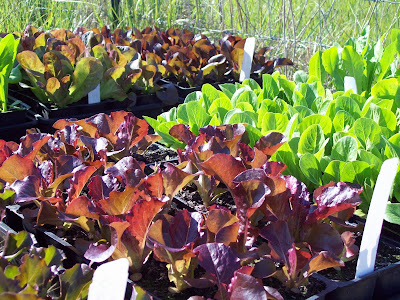
Lettuce grown from seed we saved.
How do we grow your food?

No herbicides or pesticides
Soil-fertility is created primarily through compost, worm castings, leaves, grass-clippings and wood-ash.
Slow-grown for maximum density of nutrition and flavor.
We encourage birds and beneficial insects for natural pest-management.
We grow all heirloom varieties (no hybrids or GMO) from 85% (or more) of seed we saved ourselves.

Commitment to living lightly on the Earth: Each weekly box will have a large, plastic liner that all - but a few items - will be placed in without separate plastic-bags. Liners will be re-usable. Less plastic - better for the Earth! Thank you for helping us reduce our environmental footprint.

Healthy food for you and your family!
Cost of season's 'shares': $700 (payable either in full - when you sign-up, or in two payments of $400 - when you sign up, and $300 by July 1st). This works out to about $25/week.

Payment methods: We can accept cash or checks made out to 'The Sharing Gardens'.

Where do I pick up my box? Members in the Monroe area will be able to pick up their boxes on Wed. afternoons from 1:00 to 5:00 at the Sharing Gardens.
664 Orchard St., Monroe 97456
Corvallis and Junction City: We will have a single, weekly delivery site to both Junction City and Corvallis. Day of week/time and site location to be determined based on enrollments.

Can I share my membership? Yes, if you find someone to share it with.

Can I cancel my membership? Only if we have a waiting list. You will be refunded the balance of your fees if there is someone else who wishes to buy your "share".

To sign up for the Sharing Gardens CSA,  send an email to us at - ShareInJoy@gmail.com - We will email you an application for you to fill out and mail to us, along with your payment.

Questions? Phone: Chris and Llyn (541) 847-8797
Call: 8:00 to 12:30 or 2:00 to 6:30 (we keep 'farmer's hours' and take a nap each day. 💤)