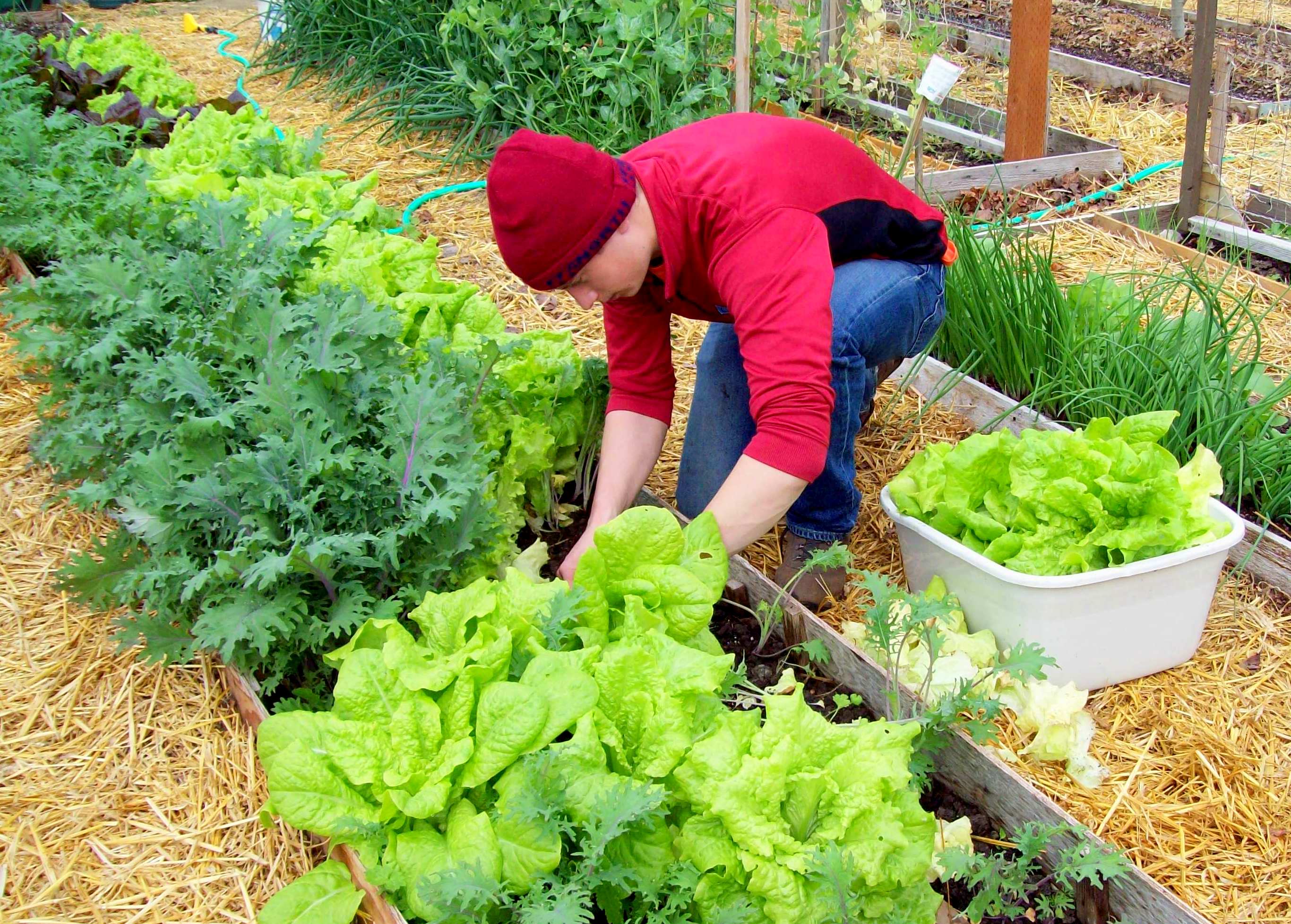
The Sharing Gardens turned 17 years old on April 15th of this year! We began in the spring of 2009 at Alpine Park; then began gardening at our present site, in Monroe, Oregon in 2010; purchased the land and farmhouse here in 2013 and moved in once we finished renovations in the summer of 2014. It's been a journey with lots of bends in the road full of both challenges and blessings. This post gives a peek at how our project has evolved over the seasons and an overview of our current situation.
 |
| Here's our farmhouse before renovations (built in 1875, the oldest house in Monroe that's still lived in). Llyn is loading mint-straw into wheelbarrows to use as mulch/fertilizer on the Gardens located behind the farmhouse. |
 |
| Here's our dear home after renovations. We planted the Red Hot Pokers in the foreground underneath where that mint straw had been. |
We founded the Sharing Gardens under the belief that food should be a basic right; not something to be bought or sold. We are a 'community garden' but, instead of separate plots, with a membership fee, we all garden together (no fees). The food that is grown is shared amongst the people who support the project, while the surplus is shared through local food charities. Overview and Benefits of the Sharing Gardens
In the beginning, we were almost the only gardeners in our area sharing produce with the food charities. Much of the produce that our local Pantry had for distribution was rather nasty rejects provided by grocery stores for the tax-write off they received in exchange. Some produce was purchased new but it was still of low quality (and never organically grown).
 |
| Here's Llyn with our very first donation to the S. Benton Food Pantry. More than half of it actually came from our friends who had more established gardens. |
 |
| Once we got established, our donations grew to about three tons per year! Here we are in the early days with one week's lettuce donation to Local Aid in Junction City. |
Gradually our donations grew and grew till, at our peak, and for several years that we measured everything the garden produced, we were growing about 6,000 pounds per season! All shared freely. Nothing ever sold. (Actually, for three seasons we had a CSA - community supported agriculture where people paid an annual subscription and received a box of produce each week for half the year but we dropped the CSA as soon as possible as it never felt aligned with our deepest beliefs that no one should ever be charged money for food. Llyn's mother has made some of Llyn's inheritance available prior to Judy's passing. This is our primary source of income these days. It is our belief that our generosity will be supported and so far this has held true.)
 |
| Generosity creates abundance...Service Learning students sharing in the harvest at the end of their volunteer session. |
Within a few years, other gardeners began bringing their surplus
produce. Also, produce was gleaned from farmer's markets and other
sources. Eventually this support grew to the point that, during peak
garden-harvest time (August - October) our closest Pantry has far less
need of our donations (sometimes it's hard to find room on their
distribution tables!)
 |
| Tomatoes, cantaloupe and greens donated to the Pantry in 2015. |
I overheard a nice comment at the Pantry just the other day
as I helped restock the produce mid-morning. A customer said that
she's been to many, many Pantries over the years but that the one in
Monroe is her favorite because they/we
"always have the freshest and most abundant produce". She said,
"I don't want to just be eating canned and processed foods. I so appreciate that I can get a variety of fresh produce here!". It's gratifying to know that the Sharing Gardens has been such a big part of bringing fresh produce to Monroe's Food Pantry.
 |
| By the time our peppers and tomatoes are coming on strong, other local gardeners have lots to donate to the Pantry, so the volunteers in the gardens, Chris and myself, receive the majority of the Garden's abundance in peak garden times. |
We've had a fluctuating team of volunteers through the years. Sometimes as few as one or two per session; at most we had about six people join us. More than that proved too difficult to manage. Mistakes were made, and Chris and I spent so much time overseeing the volunteers that we didn't get to do much gardening or socializing ourselves on volunteer days! So now, from mid-spring to late fall, we have two sessions a week with 3-4 volunteers each time and that seems to work quite well.
 |
| Nowadays we average two volunteer sessions per week, with three to four people per session.Volunteers help with whatever needs doing and share in the harvest. Volunteering and Garden Location |
 |
| Because we're not in competition to get our crops to market, the Sharing Gardens produce is 'slow grown'. We don't use commercial fertilizers to hasten growth (which can lead to an increase in water-weight, lower density of nutrients and the plants' greater susceptibility to diseases and pests). Our produce is sweet, tender and full of vitality. |
From the beginning, the Sharing Gardens has always had a focus on education; we love to share what we have learned from experience (Chris has been an organic grower for close to 60 years!) and Llyn has been a writer from her earliest days; we make a great team! Our educational outreach goes first and foremost to the people who join us in the Gardens through the volunteer program. These folks get hands-on training.
Our website reaches hundreds of people daily, worldwide. This spring, the site
surpassed the million-views mark and shows no signs of slowing down. With close to 300 published posts, we've covered a lot of topics! The majority are
"How to" articles based on our first-hand experience. The site has always been (and will always be) 'ad-free'.
Chris and I have both spent time over at Monroe's Pantry (it shares our same parking lot) talking with people and teaching them about healthy eating. We encourage people to try new fruits and vegetables, suggesting ways to prepare them.
 |
| A sign we posted with our kale donation... |
 |
| Striped German tomato |
A funny story from the early days:
Because Heirloom tomatoes often 'look funny', with deep lobes and
unusual colors in many varieties, Pantry-goers were leery of trying
them. They would reach for the uniform-sized, pale red varieties with a
mealy consistency and no flavor because 'they were familiar'.
For
a few weeks, Chris and I stood at the Pantry with pocket knives in-hand
and we'd slice off samples our our tomatoes for people to try.
At first
people hesitated (and to be fair, some varieties with greenish
shoulders don't look too appetizing!). But their responses were so
gratifying each time they got over their fears. "Wow, that's amazing!",
"That's how tomatoes are supposed to taste!" "I haven't had a tomato that tasted that good since I ate out of my grandma's garden!".
We
knew that we'd successfully converted the crowds when, after a few
weeks we saw them by-passing the anemic commercial toms and overheard
them arguing among themselves about which of the Heirloom varieties we'd
provided were their favorites. Wonderful!
 |
| Though we love the knobby, strangely colored varieties we grow, to the uninitiated they may seem ugly and unappetizing. |
Another way that we are teachers in our community is through the Service Learning program offered through Oregon State University (OSU). Students volunteer for four hours per term in a project relevant to their studies and, after completing a presentation to their classmates receive college credit.
Since our first groups came in 2012, we have been blessed by the students' presence (and labor!) as we pass on a bit of knowledge about growing food without the use of chemicals, commercial fertilizers or animal by-products. Service Learning: A new model for our schools?
 |
| The Q&A session with snacks is always a highlight of the Service Learning mornings. We love to feel their enthusiasm for making the world a better place and it feels good to be drawn-forth and queried for the knowledge we've gained over the years. (Pic is from our cozy living room). |
 |
| Students help us with a variety of tasks. Here they are weeding a garlic patch. |
 |
| Sam is sifting soil in the foreground; students are prepping beds along the side while Llyn and Margaret plant seeds in the back. |
 |
| Shelling dried beans is a favorite activity for students (and our volunteers) alike. Very meditative and satisfying. |
We grow almost 100% of our own 'starts' and share hundreds of plants in the community each season through school-gardens, recipients at the food pantry and other local gardeners. We like to support folks who are growing food to share (not sell).
 |
| Early years...2011 'starts' (lettuce, sunflowers, cabbage and more...) |
 |
| Lua and Llyn with a fraction of the 'starts' we've donated to her amazing school gardens. Luckiamute Charter school garden program. Lua has developed a program that goes from K-8th grade in which the students get hands-on learning about gardening and harvesting fruits and vegetables; growing native plants and supporting wildlife. The students learn how to prepare the foods they grow (along with other healthy ingredients) for tasty, simple snacks that expand their 'food vocabulary'. Lua is amazing! |
We grow, process and save almost all of the seeds we use in the
garden. This is a major focus of our teaching-posts. Because of the
'economy' of seed production, one seed can generate literally thousands
of offspring. To learn more:
Basic Seed-Saving on a Small Scale  |
| Part of our 2025 kidney bean and blue corn harvests ready to finish their drying process in baskets on shelves above our wood stove. These beans and grains can be eaten and/or used to grow future crops. The 'economy' of seeds..."From the one, many...". |
We always have way more seed than we can use and
share through various networks.
 |
| Part of the seeds that we grew and processed ourselves in 2025 and donated to the Agrarian Sharing Network - a wonderful, regional network equally dedicated to keeping our food-system commercial-free. |
We continue to develop
low-tech, small-scale methods for saving storage crops such as
dried corn,
sorghum, amaranth, and
dried beans to help feed us through the leaner months when gardens are not
producing as abundantly.
Local food: Grow your own beans and grains  |
| Heirloom corns come in many colors. Corn is "promiscuous" and cross-pollinates easily. Here are crosses between Hooker's Blue and Golden Bantam. Grow Your Own 'Blue Corn' |
As supply chains for commercial
fertilizers tightened with the onset of war in the Middle East this past winter, we felt
such gratitude that
our methods of veganic agriculture continue to serve
us well.
Locally Sustainable Gardening in the Face of Supply-Chain Shortages This is our eighth season without purchasing any commercial fertilizers or animal by-products (bone meal/blood meal etc), and without using animal manures for fertilizer.
The majority of our fertility comes from: composted leaves, lawn-clippings and kitchen scraps. We also use ashes and coffee-grounds. We've begun experimenting with comfrey tea too (more on that to come).
 |
| People often comment that our plants seem to be "glowing from within". We feed the soil and the plants take care of themselves! Because our food isn't forced to grow quickly (no commercial fertilizers), the plant cells are thicker and the plants are more resistant to disease and insect infestations. |
 |
We are able to grow abundant crops without commercial fertilizers and animal by-products or manures. For a detailed description of our methods: Making Your Own "Veganic" Potting Soil in Your Greenhouse Paths - Using Worms (Broccoli and peppers in the foreground with corn in the rear. The red plant is a volunteer 'Hopi red-dye amaranth' which is edible and we harvest, dry and grind it for use in cooking.)
|
Another part of our mission is to
encourage more people to live in a spirit of generosity, reciprocity and trust that,
the more we shift from a 'transactional' (buying and selling) mentality to a 'gifting', relational ecology, the healthier all of us (and the natural world) will be. In this spirit, we
maintain another website that is full of
uplifting examples of the power of sharing, generosity, and caring for Creation. To visit the site:
All Things SharingWe feel incredibly blessed to be on this garden journey and look forward to continuing on this path of growing and sharing. Thanks for coming along!
 |
| Sharing Gardens founders, Chris Burns and Llyn Peabody in our front yard kale patch, 2017 |