(The following article was originally posted several years ago...Perhaps its time has come!)
If you've been wanting to increase the amount of organically grown foods in your diet this post is for you! Here are many reasons including the beneficial effects on the environment, the people who grow and harvest our food, the animals raised to provide food and your own health.
Thank you for taking this important step in your life.
Chris and I eat almost exclusively organically grown foods when we're at home. At 73 and 60 years old respectively (Feb. 2023), we are both very healthy. We take no prescription medications and, in fact had a bottle of aspirin pass it's expiration date in our medicine cabinet once because we were too slow in using it for occasional muscle soreness or headaches! We each have had three colds in the last 16 years but no other illnesses that caused us to be bed-ridden for even a day.
Our food is our medicine (along with other healthy lifestyle habits including meditation, stretching and exercise practices and a generous lifestyle geared towards service) and
we feel strongly that a societal shift towards an organic, whole foods, plant-based diet would have significant positive effects both on people's personal health and the health of the natural environment as well.
 |
| Image credit: Maria-Marlowe |
We
are at an advantage over most people as our large gardens provide a
high percentage of the foods we eat but for many years
we have made it a priority to let our food-budget reflect our values and
we only buy groceries that are organically grown. The only times we don't eat organic are when we eat out at restaurants or are visiting friends, which amounts to three to six times per month.
This post offers an overview of what we feel to be the most important reasons to shift to an organic diet. For those readers who have the financial means to make this shift entirely, we encourage you to jump into an organic life-style whole-heartedly. We also encourage you to
cultivate relationships with local farmers through shopping at farmer's markets and co-ops that feature local, organic foods or joining a CSA (Community Supported Agriculture). See also:
Seven Tips for Shopping at a Farmer's Market
We realize that,
for many people who are living close to the edge financially, that committing to buying all your groceries organically-grown may be impossible at this time. If that is the case, consider making smaller incremental changes such as committing to
only buying organically and humanely produced animal products (where farm chemicals become most concentrated)
or only buying organic "treat foods" (whatever that means for you). Their higher prices may encourage you to eat less of these items which will be
better for your own health and for the health of the planet.
Another option to increase your intake of organic garden-produce is to
start your own garden, or start or join a community-garden.
LINK: So, you want to start a Sharing Garden.
We like to remind ourselves as we adopt new lifestyle choices that
"it's a direction, not perfection." Be gentle on yourself as you make new changes and,
if sometimes you decide to eat something on your "no-no list", do it consciously, do it with joy and then re-commit to following your chosen dietary guidelines once again. Happy eating!
 |
| Image credit: Enki quotes.com |
So, here are some of the top reasons we feel it is important to eat organically grown foods.
Healthier for you: Ingesting farm chemical residues isn't good for your
health
. Many of these chemicals can build up in one's tissues over time so,
even though we may only eat small amounts with each meal, their
accumulated amounts can be significant over a life-time. Also, children
tend to be more susceptible to environmental toxins as they are building new tissues at a faster rate than adults.
LINK-Pesticide Action Network
Any farmer who grows "organically" may not use herbicides, pesticides
or fungicides - unless they have been approved by the
organic-certification agencies.
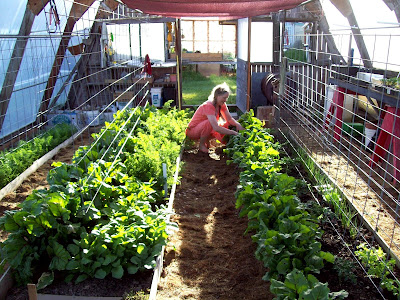 |
| Slow-grown food is more nutrient-dense. |
More nutrient dense?
The truth is, most organic-farmers struggle under the same competitive
conditions as farmers who grow using conventional practices. This means,
they need to invest
the least amount of money in fertilizers and other
soil amendments, and grow their produce as fast as possible, to get it
to market ahead of their competitors to make
the most profit. These practices lead to more "water-weight" and less
nutrient-dense foods. This means
that the vitamin/mineral content may not vary much between organic and conventional farmers.
On the other hand,
some studies suggest that, on average, organically-grown produce is consistently more nutrient-dense and lower in pesticides and heavy metals.
Nutrient Levels in Organic vs. Conventional Foods
This is why it is important to know your farmer so you can confirm
that their food is slow-grown and that the farmers are replacing the minerals
that get depleted in their soil from harvesting crops.
 |
| Adding compost-tea to our gardens is one way we replace many of the nutrients that are depleted through harvesting. |
GMO versus organically-grown: There is still debate about whether foods produced from Genetically Modified Organisms (GMO's) are a health risk to humans.
We
are strongly opposed to them because of the compelling
research pointing to the possibility that eating GM plants, or livestock raised on GMO feed can lead to leaky-gut
syndrome and a whole slew of health problems including severe
food-allergies, learning disabilities and autism-spectrum disorders in
children.
Autism and GMO's LINK Institute for Responsible Technology-a GMO watchdog group. Genetically Modified plants and animals have the potential of interbreeding with plants and animals that were not genetically modified, with unforeseen consequences. Some GM plants (corn and soy) are specifically bred to be
resistant to Round-up and other herbicides meaning large amounts of
these chemicals can be used to grow them. This leads to well-documented cases of super-weeds that have become resistant to herbicides and require ever stronger chemicals to keep them in check.
LINK: The Dangers of Round-up Ready Foods,
LINK-GMO Health Risks Also, GM corn and soy are
used extensively in livestock-feed so
you can imagine how these farm-chemicals concentrate in their tissues.
We feel strongly that it is important to avoid eating any genetically modified plants. We feel it is especially important to avoid eating animal-products (meat, dairy, eggs) from animals fed on GM feed.
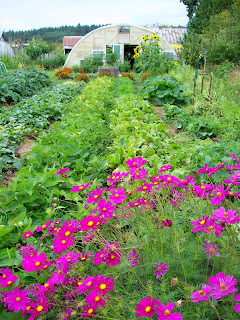 |
| Sharing Gardens - 2019 |
But what about just eating non-GM foods? Well yes, this is a step in the right direction but
just because something is non-GMO does not
mean that it's grown without farm chemicals. Industrialized farming uses plenty of chemicals in growing the food.
Did you
know that it is also a legal practice for farmers to use Round-up as a desiccant (which causes withering and drying in
plant tissues) to artificially dry crops if conditions are too wet for the crops to fully ripen in the field?
LINK-Wikipedia,
LINK-EcoWatch.
By definition, organic farmers are not allowed to grow Genetically Modified crops, or feed them to their livestock.
Better for the environment. Anyone
following the news knows that our environment is under attack from all
sides. Industrial farming is one of the biggest culprits.
Pollinators
are under siege from the practices of growing "mono-crops" (all one
variety) for thousands of acres, offering no variety in their diet of
pollen, and many farm-chemicals are damaging to their health
as well.
LINK - Why growing sunflowers is great for bees.
Soil health: Industrial farming - through over-tilling and depleting
soil
of organic matter makes soils void of all life and destroys the
structure of the soil itself which no amount of added fertilizers and
chemicals can restore.
 |
| Healthy soil means healthy soil-organisms. Eight-year old, Ricardo holds an earthworm found in our gardens. |
Industrial farming is a major source of water-pollution. Industrial farming has negative effects on the world's water for many reasons. Here are a few: Heavy Metals build-up; Algae Blooms, Dead-zones and Acidification; Nitrates; Pathogens and Over-use of water reducing water-levels in our aquifers. (
LINK-How Industrial Agriculture Effects Our Water)
Many bird species have a hard time finding
enough insects to feed their young. Farm chemicals tend to concentrate in the tissues of animals, the higher-up you go in the food chain as Rachel Carson so famously proved
in her landmark book from the 1960's titled
Silent Spring.
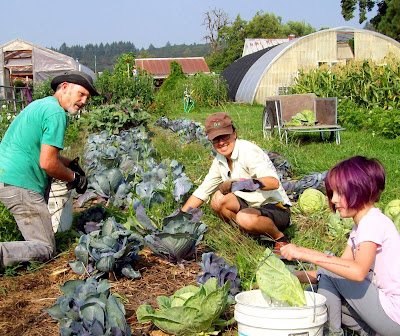 |
| Thorin, Eliza and Adri harvest cabbage, 2018. |
Be
aware too, that this principle of chemicals concentrating in tissues
applies to foods raised for human consumption too. The accumulation of
these chemicals in our own bodies will therefore be less with a plant-based diet.
The more meat, dairy and eggs one eats, that are
not organically-raised,
the higher concentrations people have in their bodies of these chemicals. Bear in mind too
that the
quality of life for livestock animals grown organically is
more humane as well.
Organic farming practices keep our air, water and soil healthier and can even contribute to the increase of viable habitat for wild plant and animal species.
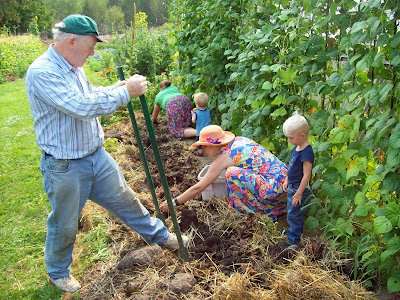 |
| Organic farming is better for the farmers
and farm-workers who grow our food. Sharing Gardens volunteers digging potatoes 2018. |
Healthier for the farmers and farm-workers: When we use our purchasing power
to make a statement about our values, we are directly contributing to
healthier lifestyles for everyone involved in the food-growing
community. LINK - Agricultural Chemicals and Human Health
In this complex world of competing dietary studies which often offer contradictory results
it can be difficult to know who to trust and which dietary practices will be best for your health and the health of the environment on which every living things depends.
If you have been feeling on the fence about whether to make the commitment to
eating more organically-grown foods, we hope this post has helped you
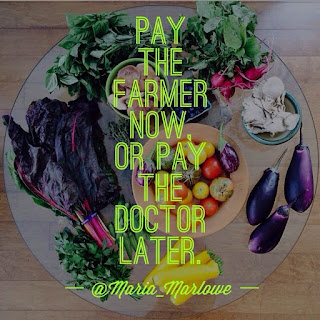
make that shift. Just remember that wise saying, "You can either pay
your farmer
now, or pay your doctor
later." We think this is good advice.
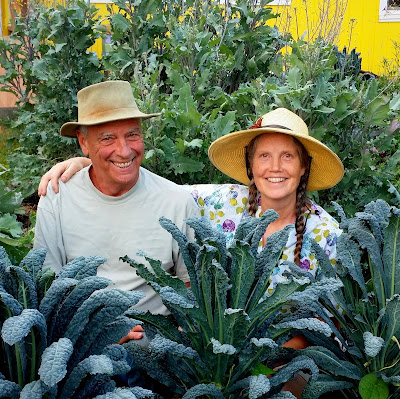 |
| Get to know your farmers! Chris and Llyn in the Sharing Gardens, your friendly, neighborhood "farm-acists". |
 |
| Bella loves kale! |
Other relevant LINKS:
Organic diet intervention significantly reduces urinary pesticide levels in U.S. children and adults - Science Direct
What the pesticides in our urine tell us about organic food - The Guardian
The States in America That Use the Most (and Least) Glyphosate - Zero Hedge
What's in standard 'fast food'?


 We realize that, for many people who are living close to the edge financially, that committing to buying all your groceries organically-grown may be impossible at this time. If that is the case, consider making smaller incremental changes such as committing to only buying organically and humanely produced animal products (where farm chemicals become most concentrated) or only buying organic "treat foods" (whatever that means for you). Their higher prices may encourage you to eat less of these items which will be better for your own health and for the health of the planet.
 In this complex world of competing dietary studies which often offer contradictory results it can be difficult to know who to trust and which dietary practices will be best for your health and the health of the environment on which every living things depends.