A unique and viable approach to establishing local food self-reliance and building stronger communities.

Showing posts with label Other Sharing Projects. Show all posts

Wednesday, January 1, 2025

Giftivism: Another Name for 'Sharing'

Pavi Mehta: Reclaiming the Priceless

"Giftivism: the practice of radically generous acts that transform the world. History has seen giftivists in all corners - Gandhi, Mother Teresa, Martin Luther King, Nelson Mandela and so forth. People who believed that when we change ourselves, we can fundamentally change the world. But this ability isn't restricted to social change giants. The seeds of giftivism lie in each of us. But to tap into it we have to do something all these people did. We have to upturn one of the core assumptions of economics - the assumption that people always act to maximize self-interest. The assumption that we are inherently selfish beings. Giftivism flips that idea on its head. What practices, systems and designs emerge when we believe people WANT to behave selflessly?" 
In this heart-stirring talk filled with real-life stories, writer Pavi Mehta describes the path of Giftivism and the vast potential it holds for returning us to the priceless.

This video was sent to us because we subscribe to an email service: Daily Good - which sends us examples of positive, hopeful actions taking place worldwide. 
 
Here is the link to the original post with a video of Mehta's speech and a written transcript. Enjoy! Giftivism: Reclaiming the Priceless


Sunday, September 15, 2019

Can We Create Social Change Without Money?

We're up to our eyeballs in harvesting and food-preservation so haven't had time to publish something new in awhile. This is a re-publishing of a post from October of 2015. Still as relevant as ever. Enjoy! Llyn and Chris


Here is a video and transcript of a Ted-Talk by Nipun Mehta, a pioneer in 'sharing' and the true gift-economy (giving without thought of receiving). Nipun beautifully articulates the community-building, healing power of generosity. We decided to post this on our Sharing Gardens site because our project is deeply founded in the principles outlined in this video. Enjoy!

Can We Create Social Change Without Money?

--by Nipun Mehta, Oct 28, 2015

Can we create social change without money? I don't have a conclusive answer but just holding that question can raise some very interesting insights.

Since we're talking about money, I thought I'd start with a story on Wall Street. One of my friends was running a venture fund on Wall Street. They had a great year, and his boss calls him in to congratulate him and offers the proverbial blank check, "What would you like?" He looks his boss in the eye and says, "What I'd love is a minute of silence before all our group meetings."

Wow. The boss is thinking, "In a context where people are billing every three minutes, a minute of silence to do nothing? That's like wasting time." He refuses. "No. Anything else?" he asks. No. After sleeping on it, though, the boss comes back to say, "Look, if you really want that minute of silence, fine, I'll give it to you." They start meetings with a minute of silence. That minute turned into two to three to five minutes. Today, they do thirty minutes once a week, and even have their own meditation bell.

What was my friend thinking? On one side he could've asked for a monetary raise, but on the other side was very different kind of capital — mental quiet, connection, trust. He is thinking, "I don't want to meet people in a space of rush. I'd rather meet them with a bit more peace." It changed his relationship to himself, it changed his relationship to other people and certainly with his boss. And it didn't just stop there. It changed how everyone related to each other. It changed the whole culture of their office space. And that was something he valued more than the financial capital.

How do we broaden our lens to include alternative forms of capital? This is a question, this is a possibility, that we all have access to but in our current world today, we're very biased towards financial capital.

In theory, our society is supposed to balance all these biases. We have three big sectors. The private sector is rooted in extrinsic motivations like money, power, fame. On the other end, we have the voluntary sector that is rooted in very intrinsic sort of motivations. Compassion, knowledge, purpose. And then there's the public sector that is supposed to regulate between the two and work on both sides of the aisle.

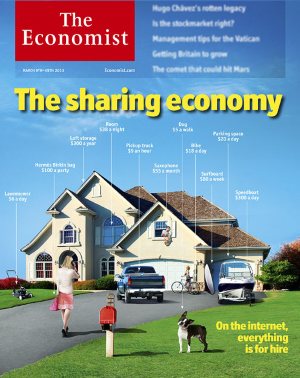
This is how it's supposed to work in theory. In practice, though, the private sector starts to take over. In fact, it starts to dominate. We do have a public sector, but the public sector is increasingly being controlled by the private sector. There is a small voluntary sector, but these days, in the name of the sharing economy, even that is being commoditized. Courtesy of the "sharing economy", your lawn mower can get you six bucks a day, and you can rent out your Hermès purse for a hundred dollars a party and your dog for five dollars a walk.

When we have a hammer, everything starts to look like a nail. If money is the only metric we have, we start to put a price tag on everything.

The problem with price tags is that we start to lose connection with the priceless. We start to lose connection with our intrinsic motivation.

What does science say about all this? Edward Deci at the University of Rochester has been studying incentives for over forty years. After thousands of experiments, he categorically asserts that the carrot and stick model doesn't work. This idea of a contingent reward — if you do this, you will get this — doesn't actually work.

For example, he studied people who loved to solve puzzles. Initially, they would solve puzzles just for the love of it, just for its intrinsic enjoyment. Then he started to pay them to do the same thing. So far so good. Then, at a later point, he stopped paying them. As soon as he stopped paying them, you would think they would return to that original state, right? It turns out, though, that they were no longer interested in solving puzzles at all!

What his research shows is that money desensitizes us. What science is actually telling us is this: Don't show me the money. When you're working with intrinsic motivations, financial rewards can backfire.

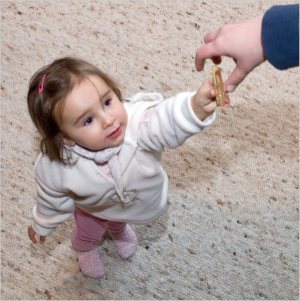
At the Max Planck Institute, researchers have been studying 18-month olds. These toddlers are just playing and all of a sudden they see a bunch of strangers who are putting clothes out for drying. In the process, they drop a clothespin and need help getting to it. The toddlers see that a person is in need, and immediately go out to help. They pick up the clothespin and hand it to the strangers. Now, at that age, they haven't yet been taught kindness or compassion but they're still moved to help. They're still moved to cooperate.

What science is telling us is that it's natural to give, that we're wired to care. In fact, not only is it guiding us to "don't show me the money", but it's saying to not offer any rewards at all. It's just not necessary.

The question we are left with is this — what designs emerge when we don't lead with money? What designs emerge when we lead with something subtler or something internal? We have many examples that offer insight into this inquiry.

Mother Teresa, of course, is an example that all of us know about. Someone purely motivated by intrinsic motivations. One of my friends, Lynne Twist, is a world-renowned fundraiser and author of a book titled, Soul of Money. She knows money. Many years ago, she had a very interesting conversation with Mother Teresa, whom she knew personally. "Mother Teresa, what's your fund raising strategy?" she asked. And Mother Teresa, with her big-hearted compassion, simply replied, "Oh, I just pray. Whatever I get is what I need."

It was simple. Here was a woman who had 400 centers in 102 countries and she's kind of like the CEO of this whole operation and she is saying, "I have no fundraising strategy." Or rather she is saying, "My fundraising strategy is to be rooted so deeply in intrinsic motivation that external security is not even a concern."

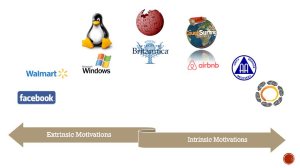
We have many modern examples as well. Linux rivaled Microsoft Windows purely with a distributed army of volunteers. Wikipedia did that with Encyclopedia Britannica. On Wikipedia alone, through those micro-edits that volunteers made, hundred million volunteer hours have been donated. CouchSurfing, similarly, allowed strangers to stay on each other's couches and disrupted the hotel industry.

As we look closely, we see an entire spectrum of motivations. It starts with extrinsic motivations on one side and goes all the way to intrinsic motivations. On the extrinsic side, there's money, power, fame; somewhere in between you have things like fun, learning, growth and purpose. Then on the intrinsic end of the spectrum, you have these very profound motivations like healing, forgiveness, inner-transformation and ultimately compassion.

On that extrinsic end, we have thousands and thousands of examples, but on the other side, on the side of intrinsic motivations, we don't have too many. Alcoholics Anonymous, for example, is a completely decentralized, distributed, and a never-monetized effort. It points towards the other end of the spectrum, but we have an opportunity to create a lot more examples here.

Back in 1999, we started ServiceSpace that rested squarely on the intrinsic end of this spectrum. It started with four of us, building websites for non-profits. Underneath the work, though, what we wanted to do was to anchor ourselves purely in the spirit of service. Over the last sixteen years, we've organized around three core principles that have kept us rooted in that intrinsic motivation.

The first one is that we are volunteer run. Many people look at that as scarcity of paid staff and ask, "How will you scale?" What we noticed was that we actually had an abundance of social capital. Imagine that you're trying to raise a million bucks. You could get it from one or two people, or a dollar from a million people. Which is stronger? A million people saying, "Yes, I believe in what you're doing. Yes, I care." The cumulative energy of that is profound. It's powerful. That's what we were experiencing with small contributions of time from many volunteers.

Similarly, our second principle is to not fundraise. When you don't ask for resources, you naturally feel a lot of gratitude for all that ends up in your lap. You learn to creatively work with what you've got, and you start to cooperate. Incredible synergies emerge, particularly when working with non-financial capital.

Lastly, our third principle is to focus on small. It wasn't about big things outside, but rather it was about the subtle on the inside. Being in the change you wish to see in the world starts to attune us to the subtle. The resulting awareness, in a very profound way, ignites our deepening understanding of interconnection.

With these three principles, ServiceSpace manages to create lot of impact in the world. We started by building websites for non-profits and we ended up helping thousands of efforts come online. Then we started building portals like DailyGood and KarmaTube. Every year we send seventy million emails, and not a single one of them has an ad -- or even a reference to buying something. It is purely non-financial.

Still, how far can we push ourselves while still operating solely on the strength of these intrinsic motivations?

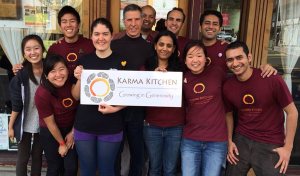
We started this game of kindness called Smile Cards and it spread to over a hundred countries. In local communities we started these gift-economy experiments like Karma Kitchen where people are redefining what it means to engage in transaction. In living rooms around the world, Awakin Circles started. In all, more than half a million members were co-creating something that was engaging the attention of millions -- all without ever raising a single penny, and moved by love, service and our innate connection to each other.

It's not just that you can do a lot with this. We often take metrics from the extrinsic side of the spectrum to measure the impact on the intrinsic end. That puts a very low ceiling on its potential.

Operating with the power of intrinsic motivation alone fundamentally changes the way in which we relate to each other. It gives birth to a whole new realm of possibilities.

Karma Kitchen is like a regular restaurant, except that at the end of the meal, your check reads zero. It's zero because someone before you has paid for you and you get to pay forward for somebody after you. You are trusted to pay forward whenever you want. When people are just giving for the love of it, it changes the way they interact in that collective space. It's a profound idea that has worked wonders in seventeen places around the world.

What works, though, isn't the intellectual idea -- it's actually the experience. It's actually realizing that when you walk in, the greeter is a volunteer. The person who is waiting on your table, the person who plates your food, the person who's bussing your tables, they're all volunteers. That guy doing dishes in the back, who signed up to be on his feet for six hours, to just do dishes so you can have an experience of generosity, is also a volunteer. When you realize this, it begets a very different kind of generosity in you. A flow of deep compassion emerges. It's very natural.

Minah Jung was a student at UC Berkeley when she first volunteered at Karma Kitchen. She was so moved by the concept that she decided to study it. In fact, her research on Karma Kitchen and other gift economies became her PhD thesis. With eight different experiments, she poured through data with academic rigor, and came out with a seminal paper titled, "Paying More When Paying For Others." If you create a strong context, people respond to generosity with even greater generosity.

Richard Whitaker runs his art magazine in the same way. He was running it for fifteen years with the traditional subscriber model, and then he ran across ServiceSpace and said, "Wow, this is great. This is how I want show up in the world." He offered refunds to all his current subscribers and said, "From now on, the magazine will operate only offerings of gratitude."

Similarly, Thuy Nguyen is experimenting with this pay-forward model at her acupuncture clinic.

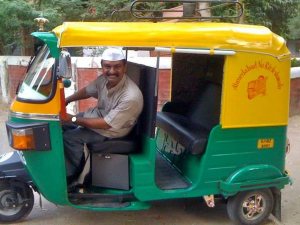
I want to end with this story of one of my friends, Uday-bhai. He's a rickshaw driver. By all traditional metrics, he would probably be a UN statistic on one of those poverty charts. He's a humble rickshaw driver but he has another kind of resource. He believes in love, he believes in people. Uday-bhai decided to run his rickshaw on a pay-it-forward basis. You sit in his rickshaw and there is no money meter. Someone before you has paid for you and you get to pay forward for people after you, whatever you moved to offer. He trusted that goodness in people, in the sixth largest city in India. Naturally, many asked him, "Is it working?" He says, "Here's my ledger. Point A to point B, point B to point C. Yes, some paid more, some paid less. On the whole, it evens out."

Then he adds, "Let me also show you this other notebook. This is where I ask people to write down how they felt sitting in my rickshaw." Imagine sitting in Uday-bhai's rickshaw and being completely caught off guard by the generosity of his process. This is not a billionaire doing philanthropy, but an everyday hero putting his entire livelihood on the line -- for love. It moves people to tears, people take vows for life. It's just deeply transformative and you can see that in all the notes.

Uday-bhai didn't have money, but he had a deeper kind of resource. Through that resource, through his belief in our innate generosity, he created a massive ripple that is certainly changing the world. He is redefining what it means to have capital. He's diversifying that portfolio of wealth. When you do that, when you really start saying yes to that idea, you are essentially saying, "It's no longer about the CEO, it's about the everyday Joe. It's no longer about fundraising, it's about friend-raising. It's no longer about price tags, it's about the priceless."

All of this sits on a single idea — what we will do for love will always be greater than what we do for money. May we all lead with love and change the world. Thank you.   


Nipun Mehta is the founder ofServiceSpace.org, a nonprofit that works at the intersection of gift-economy, technology and volunteerism. You can read more of his talks online.    
This video and article were copied from the Daily Good site, a free service that sends out emails featuring inspiring, uplifting news from the world free of charge and with no advertising. LINK


Wednesday, February 12, 2014

Amish Farmers - Reinventing Organic Agriculture

Chris and I were surprised and disturbed to hear that many Amish farmers have resorted to heavy herbicide and pesticide usage in growing their crops. We assumed that their desire to shun many modern mechanical and industrial short-cuts/conveniences would extend to these heavy-handed chemical ways of farming. Apparently we were mistaken. The young Amish farmer in this article is forging a new and inspiring path. Using a combination of science and intuition he is letting the plants and his own experience guide him into a more natural, healthy and more productive way of growing food. (Reprinted from The Atlantic - Oct. 6, 2014)

The Amish Farmers Reinventing Organic Agriculture

“In the Second World War,” Samuel Zook began, “my ancestors were conscientious objectors because we don’t believe in combat.” The Amish farmer paused a moment to inspect a mottled leaf on one of his tomato plants before continuing. “If you really stop and think about it, though, when we go out spraying our crops with pesticides, that’s really what we’re doing. It’s chemical warfare, bottom line.”
Eight years ago, it was a war that Zook appeared to be losing. The crops on his 66-acre farm were riddled with funguses and pests that chemical treatments did little to reduce. The now-39-year-old talked haltingly about the despair he felt at the prospect of losing a homestead passed down through five generations of his family. Disillusioned by standard agriculture methods, Zook searched fervently for an alternative. He found what he was looking for in the writings of an 18-year-old Amish farmer from Ohio, a man named John Kempf.

Kempf is the unlikely founder of Advancing Eco Agriculture, a consulting firm established in 2006 to promote science-intensive organic agriculture. The entrepreneur’s story is almost identical to Zook’s. A series of crop failures on his own farm drove the 8th grade-educated Kempf to school himself in the sciences. For two years, he pored over research in biology, chemistry, and agronomy in pursuit of a way to save his fields. The breakthrough came from the study of plant immune systems which, in healthy plants, produce an array of compounds that are toxic to intruders. “The immune response in plants is dependent on well-balanced nutrition,” Kempf concluded, “in much the same way as our own immune system.” Modern agriculture uses fertilizer specifically to increase yields, he added, with little awareness of the nutritional needs of other organic functions. Through plant sap analysis, Kempf has been able to discover deficiencies in important trace minerals which he can then introduce into the soil. With plants able to defend themselves, pesticides can be avoided, allowing the natural predators of pests to flourish.


According to Kempf, the methods he developed through experimentation on his Ohio farm are now being used across North and South America, Hawaii, Europe, and Africa. The entrepreneur promises clients higher-quality crops, bigger yields, better taste, and produce that carries a lucrative “organic” label. Kempf, however, considers his process as an important improvement upon standard organic farming methods. “Organic certification is a negative-process certification,” he explained, “You can do nothing to your field and become certified. In contrast, we focus on actively restoring the balance found in natural systems.”
I recently sought out Samuel Zook, one of Kempf’s earliest converts, at his farm in Lancaster, Pennsylvania to see Advancing Eco Agriculture’s practices in action. After trailing a leisurely horse and carriage in my car for several miles, I was greeted at the farm by a bounding dog and Zook’s young barefoot son. The boy stared silently with his arms wrapped around a watermelon almost as big as himself. In a straw hat and suspenders, he looked like a miniature version of his father. The elder Zook smiled demurely through a neatly trimmed beard and extended his hand before inviting me on a tour of his fields. A hushed gaggle of children tripped along behind us as we walked among the bales of hay and rows of tomatoes, onions, melons, and squash.

Roc Morin: Can you describe the differences between how you used to farm and how you farm now?
Samuel Zook: The inputs changed drastically. Instead of trying to grow crops that are healthy with fungicides and pesticides, I started to grow crops that are healthy with nutrition.
Morin: What was the hardest part about making the change?
Zook: Well, there was a big psychological block that I had to get through. I’d see a couple bugs out there and feel like I immediately had to do something about it. But, I learned that if I sit back, things will often take care of themselves. That first summer for instance, we saw a lot of horn worms. Before that, I would have sprayed them right away, but this time I waited and a bunch of wasps came along and killed them. Once I saw that, I started getting really excited.
Morin: So, when you use a pesticide you’re killing the predators too, right?
Zook: Right. You’re killing the entire ecosystem.
Morin: Have all of your problems disappeared?
Zook: I wish I could say that, but not entirely. We’re not living in the Garden of Eden yet. The issues I had before have disappeared, but we still have some other issues that we’re working on. One of the main things that has improved is how it feels to farm. Before, if I applied fungicide on my tomatoes, I had to wait three to seven days before I could reenter the area. Now, it’s so nice to just walk in my field any day of the week and not worry a bit. That in itself is huge. The other thing is, when I used to mix these skull-and-cross-bones chemicals to put in my sprayer, I’d have to be suited up. The children would be around and I’d say, “Now, get in the house. It’s not safe.” Now though, if the children want to help, it’s fine. If I want to mix the solutions better, I’ll just put my hand in a stir it around.
Morin: What are some of the problems that you’re dealing with now?
Zook: One of my major issues in the greenhouse is spider mites—little insects that just love a warm, dry environment. It’s very hard to control them, even conventionally. We usually get them under control, but we often lose some yield.
Morin: How do you get them under control?
Zook: Mainly through applying specific trace minerals like iodine and a whole line of ultra-micronutrients. We analyzed the sap of the plants with the help of a lab and I think we’ve narrowed the problem down to excessive ammonium nitrates. If ammonia builds up in the plants, it’s bug food, so we need to figure out a way to convert ammonia fast. I just spent two days with John [Kempf], and he came up with an enzyme cofactor which we’ll use to stimulate that ammonia conversion. We figure things out ourselves now rather than call up the chemical rep.
Morin: What did your chemical rep say when you told him that you didn’t need his services anymore?
Zook: Well, that was an interesting summer. He used to come here every week telling me horror stories about all the diseases in the neighborhood. But, I had made up my made up my mind, “No mas.” He came back every week for eight weeks telling me what I needed to spray. I said, “I’m fine, thanks.” The last time he was here, we were out picking tomatoes and he walked over. He was looking around and talking about this and that, and he didn’t even mention pesticides. “Well,” he said, “your tomatoes look pretty good.” I thought, “Yes!”
Morin: One thing that I immediately noticed is how great everything smells here. Do you still smell it, or are you accustomed to it?
Zook: Oh, I smell it every time I come here. It’s exciting. Those aromas are actually compounds the plants produce to defend themselves from insects and disease attacks. A lot of people don’t realize that plants have immune systems.
Morin: So, you can smell health—can you can smell problems too?
Zook: Yes. There’s a real science to walking through a field and pausing to feel what the plants are feeling. There’s a huge difference between walking in this field and walking in one that has had six fungicide applications. The plants just don’t radiate that same vitality. Another thing I learned is that every time you spray with a fungicide or something, it’s actually suppressing the plant as well as the fungi.
Morin: The same way that antibiotics can weaken a person’s immune system?
Zook: Yes. It might kill the disease, but then because it has weakened the plant, a week later the plant is much more susceptible to that same disease again. That’s the way it is with miticide. If I come in here and spray the mites with it, it would kill some of them, but it kills by messing with their hormones, so the ones that do survive will then mature 50 percent faster. So, it’s pretty much guaranteed that I’d have a huge mite outbreak 10 years later. Instead of doing that, let’s figure out what this plant wants and provide it. They really do respond.
Morin: What else can you tell by looking at your plants?
Zook: Well, one thing we learn is to read the leaves. This asymmetry here indicates zinc deficiency. The spots over here indicate a phosphorus deficiency. And, this here rippling of the leaf usually indicates excess nitrogen.
Morin: Before you started with this method were you able to read the leaves?
Zook: You know, I barely noticed them at all. I just planted and sprayed. Now, it’s much more fun.
Related article written by the Sharing Gardens on our deep-mulch method of organic gardening.

Sunday, March 24, 2013

A "Growing" Movement

Hello dear friends and followers of the Sharing Gardens,

Heavenly Blue Morning Glory
We're heading into our 5th season with a renewed sense of enthusiasm, due in part to what appears to be a growing upsurge of similar efforts and projects like ours popping up around the country and around the world. In the last few months we've watched the 'stats' on our website (the numbers that tell us how many people, and from where around the globe they are coming from, as well as what kinds of information they are seeking) continue to rise to the point where, at the time of this email, there are nearly 3,000 visits to the 'Sharing Gardens" site each month!!! If you do a search for "sharing gardens", or ask "how to grow potatoes", for example, you will find us near the top of your search. This is amazing!! We just wanted all of you who have participated in some way to know that your efforts are really making a positive difference. People are coming to our site from all over the planet, and are able to translate the information into nearly every spoken language. You can all be quite pleased by that! And we hope that it will inspire you to keep on participating, not only for the great food and exercise, the great social experience and the shared gardening knowledge, but because your contributions, added to each and every other person's contributions, are sending a message out into the world of a way to begin to take back our communities, our health, and our sense of belonging to something bigger than our own little selves.

Briggs-family in the bean patch.
We discovered these two fabulous 'Ted Talks' that really capture the essence of
what our 'Sharing Gardens' are all about. We urge you to PLEASE set aside a little time to watch them. They are very inspiring and passionate examples of work that is SO cutting-edge and SO relevant to the times we live in that we believe that you won't be disappointed. Perhaps you will be even MORE motivated to get involved with us or get something started yourselves in your own communities. The time is NOW! It always IS!

Follow these two links and be inspired! And, if you feel moved, please let us know your thoughts about this topic. Post your comments at the bottom of this post if you'd like, so that others can read them.

Be well, and we (Llyn and I) look for ward to being with many of you in the garden again this season.

Ron Finley: A Guerilla Gardener in L.A.
Roger Doiron: A Subversive Plot; 
How to Grow a Revolution in Your Own Backyard

If you'd like to sign up to receive notices about volunteer-times in the garden: Click Here

To see our current wish list: Click Here

Tuesday, July 10, 2012

Sharing Spreads Across the Globe

Sharing Gardens are growing -- around the world!
Sometimes Chris and I feel our faith weakening. We witness the enormity of the world's problems and wonder how our little project can even begin to make a difference. But then we'll hear of others who are implementing similar projects in other parts of the country, or around the world, and our spirits are lifted. This post features two of the many projects we've heard of in recent times. We hope their stories will lift your spirits as well.

Back around the New Year of 2012 we received a beautiful email from a young man in the Philippines, named Rey Mendoza. He had seen our Peak Moment video interview (LINK) and was inspired by our project. Faced with many similar challenges to those we experience here in the U.S., such as toxic agri-business farming practices, poor nutrition choices amongst people who just don't know any better, and a feeling of disconnect--a loss of community, Rey decided to start a Sharing Garden.

The joys of gardening start young.
Our email conversations have been rich in content and the teaching/learning goes both ways. We have sent along encouragement and tips on how to develop himself as a leader and teacher, and he has been educating us about his country. Once a lush and varied landscape of tropical fruits, now the most fertile lands have been cleared and planted with crops of bananas, pineapples and other high-demand fruits that are exported to feed people in wealthier countries. Because the farmers use modern practices of farming that use lots of chemicals, and don't replace the organic matter that comes with constant harvesting, their soil is being depleted and the ground-water polluted. Many Filipino farmers have been sold on the idea of chemical farming which, in the first few years, yields a surplus of produce. What they were never told is that their crops then become dependent on the chemicals and, after a few years, their yields steadily decline. They must apply more and more expensive chemicals and they get fewer and fewer returns for their money. Even though the majority of Filipino bananas go to Japan, this story is repeated in any tropical country that exports its fruit to America. This is why it is so important for consumers in America to insist on, and only buy, organic produce. Not only will we be eating healthier ourselves (without chemical residues in our food) but we will have a positive impact in the countries where the food is grown for export.

Bread Homes Sharing Gardens involves many children.
Though English is his second language, Rey writes beautifully. It is inspiring to read of his persistence in bringing his vision for a garden and community-center to life. Here is a link to his blog: Bread Home Sharing Gardens
Bread Home Sharing Gardens is a volunteer-run community gardening project in Davao City, Philippines open to people of all ages which practices and promotes an organic model of producing food and medicine. It also aims to educate and inspire others while building a community based on caring and empathy that will uphold the principle of sharing not only food and resources but also skills, knowledge, and other important things in life.
Back in January, when we first "met" Rey, we sent him a box of seeds. We researched the vegetables that we grow here that would also grow in his climate and shared extensively from our seed-bank. Most of the seeds we sent were ones we'd saved ourselves. We encouraged him to reach out to his community, as we have, to find materials and tools he could divert from the waste-stream. It was eye-opening to realize that, as an island, and with many people living in poverty, there really isn't much of a waste-stream. Everything that can be re-used, is re-used. For this reason we would like to appeal to the circle of people who read these posts. If you feel moved to support this worthy and inspiring project, we ask you to send a donation to us and we will forward it all to Rey and the Bread Homes Sharing Gardens.

Potatoes given out at San Francisco's Free Farm Stand
Closer to home, in the heart of San Francisco we have an example of a "Sharing"-type garden and gleaning project that thrives in an urban setting. The Free Farm and Free Farm Stand are the projects of a man who goes by the name of Tree. Tree was inspired by the "Diggers" in the Haight Ashbury District of San Francisco back in the 60's and 70's. The Diggers were known for giving away free food on the streets. They opened "stores" which simply gave away their stock: food, clothing and household items. Their clinics provided free medical care and the Diggers also helped people  who were in need of transportation and temporary living-shelter. The original Diggers were a group of displaced farmers in England during the mid-1600's who attempted to reclaim the Commons (land not owned by private individuals) to give access to food and housing to the poor of England. (LINK to Wiki article on the Diggers.)

The Free Farm is a garden started on land loaned by St. Paulus Church in San Francisco. Volunteers grow and harvest the produce while learning organic gardening techniques; much as we do at the Monroe Sharing Gardens. The food that is harvested, along with surplus from the local farmer's markets and produce gleaned in the city and from surrounding farms, is all brought to a public park and distributed weekly, free of charge, to any who come. In a recent email, Tree wrote to us, "Our project is similar to yours in that I am really trying to do more than just give free food away...I am trying to create a network of neighbors growing food and sharing their surplus with those in need."

San Fran's Free Farm Stand gives away food gleaned and grown in the Bay Area.
The Free Farm has been given notice that they may need to relocate from their current site. Here is a video from two women, Tash and Anna (students of the Academy of Art University) who have  been making a documentary, over a number of months, about the Free Farm. Tree said (on his own site) "I am posting it here because it is really great and it gets our philosophy down pat! The two women have an ending to the video which is what they thought "a call to action" should be. I think it is a bit premature as we actually have two to three years before we may have to move. The property we are on is owned by St. Paulus Church who is generously allowing us to grow food here to give away and we are a resurrection of their church that was here and burned down in 1995." Much could happen before the moving deadline arrives, so the urgency expressed in the video may be premature. But, if you live in the Bay Area - The Free Farm and Free Farm Stand could always use more volunteers.  Here is a LINK to the video. A LINK to the Free Farm blog and a LINK to the Free Farm Stand blog.

Monroe Sharing Garden - July 6, 2012
These projects are just two of the many we have heard of cropping up. It seems that people around the world are seeing the importance of learning to grow food without the use of harmful chemicals and are yearning for a connection with their neighbors. The urge to be generous towards those who are in need is one that needs cultivation wherever it springs up. It is good to know that these projects are taking root in cities, in rural areas and in other parts of the world as well.
"Never doubt that a small group of thoughtful, committed citizens can change the world. Indeed, it is the only thing that ever has." - Margaret Mead
Here are links to other posts we've previously written about garden-sharing projects:

The Generous Garden Project in South Carolina, USA
Todmorden, England - a whole village working towards food self-sufficiency.

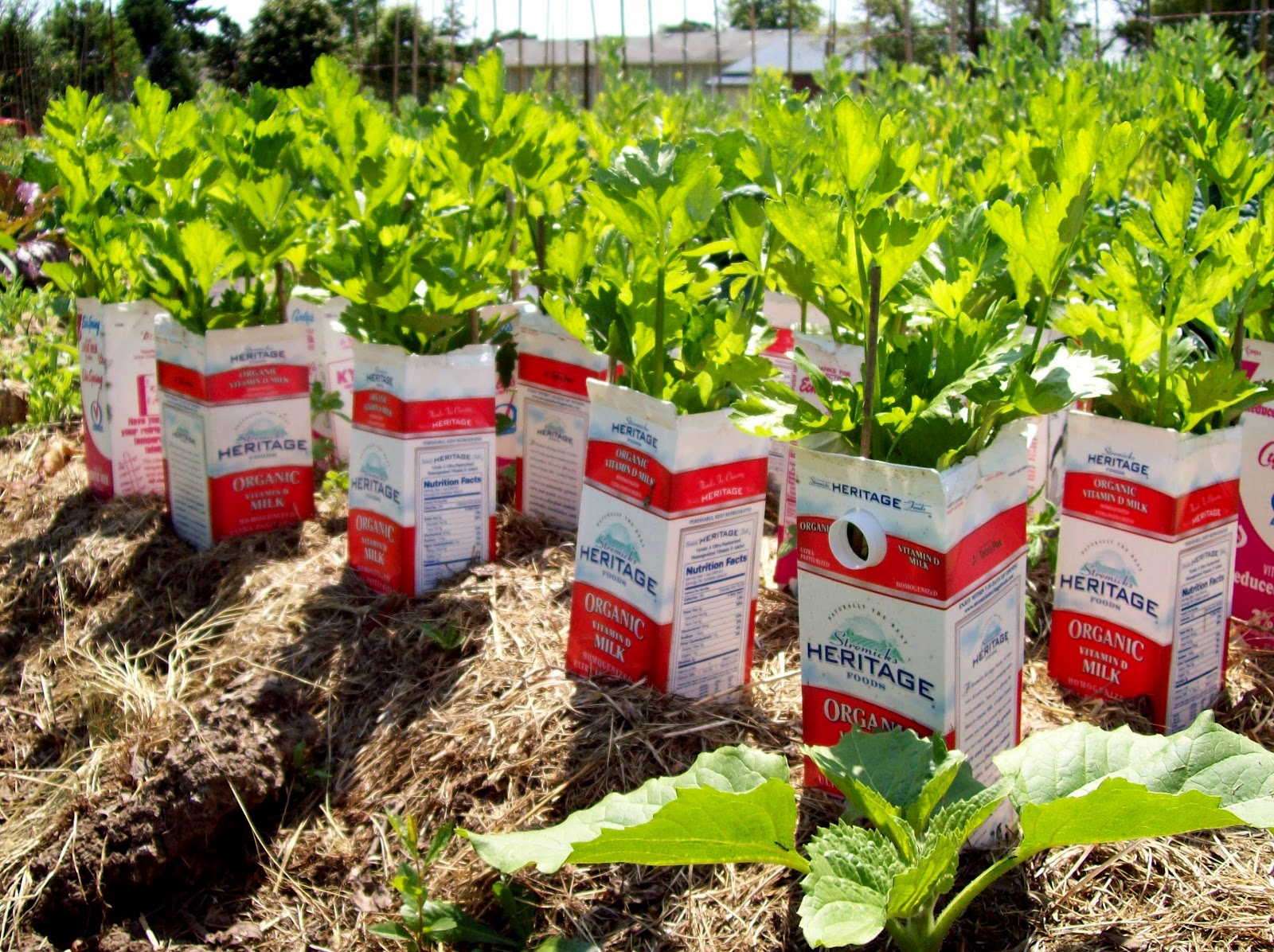
Yes we can grow celery here. Monroe, Oregon 2012

Tuesday, June 19, 2012

The Generous Garden - SC

We recently heard of another "Sharing"-type garden in South Carolina called the Generous Garden Project. They too grow food on a volunteer basis and make it available for free to Food Banks, Shelters and others in need. They are excited to announce that they have been gifted with two, twenty acre parcels of land to expand their project! Watch this inspiring video made several years ago when the project was just getting started.  Enjoy, and be inspired!


Check out their site if you wish to learn more about them.


Wednesday, April 27, 2011

40,000 People; One grocery store!

Sharing Gardens Reaches Beyond Oregon

Here is an email we just received from someone who saw the Peak Moment TV interview about the Sharing Gardens on YouTube. We wish to extend our sincere thanks to all the many supporters near and far who have nurtured the program up to this point. Here is evidence that our effort reaches out beyond our own small community. We wanted to share our excitement with you all.
Scenic Chester, Pennsylvania!
Hello Chris and Llyn.
First of all, please accept my thanks for being the "break-through" people in trailblazing this idea.  I wish I had the words to describe how my heart leapt when I watched your video on Peak Moment.  I have been reaching out (metaphorically speaking) launching my faith in hopes that what I am supposed to do and be in this world will come to me.  I believe it has.  I love gardening.  I feed my family from our small garden.  And last year, I was able to give a lot of food away.  I have been praying for an opportunity to share that will incorporate my love of gardening.  I believe this is it.
Our city, Chester, PA, is a very poor and declining city.  We have one supermarket in the entire city of 40,000 people.  And although there is a state of the art soccer facility and Harrah's Casino in our town, the people struggle to eat.  The majority of our residents rely on government help to feed their families.  For the first time in the many years I have lived here, I see people begging for food or money. 
There is also an abundance of vacant land in the city.  I believe a sharing garden will serve to feed many hungry people and aid in the revitalization of the city.
You mentioned your willingness to help folks who have a heart for such a revolutionary idea.  That would be me.  If you would consider mentoring me, I would love to share your vision here in our dear city.
A. Costa
Click on image for link to map of Chester, PA
It appears that the "Sharing Gardens" website has been translated into Russian!? (Click Here) Our site is being linked to other sites all over the world.

Thursday, March 25, 2010

Signs of the Times

Chris finished painting both garden signs and we look forward to another break in the weather to hang them at the garden sites. Here's the one for Alpine:


And here's the one for Monroe:


Someone sent us a link to this article in the San Francisco Chronicle featuring a garden similar to our "Sharing Gardens". Its called a "Free Farm". "Free Farm article"