Greetings friends of the Sharing Gardens, near and far!
It's been over two months since we last posted. Spring-time planting
can be all-consuming but we hope you'll find the wait has been worth it.
Since 2012, the Sharing Gardens has partnered with Oregon State University to offer Service Learning experiences for their students. Through this program, students receive college credit for
volunteering in the community and making a presentation to the rest of
their class highlighting what they learned. Their
participation in Service Learning typically counts for about a third of
their grade.
"Service learning integrates meaningful service with reflection to enrich
the learning experience. A form of experiential learning, it provides a
hands-on opportunity for students to make a difference while applying
what they’ve learned in their classes."
Quoted from OSU - Service Learning webpage
 |
| Planting seeds. |
A Service Learning group consists of four to six students for four hours. Our groups have always come from either a class on
Soil Science or
Sustainable Living so their experience is relevant to their studies.
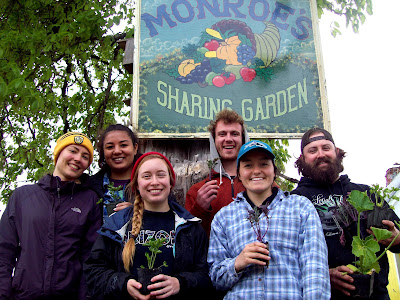 |
| A typical group has four to six students. Often they will take home plant 'starts' for their own gardens. |
Chris and I always feel incredibly grateful for the amount that gets
done when the students come.
We typically reserve the 'big
stroke' projects for these helpers. For example, they have helped us with
planting, turning huge compost
piles and distributing the
compost and mulch around the gardens but
we try to make it fun and educational as well so we often include other
hands-on gardening projects such as
planting seeds and 'starts' and have them
harvest produce and
process dried beans and grains. Planting:
 |
| Amy, planting onion seeds. |
 |
| 'Potting-up' tomato starts. |
 |
| Blueberry bushes planted in 2014 now yield 2-gallons of berries or more, each year. |
 |
| Tree-planting in 2014. Those slow-growing red maples are 4' tall today. |
 |
| Sprouted corn finds its new home in the ground. Guideline strings help students keep the rows straight. |
 |
| Teamwork makes any project more fun. |
Turning compost piles: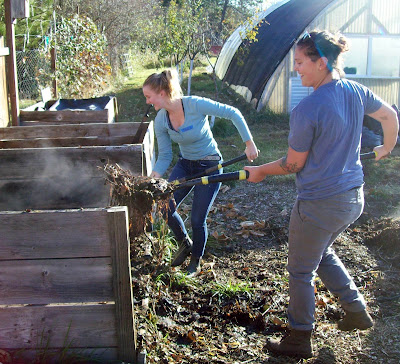 |
| Some groups especially enjoy the vigorous demands of turning compost piles. |
 |
| There's something very satisfying about moving a big pile of material from one spot to another. By turning the piles, we introduce oxygen which causes them to cook down faster and be ready to use in the Gardens. |
 |
| A job well done! |
Distributing mulch and compost:
 |
| Every autumn, members of our small town bring us trailer-loads of leaves. Students help distribute them as mulch. These gals loaded leaves into carts... |
 |
| These gals dragged them using tarps. Over the winter, these leaves break down and feed the soil for spring plantings. |
 |
| Many years, students have spread wood-chips around our fruit trees. These keep the soil temperatures and moisture levels even. |
 |
| When we don't have enough wood-chips, we mulch our trees with leaves. |
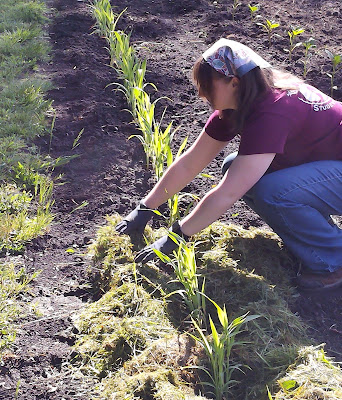 |
| Grass clippings provide the same functions as wood-chips for our annuals (soil temperature and moisture moderation). These are baby sorghum plants. |
 |
| Compost, after being loaded into buckets is carried to where it's needed. In this case we were preparing the ground to plant cucumbers and winter squash (both are heavy feeders). |
Autumn clean-up:
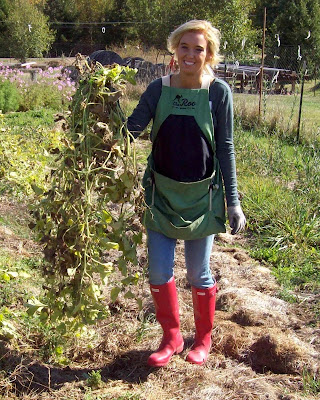 |
| Our autumn groups help with putting the gardens to bed. Most plant-material goes back into the compost piles to decompose over winter...And the cycle starts again. |
 |
| A whole long row of pea-plants filled this garden-cart to overflowing! |
In addition to the 'big-stroke' projects, we try to keep things fun and educational as well:
 |
Chris teaching about planting seeds in tofu containers.
|
 |
| Sifting compost is a relaxing step that helps us build our potting mix. |
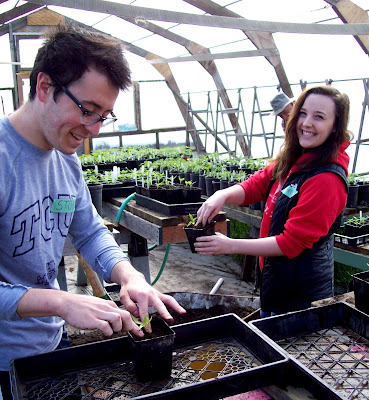 |
| We grew a lot of tomatoes that year (over 200 in the garden! and an equal number of 'starts shared in the community). Here, students were learning how to transplant them to bigger pots. |
Harvesting produce:
 |
| Apple-picking in the misty autumn... |
 |
Everyone seems to enjoy the fun of digging potatoes!
|
 |
| Harvesting lettuce in the spring. |
 |
| This group harvested and bagged all that lettuce for us to donate to a food pantry. |
Processing dried beans and grains:
 |
| In the fall there are lots of dried beans to be pulled of the vines, shelled, winnowed and stored for winter soups. |
 |
| More bean-processing. There's something ancient and deeply satisfying about these hands-on methods of growing and storing food. |
 |
| In the fall, students all harvest winter squash (pictured: Sweet Meat squash) |
A
typical session includes Introductions: so they understand the
philosophy behind the Sharing Gardens and we get to know them too. We
then move outside for about two hours of focused garden-time. By this time the students have built up, both
an appetite, and a load of questions about our philosophy and methods so we traipse back into our cozy farmhouse
for a snack and Q&A.
 |
| A recent group enjoying popcorn and herbal tea/lemonade during our Q&A session. |
They ask many important questions,
ranging from the practical, to the
philosophical,
 |
| Sometimes students experience their first contact with wild animals in our Gardens. Here, a student lets a baby garter snake flow through her hands. |
Typically we'll have time for one more pulse of activity in the
gardens. We always end by sharing with them fresh-harvested produce and
plant 'starts' (if we have any) for those who have garden access where they live.
 |
| Students receiving freshly harvested produce from the Gardens. Many of them try new foods for the first time... |
 |
| ...or find that veggies they never liked before taste much better when grown organically. |
“Students gain … community-building opportunities with both the community
partners and with one another,” said Assistant Professor Natchee Barnd,
who teaches several service learning courses in the College of Liberal
Arts. “The students consistently report these activities as the single
most memorable and impactful experiences of the class. They are able to
concretely apply their learning to ‘real world’ situations and
contexts.”
 |
| This group had a great time! Can you tell? |
We are so grateful for how much the students contribute to the cultivation of the Gardens but
our
greatest joy comes from meeting them, many of whom sincerely want to
help the world become a better place. This gives us hope and a sense of meaning and purpose in what we do. We're planting seeds, not only to grow food but in the hearts and minds of those who feel touched by the Sharing Gardens Mission.
"I had SO much fun with this project. Chris and Llyn were great
communicators and seemed genuinely delighted to have us there. We enjoyed their wealth of knowledge, patience,
cheerfulness, and willingness to teach."
"Honestly, I wish more student-groups could do the Sharing Gardens. It was
extremely fulfilling and fun, and I learned a lot about soil. I think
adding more partners like Chris and Llyn would increase students'
engagement in the community as well as their understanding
of soil health and what a healthy, productive garden looks like."
Olivia - Service Learning student - May 2025
Olivia (right) has continued to volunteer in the gardens since completing her Service Learning assignment. She even enrolled a friend (who wasn't in the class but thought it sounded fun).
We appreciate her cheerful willingness to do whatever is needed and her curiosity in learning the ways of the Sharing Gardens. (I think she also likes the free veggies we send home with her and Milan at the end of each session <smile>).
 |
| Olivia, laying Golden Amaranth out to dry. |
 |
| Olivia's friend, Milan - trimming garlic. |
Since 2012 we've hosted 55 groups (over
300 students)
! We hope this partnership continues for many years
to come!
Video made by a Service Learning student in 2017
 |
| Wouldn't it be wonderful if all our school systems integrated 'service learning' into their curriculum? |