A unique and viable approach to establishing local food self-reliance and building stronger communities.

Monday, April 24, 2023

Garden news and Springtime LINKS

We have so much to be grateful for at this time of year.

Our greenhouses are filling up with beautiful plants, both in the raised beds, and on our potting tables. We've been eating and sharing lettuce and green onions for the past month with our share-givers and the Monroe Food Pantry. Our kale and collard plants (outside) have been producing such healthy, good food all winter. We finally picked the last of the kale raab (flowers) - a highly nutritious form of the plant before it goes to seed. Here's a link to our post about why it's important to eat organically grown kale; Kale, again makes the Dirty Dozen - LINK, and How to Grow Kale - LINK

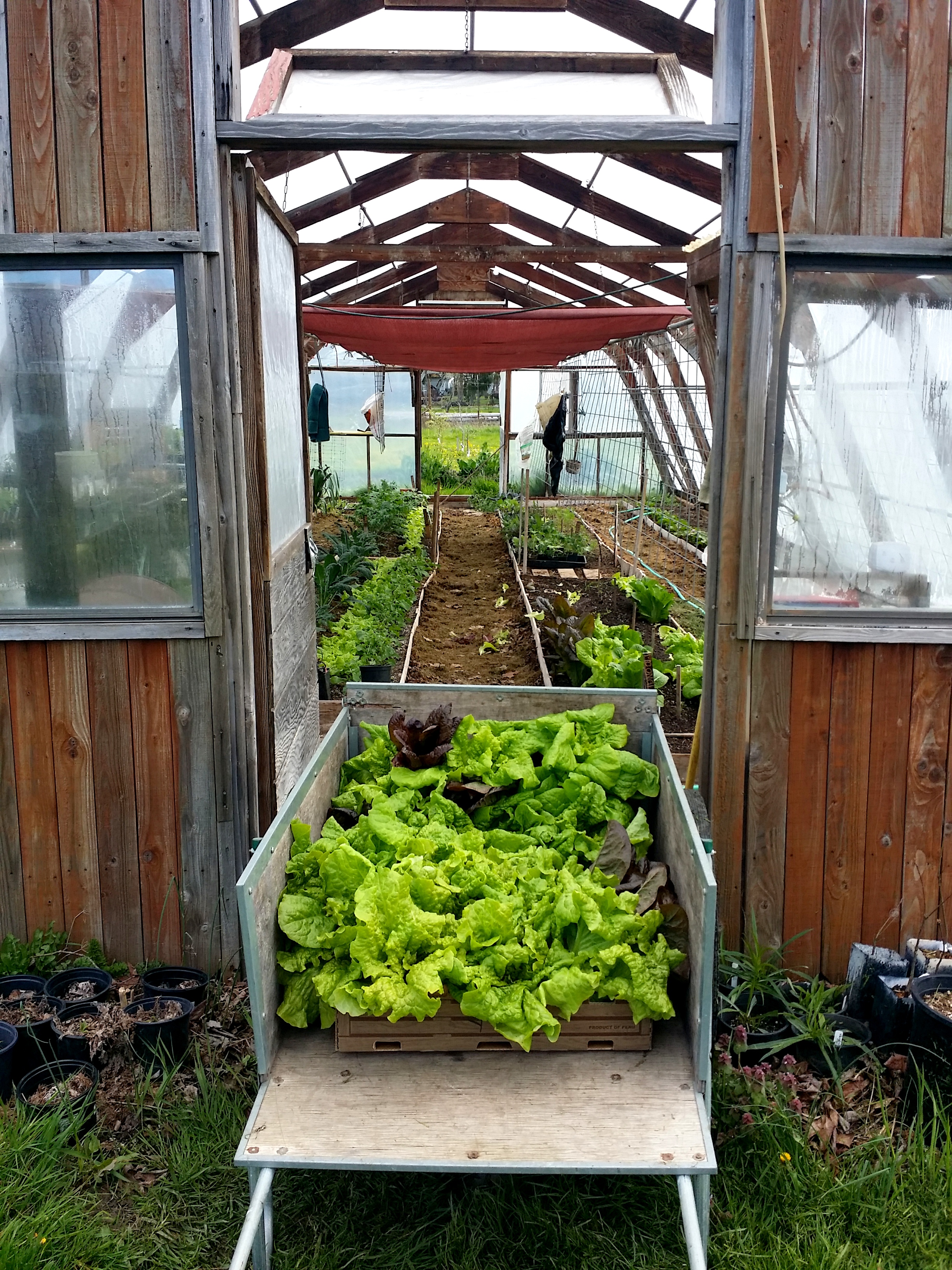
Lettuce harvest in front of our Ark greenhouse. We've eaten and shared over 45 pounds of lettuce so far this season and we're still planting more!

Slo-bolt lettuce on the left, potatoes coming up in the center (it's an experiment to grow them in our greenhouse) and Chris planting onions on the right. April 24, 2023

We have a deepening collaboration with Lua Siegel (left) and the Luckiamute Valley Charter School gardening programs (both grade- and middle-school sites). We're very excited about the reciprocal generosity we feel with this project. Read about it here.

If you're local and would like information on our grass-clipping drop-off site (right) or volunteering at the gardens, Click here: Local News: Grass-clippings drop-off, volunteering, gratitude 

Here's an idea for people who are wanting to jump into gardening but without the expense of building raised beds. This system only requires cardboard boxes, chicken wire and burlap. Instant raised beds: An attractive, inexpensive idea
 
Why pay for a gym membership when you can work out in your garden instead!
Gym, no! Garden, yes!

​We wish to extend blessings to everyone reading this, Llyn and Chris​

Local News: Grass-clippings drop-off, volunteering, gratitude

This post features locally relevant news: Where to bring your grass-clippings, how to volunteer in the gardens and continued gratitude for the support we feel from our local community. Much thanks!

Grass clippings: Thank you to our neighbors, the Dillards for having their yard work guy - Chuey - bring us their surplus grass-clippings. And thank you Chuey for bringing those, and from your other local clients as well. This is a real win-win because in our small rural town, there is no yard-waste pick-up service. Many people have no way of disposing of grass-clippings on their own land and so without our drop-off site it ends up in landfills, burn piles or must be driven 30-miles to the nearest urban large-scale composting site and "donated" for a fee.  

Thank you too, to the mystery people who have begun to bring us your bagged grass-clippings this season. Grass clippings are a major source of garden mulch and fertility. Here's Donn (left) spreading them in our Sunship greenhouse paths.

Grass-clipping donations: We have a drop-off site under the big hickory tree in front of the gardens. Please, no sticks, loose weeds, trash or thorny-plants. Don't fill the bags too full or tie them. We hang the used bags to dry and re-distribute them for free (in the trashcan at the base of the hickory). Feel free to take as many recycled bags as you can use.

Our drop-off site for leaves and grass.

People have begun to ask us about helping in the gardens this summer. Because of the cool, wet spring, all our garden activity has been confined to our greenhouses and we've been able to manage them ourselves, with the wonderful committed help of Donn and Jewels who have come almost weekly throughout the late fall and winter. If joining in the fun of growing food and learning gardening methods that are light on the Earth; sharing in the harvest and helping us to grow food to give away to local food charities sounds like something you'd enjoy, send us an email and we'll let you know when there's more to do in the gardens, later in the spring. LINK to volunteer info

We want to extend a special thanks to our friend Rook (right), who's been participating in the gardens as a share-giver since 2016 and who works at  Safeway's deli in nearby Junction City has made it a point to collect clean, food-grade 5-gallon buckets for us. These are great for collecting rain-water as we can be sure there are no harmful residues in the buckets. Rook has also been collecting used coffee-grounds from the coffee-shop at his work and completely filled both our 30-gallon bins this winter. We use the coffee-grounds as a soil amendment (Coffee Grounds and Wood Ash for Soil Fertility).

Thursday, April 20, 2023

A new collaboration: Mutual-generosity

We're very happy to announce a growing partnership between the Sharing Gardens and the Luckiamute Valley Charter School Gardening Program. The head gardening teacher, Lua Siegel, is a real gem and shares so many of our values and vision for a healthier, mutually-caring world. The two school gardens (grade school and middle school) are grown using organic methods. Lua coordinates with the school's science teachers to create relevant lesson-plans. LVCS Garden projects have included such diverse activities as building Hugelkulture mounds and using hydroponic tables to grow winter greens. (Left: a child from LVCS sampling collards, right out of the garden!)

The garden program has a regular feature of exposing kids to new foods, either plain, or in recipes the students help prepare themselves. Last fall, the school gardens produced enough surplus tomatoes for them to preserve through canning. These were then used to cook meals for the students throughout the winter. Lua's program is truly full-circle: from seed to table. (Rt: a platter of foods to sample)

Lua is always finding new ways to encourage participation from the parents in the school community. This year she has secured funding to install ten cedar raised beds at the homes of ten school families. Any parent who volunteers at all in the school gardens has been entered in a drawing to win one of the raised beds. (LFT: more sample foods from the school gardens)

The Sharing Gardens is supporting Luckiamute VCS both through a cash grant and by growing 'starts' both for the gardens at school and for the families who receive a raised bed from the drawing. Our only regret in this partnership is that our gardens are so far apart. (They're about an hour's drive north of us). (That's Lua and llyn with last year's starts-to the right)

We met Lua several years ago when she answered a Craig's list ad we placed, giving away free building materials for another garden program she was overseeing at the time. One thing we've always appreciated about her is her commitment to reciprocity, or "mutual generosity". Early on in our relationship she began asking us if there was anything we needed. Over the years she has loaded her pick-up truck with leaf-mold (compost made from decomposing leaves) that she purchases from a local organic farm (who makes it from surplus leaves gathered by city-workers in Corvallis). The leaf mold is an excellent mulch for our potatoes and other heavy feeders as the plants receive a slow-release fertilizer as we water through it. (More student food sampling - Left)

Lua, unloading leaf mold compost, 2022.
It just so happens Lua will be bringing us a load of leaf-mold at the end of the month for college students to unload for us. This leads us to another partnership we have in the community: Oregon State University, in Corvallis, invited us to participate in another "service learning" project with one of their Soil-science classes this spring. Service Learning is a great OSU program where students receive college credit for performing relevant volunteer work in the surrounding community Service Learning LINK. We've been hosting groups since 2013: six students for four hours. They learn a bit about organic gardening, feel the joy of being in service and get a lot done!
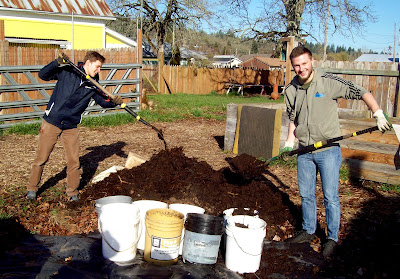
OSU service-learning students loading buckets of compost to build squash mounds.
Carrying compost...
Turning the compost piles...
...and bringing in the harvest.
With the Luckiamute Valley Charter School garden program, we're just really grateful to have a found such an appreciative outlet for the Sharing Gardens surplus 'starts' and other resources we can channel their way. For more information, here is their Facebook page.

Blessings to all who are reading this.  Llyn and Chris

Sunday, March 12, 2023

Spring has sprung! Sharing Gardens update

Hello friends and family of the Sharing Gardens - though we've had two brief snow storms since our last update, each accumulating about 2" of the white stuff, spring is definitely in the air! Temperatures are consistently reaching the low-to mid-50's in the day and rarely dipping much below freezing at night. Soon we'll turn the water back on to the garden spigots and give our two main greenhouses a thorough soaking, including the paths, and begin the cycle again of generating compost right in our paths! (LINK-How we grow...Veganic Community-based gardening)

Before we give you our latest garden-related links, you might enjoy watching this short video of a joyous, sweet song performed by the Masaka Kids Afrikana - I Look to You-LINK. Guaranteed to make you smile!

Early spring snow, soaking the ground.
In our planting zone (Willamette Valley, Oregon, USDA zone 7b), early March is a time of completing the pruning of fruit and nut trees and the pruning and care of other perennials (before warmer temps cause the sap to begin to rise). We continue to start seedlings both on heat-mats, and directly in the raised-beds in our greenhouses.

Though this picture was taken in 2022, it shows our 48 grape vines after pruning. LINK - Great video on Pruning Table Grapes.
Here are our most recent garden-related posts:

Growing your own celery is not difficult, it just takes a lot of time to get the celery plants started! (Their roots are very slow to develop). But once they do you can have cut-and-come-again celery that extends through the main growing season, and in a greenhouse, right through to mid-winter! LINK

Growing Lettuce from seed (with general tips about starting seedlings at home).

Great news for the Monarch butterflies in southern California! After a nerve-wrackingly low winter count of nesting Monarchs in 2021 (only 2,000), they seem to be bouncing back! (250,000 in 2022 and 335,479 in 2023). Even if you live too far north to help the Monarchs (there are no consistent sightings north of Portland Oregon), planting milkweed will still benefit other pollinators. They are gorgeous, stately plants and smell divine! Here's how to grow milkweeds: LINK.

Adri and Kaylynn holding up Showy Milkweed seedlings they helped grow.
In our last newsletter, we included a link to a video about a small town in NZ that came together during the lock-downs to collectively make sure all its members stayed fed with healthy food by, among other things, working as volunteers to create and maintain garden-plots for single-parent/low-income families. Any food that the families couldn't eat themselves was harvested and prepared into healthy meals at a small cafe/community-center. This hub of community also became the site for craft-projects and the sharing of practical life-skills such as sewing and simple carpentry to create useful products sold to raise money for the project to continue. 

We've received numerous appreciative comments for sharing the link. So, in case you missed the LINK in our last newsletter, here it is again.

And, in case this newsletter was forwarded by a friend, or you've just stumbled on our website for the first time and you would like to be added to our list to receive future newsletters, send us an email at the Sharing Gardens: shareinjoy AT gmail.com "Bee" well!  Chris and Llyn

Wednesday, March 1, 2023

Starting Tomatoes from Seed


Transplanting tomato starts (tofu containers with holes drilled in bottom re-purposed for seed-starting).
Here in the Pacific NW, it's time to start tomatoes from seed. Most varieties need 6-8 weeks to grow large enough and sturdy enough to be transplanted into garden beds. Since our last risk of frost is around mid-May, early to mid March is the time to start the seeds. And, if you're like us and grow most/all of our tomatoes in greenhouses, they can be transplanted from their pots even sooner.
 
Tomatoes are warmth-loving plants needing to germinate at around 70-75 degrees so they need to be started indoors to thrive. We germinate ours on a heat-mat specifically designed for this purpose. Once the seeds are up, they need full sun to keep from getting pale and leggy. A greenhouse is best, as long as you don't get freezing temps or have a heat source on cold nights. If you don't have a greenhouse, a grow-light will work, or a south-facing window. Keep rotating plants so they grow straight up (not towards the window).

Thursday, February 16, 2023

Grapes, Onions and Peas, oh my!

 Light is returning! Slowly, slowly, the days are getting longer, smells of spring are in the air and the garden tasks shift from winter's rest to a quickening into pruning and mulching our orchards, managing our willow patch and starting seeds for another season of flowers for the pollinators and bounteous veggie harvests. 

Here are links to seasonally relevant posts:
Here are two posts about starting onions from seed:
And here's the best video tutorial we've found on Pruning Table Grapes
 
Finally, a photo gallery of current garden projects:

We've spent the winter in preparing greenhouse raised beds for planting...

Donn and Chris mix compost, ashes and coffee grounds into our raised beds; ready for spring planting.

 and deep-cleaning and organizing our garden-sheds...

"A place for everything, and everything in its place...". Here are tomato stakes and sawhorses just waiting to be put back into service.
Our neighbors have brought us their extra leaves which we will use for mulch and to create next year's soil...

This is about 1/3 of the leaves we've had donated this year. Thank you to the Crosby's and the Dillards who send their leaf-bounty to us each year, and to Chuey (their landscape guy) for collecting all those leaves and bringing them to us!

Many neighbors bring us their leaves in plastic bags which we hang to dry and bundle in rolls of 5 or 6 bags. These are offered back to our neighbors for free, for re-use.

Now, we're shifting our focus to pruning and mulching our perennial and orchard plants:

Our willow hedge is in serious need of pruning! This picture was taken in 2021 and many of the shoots that weren't removed then have doubled in diameter!

We use the smaller willow shoots in building this living-willow-wattle fence. Every year, we have enough smaller willow to raise this fence up another foot or so.
Now's the time to mulch all our hazelnut and fruit trees. Our wood chip pile is almost all gone.
A high-school intern and Stefani loading wood chips for distribution.

The mulch helps keep moisture in the ground, blocks weeds and protects the trees from the mower getting too close. It also provides a slow-release fertilizer as it breaks down.
Seed-starting has begun: Lettuce, onions, peas, Fava beans, carrots, beets, cabbage and kale!

Chris continues to start seedlings directly in our greenhouse raised beds...

He's also begun direct-seeding beets, carrots and spinach in the greenhouses. Here he is putting a black lawn/leaf bag over the newly seeded carrot bed. The plastic keeps the bed from drying out too fast and its dark color heats the soil below when the sun shines on it, hastening germination.

Llyn has been starting perennial, native flower seeds. Many seeds of this type need a cold-spell to break dormancy, and an extended time to germinate (10-12 weeks). Here's an excellent article on Autumn and Winter Seed Sowing in Six Easy Steps from the Wild Seed Project.

 It won't be long before we are starting our heat-loving seeds and before you know it our greenhouses will be filled with delicious, nutritious food!

Our 'Ark' greenhouse, May 24, 2022. Yum!