A unique and viable approach to establishing local food self-reliance and building stronger communities.

Monday, February 24, 2020

Spectrum of Sustainability, Groundbreaking Plastics Legislation and Garden Update

OSU students in the gardens!
Greetings folks - We had our first 2020 group of Oregon State University students last Saturday. A wonderful bunch of enthusiastic, bright and helpful young people. We are so grateful for our partnership with OSU. They send us students who receive college credit for "service learning" (volunteerism in the Corvallis area) and we receive a burst of strong, curious, willing helpers on a regular basis to assist with the big strokes of what needs doing in the gardens.

This post contains pictures from the student's visit and other recent garden activities. We have also included links to a video by the Back to Reality channel on the topic of "The Spectrum of Sustainability" and info about groundbreaking legislation being introduced into the House and Senate to address plastic pollution in an effective and comprehensive way. LINK, LINK

Blessings on your day!

Students in the gardens:
Nikolay and Reilly fill buckets with compost to transport into the garden in preparation for later-spring plantings.
Nikolay and Reilly sift coffee grounds which we use for garden fertility. Worms love 'em!
Abby sifts soil for use in our potting mix. Our mix this year is a combination of commercial, organic raised-bed soil and our own worm castings collected from greenhouse paths (LINK).
Nate spreading coffee grounds in the garden.
Reilly and Alex distribute compost.

Exuberance in the gardens!
Garden's progress:
With a mild winter and early spring, it feels like 2020 could be a very good year. Here, Nikolay spreads coffee-grounds on a bed that will grow a new variety of sorghum we hope to dry, grind and use for flour in baked goods.
Our early spring greens are up and thriving. Here, Llyn waters them with rain-water collected from our roofs.

Chris started carrots and beets in greenhouse beds back in mid-January. The seedlings are up and happy. We use the greenhouses to grow early crops such as these which will be done and harvested in time for heat-loving crops such as tomatoes and peppers to be planted in their place in late spring.
 In the house:
This winter we have done over 95% of our stove-top cooking on our woodstove with wood we gathered and split ourselves (through generous donations of wood-from Victor Stone, and a splitter loaned by our friend and neighbor - David Crosby). Cooking with wood, and limiting most of our hot-water usage to times when electric rates are low (midday and week-ends) we've cut our average electric bill from $65/month to under $45/month!
Ground-breaking Legislation to address the enormous challenges of plastic pollution: 

The world is in the midst of a plastic pollution crisis, and the current U.S. waste management system is not dealing with it effectively. Only eight percent of plastic waste in the U.S. is actually recycled. The rest is incinerated, landfilled or shipped overseas to countries even less equipped to process it, where it risks joining the eight million metric tons of plastic that end up in the world's oceans every year.

That's why Sen. Tom Udall (D-N.M.) and Rep. Alan Lowenthal (D-Calif.) introduced the Break Free From Plastic Pollution Act of 2020, a comprehensive piece of legislation that is being hailed as a first-of-its-kind attempt to address the root causes of the crisis on the national level.

Here are two links that explain the Bill: HERE, HERE.
Here's a link to a video on making producers responsible for plastic waste by Story of Stuff.

Spectrum of Sustainability: Here is a link to a video by the Back to Reality channel on the topic of "The Spectrum of Sustainability" Great message and graphics. We especially appreciated their distinction of including all of life on the planet in their definition of sustainability. That's been something we too have felt strongly about for a long time. Spectrum of Sustainability-LINK

Rook and Chris reclaim some ground where we'll install a new bean-tipi for growing scarlet runner beans LINK (Feb 2020).


Tuesday, February 18, 2020

A New Video!

Here is a short 4-minute video about the Sharing Gardens made by a student from Oregon State University who volunteered with us as part of a Service-Learning class in  2016. Enjoy! As Chris says, as he summarizes the philosophy of the Sharing Gardens, "A main element of the garden is, it has to be fun!" We hope that your explorations with growing food continue to expand this year, bring you joy and that you grow enough to share with friends, or neighbors or people in need in your community. Llyn and Chris

OSU students with a big lettuce harvest to donate to the Food Pantry. Here is a LINK to a sweet info-video made by an OSU service-learning volunteer in 2016

Wednesday, January 1, 2020

Sharing Gardens CSA - 2020

We are now accepting CSA subscriptions for our 2020 season. We have a limited number of spots so, if interested please reserve your subscription.

Here's a description of our CSA:

Llyn and Chris-Your local 'farm'acists.
What is a CSA? A CSA (Community Supported Agriculture) is a membership-relationship between you and a farm. Members receive a "share" of seasonally available produce, on a weekly basis. This gives you the benefit of superb freshness, knowing where your food comes from, how it is grown, and that you are giving direct support to the people who grow your food.

Your subscription will bring fresh and local food to your family while supporting us in our mission to donate healthy produce to people in our community, through local food charities  (3,399 pounds in 2019). We focus on familiar, staple crops; the things that are most popular at grocery stores and farmer's markets.

Home-grown fresh!
What's in my box? In the beginning of the season, boxes are less full as there are not as many crops ready for harvest in the spring. Over the course of the summer and into the fall, the boxes increase in the amount that's included so, over the course of the season, you receive generous value for your membership.

May, June: Beets, cabbage, carrots, chard, onions, kale, lettuce and radishes
July: same as above, AND early tomatoes. summer squash, garlic and cucumbers
August, Sept.: same as above, AND green beans, celery, large tomatoes, peppers, apples, pears, plums, blackberrries and grapes
Oct., Nov.: Most of above, AND winter squash and potatoes.

Dates of the season: The Sharing Gardens CSA provides weekly boxes of fruits and vegetables from May until November as it is available.

How much is in my box? At the height of the season, each member receives enough produce to feed the average family of four. We cannot customize boxes but if you are receiving more produce than you can consume, we encourage you to be generous with your friends and neighbors so it doesn't go to waste.

Each member will be added to our special CSA email-list and receive recipes and ideas for using the produce provided. We ask members to check their email regularly so as not to miss our communications.
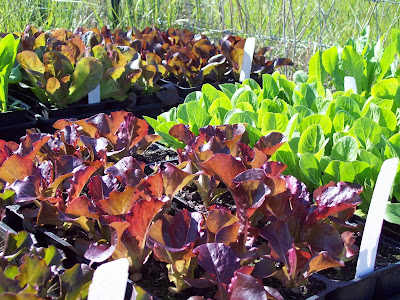
Lettuce grown from seed we saved.
How do we grow your food?

No herbicides or pesticides
Soil-fertility is created primarily through compost, worm castings, leaves, grass-clippings and wood-ash.
Slow-grown for maximum density of nutrition and flavor.
We encourage birds and beneficial insects for natural pest-management.
We grow all heirloom varieties (no hybrids or GMO) from 85% (or more) of seed we saved ourselves.

Commitment to living lightly on the Earth: Each weekly box will have a large, plastic liner that all - but a few items - will be placed in without separate plastic-bags. Liners will be re-usable. Less plastic - better for the Earth! Thank you for helping us reduce our environmental footprint.

Healthy food for you and your family!
Cost of season's 'shares': $700 (payable either in full - when you sign-up, or in two payments of $400 - when you sign up, and $300 by July 1st). This works out to about $25/week.

Payment methods: We can accept cash or checks made out to 'The Sharing Gardens'.

Where do I pick up my box? Members in the Monroe area will be able to pick up their boxes on Wed. afternoons from 1:00 to 5:00 at the Sharing Gardens.
664 Orchard St., Monroe 97456
Corvallis and Junction City: We will have a single, weekly delivery site to both Junction City and Corvallis. Day of week/time and site location to be determined based on enrollments.

Can I share my membership? Yes, if you find someone to share it with.

Can I cancel my membership? Only if we have a waiting list. You will be refunded the balance of your fees if there is someone else who wishes to buy your "share".

To sign up for the Sharing Gardens CSA,  send an email to us at - ShareInJoy@gmail.com - We will email you an application for you to fill out and mail to us, along with your payment.

Questions? Phone: Chris and Llyn (541) 847-8797
Call: 8:00 to 12:30 or 2:00 to 6:30 (we keep 'farmer's hours' and take a nap each day. 💤)


Benefits of the Sharing Gardens Model

The Sharing Garden is a unique community-garden model. Instead of many separate plots that are rented by individuals, the garden is one large plot, shared by all. All materials and labor are donated. Share-givers (volunteers) typically come one to two times per week (at scheduled times) to help in all aspects of farming from planting, through harvest. The food we grow is shared amongst those who have contributed in some way as well as with others who are in need in our community (through food pantries and other charities.) In 2018, as a fund-raiser for the Gardens, we started a CSA (community supported agriculture).

Amy and Cindy sort donated pots and trays.

Our project encourages community in a tangible way. Growing food together helps build relationships. The  Gardens have become a hub for distributing surplus building materials, garden equipment and supplies, canning jars, seeds and 'starts' and other related materials. Neighbors bring us their excess (or invite us to come pick it up) and we distribute it to those in need.  

Llyn preparing tomatoes for dehydrating.
The Sharing Gardens also has a strong educational component: share-givers learn about organic gardening, creating habitat for pollinators and other beneficial wildlife, saving “heirloom” seeds, pruning and other food-growing skills. We have also offered classes in cooking from scratch, using ingredients from the garden and encourage our share-givers and blog-readers to learn about canning and other food-storage techniques.
Every year we have been able to provide local food-pantries with a bounty of fresh, organic fruits and vegetables from the Garden's surplus. We have given away  thousands of surplus 'starts' grown in our green-house to other sharing-type gardens, and food-pantry customers. We save over 85% of our own seed which is shared through seed-swaps, and to those who will use it for non-commercial growing.
OSU students re-potting 'starts'
In recent years we have partnered with Oregon State University's "service-learning" projects. Over the school year we host 50-60 students, for four-hours each (in groups of 4-6). These students help with all aspects of our project and learn about organic gardening, sustainable living and experience the joys of being in service to the community -- while receiving college credit.
Apples gleaned from our neighbors.
Currently our project gleans fruit from neighbors' trees and provides a drop-off site for gardeners/farmers to drop-off their surplus. This is then distributed to those in need. Since purchasing the land that hosts the Sharing Gardens (2014), we have planted dozens of fruit and nut trees and berry-bushes. As these mature, we are significantly adding to the quantities of fresh, organic produce we can share in our community.

We have a strong commitment to providing habitat to birds, small-mammals, insects and reptiles. Our style of gardening provides food and shelter for many of these critters who's habitats' are shrinking due to humans' lifestyles habits.

There are many benefits to growing food in the sharing model.

You can:

Grow the maximum amount of food: Sharing Gardens use the garden space more efficiently. Since we grow all the food together (instead of separate plots) there are fewer pathways between garden rows and all of the same kind of plants can be grown together making harvests more efficient too.
Delicata squash on harvest-day.
Water more efficiently: Plants can be grouped together with similar watering requirements.
Manage weeds and pests more easily: In a typical community garden setting, pesticide or herbicide applications in one plot can lead to a mass exodus of the offending bugs or weeds into adjacent plots. This can lead to a mini “arms race” between garden plots to bolster plants against pests. In a Sharing Garden, if pests/weeds appear, they can be managed selectively without the need for ever-accelerating methods of eradication.
Cindy, Rook and John have a "weeding party".
Save pure seeds: Many plants will cross with their neighbors, or hybridize. This means that, in a typical community garden neighboring gardeners would need to coordinate so their seed-stock doesn't cross with neighbors. In a Sharing Garden, you can plan your crops to keep strains from crossing and save enough seed to last for a few years. In years that you're not saving seed, it doesn't matter if you plant varieties that might 'cross' in neighboring rows.
Kidney beans grown for food and next year's seed.
Build community: Though some community gardens have regular work parties and social gatherings, the emphasis is on each gardener doing his own thing. In a Sharing Garden, the focus is on cooperation and sharing a common goal. Having a meaningful shared purpose builds great camaraderie.
Children enjoy eating the food they helped grow and harvest!
Share knowledge: Sharing Gardens become a place where gardeners can share their experience with each other. Participants are also learning about food preservation, gleaning and other ways of increasing local food security.
Participants learn about food-preservation.
Live more lightly on the planet: An additional benefit of this style of gardening is that we use salvaged material whenever possible. This keeps these materials out of burn-piles and the land-fill while providing new life for tools, leaves, grass clippings and building supplies. By encouraging people to share their surplus we build a tangible sense of community and networks of relationship that can be drawn from in times of crisis.
Ken and Chris create tomato-cages out of old fencing material.
Help local wildlife: Each of our gardens is designed to create habitat for pollinators and other beneficial wildlife as we believe it is important to "share" the earth beyond our human family.
A Sharing Garden creates a healthy environment for humans and non-humans alike!
We are pleased to see that other communities around the U.S. are beginning to adopt the Sharing Gardens model. It's an idea with so many benefits and very few "down sides". 


The Sharing Gardens is a non-profit and tax-exempt organization. We exist primarily through grants, our CSA program and donations from people like you. If you have found benefit from our site, our project or just want to support the work we do, please consider making a donation through PayPal. (Click button below.)

Saturday, December 28, 2019

Sharing Gardens - Overview of 2019

Hello dear friends, We're already preparing for the 2020 season (we'll start our first seeds in just six weeks) but this post looks back at some of the highlights from 2019, one of our best seasons ever! This post also offers thanks to all our supporters, near and far. We couldn't do it without you!

We are truly grateful.

Chris and Jim harvesting potatoes with little Jace's help. Potato harvest 2019: 676 pounds; our best yet!
Well, the numbers are in! The Sharing Gardens have surpassed all previous records for harvesting this year with a total of 8,006 pounds!
 
Here are the highlights of our donations to charities:
South Benton Food Pantry: 1,513 pounds
Local Aid Food Pantry: 1,311 pounds
Other Misc. charitable donations: 575 pounds
                                                Sub-total: 3,399 pounds
Shared amongst participants:
Sharegiver's (volunteers) weekly distribution of the harvest (and one family facing a cancer crisis who we donated a CSA membership to): 1,447 pounds
Food Preservation (canning/dehydration) and winter storage (potatoes, squash etc) - also shared amongst participants and will continue to be donated to the SB Food Pantry through the winter: 1,078 pounds
                                                Sub-total: 2,525
Memberships:
Three CSA memberships (Community Supported Agriculture - LINK): 1,075 pounds
Equivalent of four CSA memberships offered to a class on healthy living for 12 weeks: 1,007 pounds
                                                Sub-total: 2,082

Sharing Gardens 2019 Harvest Total: 8,006 pounds!

OSU student-volunteers with sweet-meat squash harvest.
Previous years' harvests averaged closer to 6,000 pounds. The increase this year comes largely from the fact that our orchards and vineyards are beginning to really bear fruit (approx. 521 pounds). We also grew lots of potatoes (681 pounds) and winter squash (676 pounds). We've also continued to expand our vegetable garden spaces for growing annual vegetables, and in planting succession crops, so fertile ground is not left empty after crops are harvested early in the season.

In addition to the food we grew ourselves, each week we received all the surplus produce from the Corvallis Farmer's Market that was picked up by Jim Templeton from the Monroe Gleaner's. We sorted it and redistributed it back through the Gleaners and through Local Aid which amounted to over 800 pounds total - thus keeping this valuable food from going to waste.

We have so much to be grateful for.

Cash donations from individuals:
  • Peter Stoel, Karen Josephson - $2,100 (from an I.R.A required distribution).
  • Judy Peabody - $500 
  • Karen Salot: $100 
  • Lee Cornforth: $100
  • Jim and Cindy Kitchen: $50
Jim  and Cindy Kitchen (with Chris in the middle) - enjoying watermelon.
Other donations:
  • Victor Stone - honey (when a huge maple tree split open in a storm this winter, it revealed a hive of wild bees who then abandoned their hive leaving us with two gallons of wild-honey). Four cords of maple-firewood (a $1,000+ value): Victor already had enough firewood stored up for his needs so he helped us chop up that maple tree (and two others that also came down in the storm) and load the "rounds" into our truck. He got the debris from the storm cleaned up and we got several winters' worth of firewood. Now that's mutual-generosity! Victor has many maple trees on his land and this year, once again, he's blown the leaves into huge piles and then loaded them into our trailer for garden-use. Nineteen trailer loads so far!  - Enough to cover the entire garden. Much thanks.
  • David Crosby - loaned us his log-splitter to split Victor's wood-donation. Who needs a gym-membership when you have to split and stack all the wood you'll need to heat your house for the winter? David is also a local with lots of big trees on his land. We received five trailer-loads this year that he and his helper collected and delivered! Wow!
  • Neighborhood leaf donations: Our leaf drive has continued to be a big success. We estimate that we've had approximately 150 bags of leaves donated this season.
  • Llyn spreading donated leaves. Donations have been enough this year already to cover all outdoor garden-beds, our greenhouse paths and still have a surplus for next summer's growing season.
  • S.A.G.E. Garden: S.A.G.E. Garden is a non-profit project run through the Corvallis Environmental Center. Like us, they grow a huge garden of organic vegetables to be donated to soup kitchens and food pantries. We donated over 100 cabbage and broccoli "starts" to them and they let us fill up a few dozen buckets of their surplus compost. Again, "mutual generosity"! LINK
  • John and Donna Dillard - donated a chest freezer that was no-longer needed. The Dillards also donated a couple of trees-worth of firewood from trees taken down to make room for their new house. Also, cinder-blocks, large plastic and terra cotta planters, and salvaged lumber. Best neighbors ever!
  • Larry M. - Fixed mower belt. Our trusty ride-on mower finally wore out the belt that drives the mower blade. Larry saved us the money it would have cost to have it repaired at the dealer, plus the hassle of transporting the mower.
  • Craig Erken: Llyn's uncle Craig donated a Mother Earth News-subscription - the classic guide to homesteading. Also, after her help in cleaning out his garage, Craig donated a dutch-oven we are using to cook with on our wood-stove, a  mini-shop-vac, a Champion juicer and a bunch of other useful miscellany.
    OSU Service-Learning students with kale-bouquets. Nov. 2019
  • Peter Alford - driving our donations to Local Aid.
  • Wanda Foster: a grocery bag full of fresh-picked Chanterelle mushrooms (it's been a great year for them but we've only managed to go out picking a handful of times ourselves).
  • Cheryl Anson: wheelbarrow, salvaged redwood decking. Cheryl is the warehouse manager at Local Aid - one of the main recipients of our produce donations.
  • Jim and Cindy Kitchen: gloves and pruners. The Kitchens also transported two of our CSA member's boxes each week on their way home from volunteering in the gardens.
  • Catherine Henry: three and a half pounds of seed garlic (six varieties) which we've planted in our greenhouse.
  • Mara Friddle - USDA/NRCS Plant Materials Center: Forty wire tomato cages made from fencing material.
  • Our wonderful Share-givers: We couldn't do this without our core group of six wonderful volunteers. They came almost every week during the growing season for three hours, doing whatever needed to be done.
  • Oregon State University "Service Learning" students: The SG has hosted six groups of 4-6 students-each to volunteer with us in 2019. The students receive hands-on experience in some of the many tasks needed to grow food for the community, an extensive Q&A session where we delve into their curiosity in living a more generous and sustainable lifestyle, and we receive an incredible boost of high-energy labor! A real Win-Win!
Llyn, with some of summer bounty donated to the SB Food Pantry.
Foundation grants:
  • Benton Community Foundation - $2,400: This grant funded the Sharing Gardens to provide vegetables to the Total Health Improvement Program (THIP), a twelve-week free class designed to help participants address, prevent and heal from chronic health issues through adopting a whole foods, plant-based diet, and stress-reducing behaviors such as meditation and exercise. The class is a partnership between our local, Monroe Health Clinic, it's vegan doctor - Dr. Kyle Homertgen, the South Benton Food Pantry and the Sharing Gardens.
  • South Benton Food Pantry: $1,800 - for general operating expenses. This is the second year in a row that SBFP (a main recipient of Sharing Garden's produce) has made this generous donation.
  • OSU Folk Club Thrift Store granted us $772 for general garden expenses: tools, hoses, gloves and potting soil to fill up our raised beds.
Thank you "berry" much! Bella, Adri and Jasmyn enjoy summer's blackberry abundance.
The Sharing Gardens is a non-profit and tax-exempt organization. We exist entirely through grants, our CSA program and donations from people like you. If you have found benefit from our site, our project or just want to support the work we do, please consider making a donation through PayPal. (Click button below.)

Wednesday, November 27, 2019

Leaf Love!

How we use leaves in the garden...

Shag bark hickory.
Hello folks - Well, the autumn leaves have mostly fallen here in Monroe. It's been our best year yet for leaf-collection! We had a couple of cold snaps early on and not much rain so the colors were gorgeous (prettiest I can remember in over 20 years of living out west) and wonderfully dry, which makes it easier to rake them and bag them. This is the second year we've had a sign out front welcoming leaf-donations and the locals are definitely catching on. Hardly a day goes by without at least several bags showing up under our big Hickory tree. 

It's a real "win-win" as neighbors have a free, local place to bring their leaves (which they would otherwise need to burn, compost or take to the land-fill). We recycle the leaf-bags by hanging them in our greenhouses to dry and re-bundling them in packets of six which we offer free to folks in a trash can out front, saving people money from buying new ones and helping to reduce the purchase of single-use plastic.

Leaves in greenhouse paths.
The gardens benefit from having a free source of fertilizer - whether added to our compost bins, the paths of our greenhouses or directly mulching the garden-beds over the winter.

About a month ago, a local reporter offered to write an article about using leaves in one's landscape or garden and she included info about the Sharing Garden's leaf-collection program. Here is Edie's article re-printed with permission from the Tribune News (where it was first published).

By Edie Moro

The trees are beautiful in the fall with their shades of red, orange and burnt yellow. Then, the leaves are shed and the trees are bare. What do you do with the leaves?
 
Homeowners may want to make use of their bounty of leaves in their own gardens. Spread the leaves in a layer on the lawn and run a lawnmower over them several times. This chops up the leaves and adds grass clippings, which may then be spread over garden beds and under shrubs. Keep the chopped leaves away from the base of shrubs or trees where they could hide voles and other rodents that may chew on the bark.

Mowing leaves to use as mulch.
Also, for rhododendrons and azaleas, spread a light layer, no more than one or two inches, over their root zone. These shrubs are shallow-rooted and need access to oxygen. Piling mulch and clippings too deeply around these plants has been known to smother and kill them – called “death by volcano.”

Even easier - homeowners may want to just mow the leaves and let them melt into the lawn over the winter. It is a great, economical way to feed the lawn.

Sharing Gardens in Monroe would love your leaves. They use them to cover large areas of the gardens so they have time over the winter to compost and feed the worms and other soil-organisms and suppress weeds. The garden has stopped using animal manures as a source of soil fertility, and have turned to leaves, grass-clippings, wood-ash and coffee grounds as a replacement (see links below for more info).

Llyn Peabody and Chris Burns are the Sharing Gardens coordinators. They write a blog about the garden at www.thesharinggardens.blogspot.com/, which includes gardening information, recipes and other "homesteading" info. 

Llyn explains the need for the leaves, “There is a saying that, 'for every calorie you harvest out of a farm or garden, you must put at least a calorie back in'. In a typical year we harvest and share over six-thousand pounds of produce. We have to replenish a huge amount of organic-matter so our soils don't get depleted!”

Neighbors bring us grass!
The garden will accept most bagged leaves and grass clippings, with the following exceptions: “no animal waste, trash or sticks/branches, no holly or roses (too sharp), or black walnut leaves (they can kill plants). Also do not include diseased or insect-laden plant material. Just leaves and grass.

Sharing Gardens is located at 664 Orchard Street, Monroe, Oregon 97456, where there is a bright yellow house behind the Methodist Church. The coordinators ask people to leave the bags in a pile under the big, hickory tree at the back of the church parking lot. There are free previously-used lawn/leaf bags available in a trash-can underneath the hickory tree. The coordinators ask that bags be filled not too full and only lightly tied so that they may be re-used.

Thank you Edie and thank you to all the new and returning leaf-donors from this year! 
Gratitude for garden support!
For info on using leaves and grass clippings for fertility in your garden, CLICK HERE.

Leaves to mulch the gardens in winter.
For info about using wood-ashes and coffee grounds for fertility, CLICK HERE.

Adding wood ashes (and coffee grounds) for fertilizer.
For info about making your own potting mix (soil) in your greenhouse paths - using worms, CLICK HERE
Grass-clippings in our greenhouse paths.

The Sharing Gardens is a registered non-profit and tax-exempt organization. We exist entirely through donations. If you have found benefit from our project or our site, please consider making a small donation through PayPal. (Click button below.)