A unique and viable approach to establishing local food self-reliance and building stronger communities.

Friday, May 6, 2022

Garden Gallery! April 2022

Free sunflowers, Free wood chips, Garden beauty!

Good day to you! Today's post is a gallery of highlights from the past month. We're having an exceedingly rainy spring. We're so grateful for our two biggest greenhouses which have allowed us to plant and harvest, long before we'd be able to outside. We've had beautiful and heavy blooms on all our fruit trees  but we've also had some late frosts, and the rains inhibit pollinators from flying so it remains to be seen how much fruit has actually set. Here are highlights from the past month:

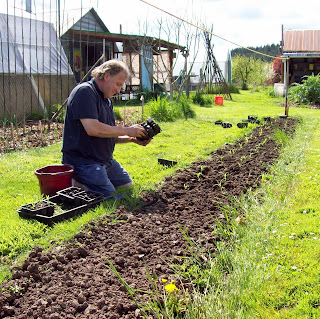
This year Chris has done an amazing job of starting seeds right in the raised beds of our greenhouses. This has given us a head start on many of the cool-weather crops. So far we've been eating (and sharing) lettuce, kale, radishes and green onions and have just begun to thin the carrots. In coming weeks we'll add spinach and beet greens to the mix as well. 
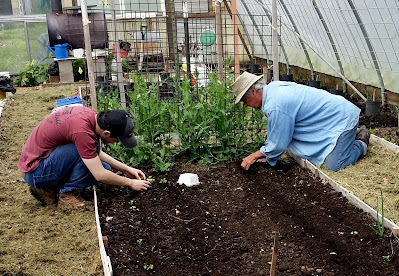
Chris planting celery with Aldrix. Peas are beginning to flower in the background...yum!
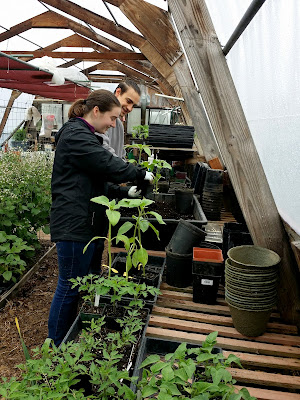
Llyn, meanwhile has been starting the other crops in pots for later transplanting. This is the fourth season we've grown all our starts with soil we made ourselves and they're looking beautiful!
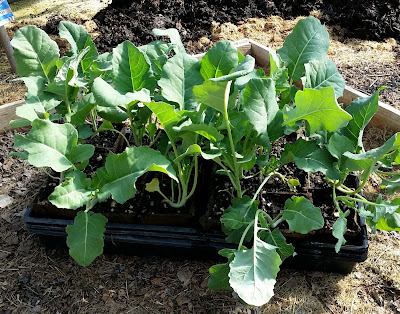
Broccoli 'starts' grown in home-grown potting mix which consists entirely of compost generated in the paths of our greenhouses, coffee grounds, wood-ash and perlite (the only ingredient we've had to purchase).
Growing plants without concentrated soil-amendments/fertilizers or animal by-products means the plants grow more slowly but they also seem to be more resistant to pests and diseases. They are also more nutrient-dense since they don't have as much water-weight. All the garden's fertility comes from leaves, grass, vegan kitchen scraps, wood ashes and coffee grounds. LINK - For more info on veganic/organic growing.

So far this season, most of the surplus produce has gone to programs housed in the church that shares our parking lot. They have a Gleaners group, a distribution to the Seniors in our community and a Food Pantry open to anyone in our school district who meets basic income requirements. To these food charities, we've added another group: the Stone Soup Kitchen in Corvallis. 

The Stone Soup Kitchen (sponsored by St Mary's Catholic church) is a charity that serves three meals a day, every day of the year! In 2021 that was an average of 3,500 meals/month but in March of this year they gave away over 4,000 meals! We feel really good about donating to them. Because they cook/prepare our food into actual meals, we feel it is more likely to actually be eaten and go to benefit those who typically have the least access to organic, fresh veggies or the means/ability to prepare them themselves. Stone Soup Kitchen in Corvallis - LINK

Volunteers: Our share-giver (volunteer) days have shifted to Mondays and Fridays. Since we no longer have CSA boxes to fill (on Wednesdays), it works best to spread these days of community-help and harvests throughout the week. We have a good circle of support already committed for the summer but if you're really eager to get involved, send us an email and we'll see if we can find enough weeds for you to pull too (or maybe we'll plant some! haha). All share-givers learn about our methods of growing organically/veganically - from starting seeds, through the harvesting of fruits, vegetables and seeds for future years' plantings, AND they share in the weekly harvests.
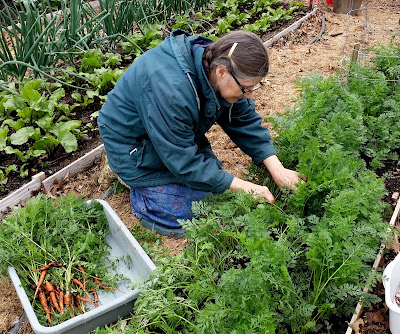
Cindy Kitchen (thinning carrots) has been coming since 2010 ...

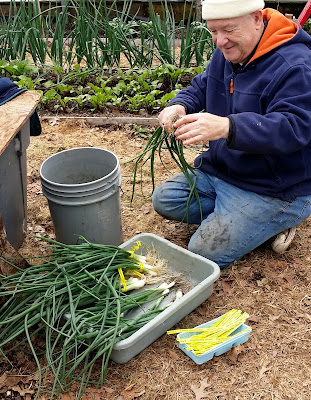
...along with her husband Jim (tying up green onion bunches to share).

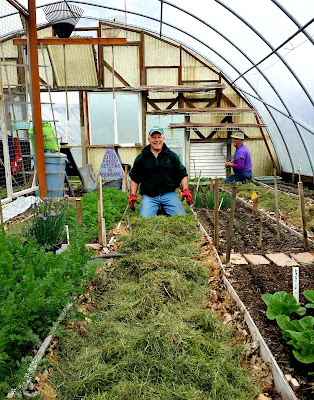
Donn, another long-term helper, spreading grass donations in the greenhouse paths. All this organic matter helps us create soil and compost for next year's fertility.

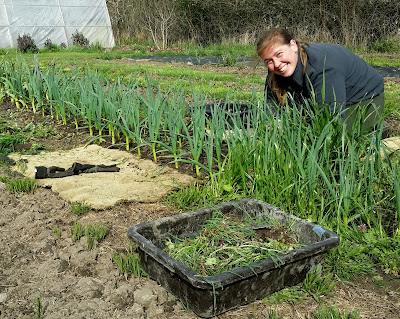
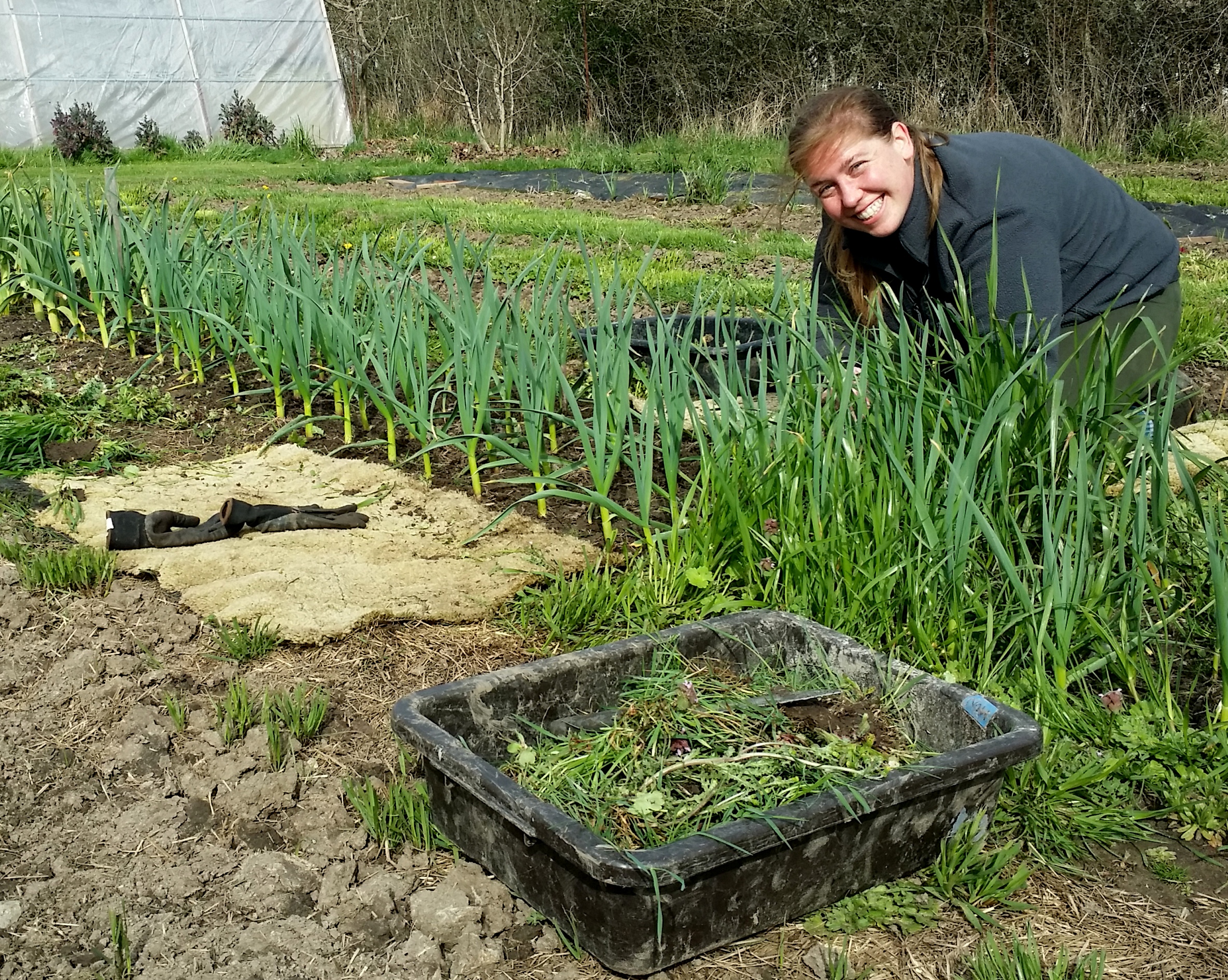
Jenny Hicks, a new friendly face; weeding the garlic patch.

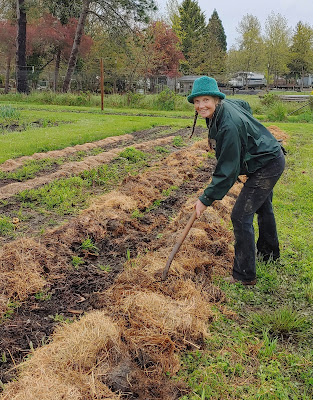
Llyn, in the rain, spreading donated wheat-straw to mulch our cucumber patch.

Suzanne, another new garden-friend, re-potting sunflowers.

Rook's still with us, entering his fifth season.

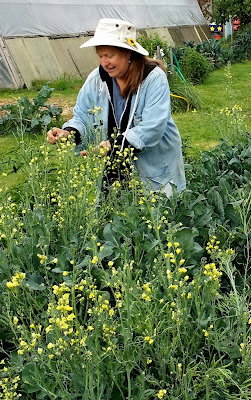
Sandra, in her second year, picking broccoli.

OSU Service-Learning is back! Oregon State University, in Corvallis has a unique offering through many of their classes. Students are asked to volunteer in the community and create a poster or slide-show describing their experience. For this they receive college credit. A typical Service-Learning group consists of 4-6 students for four hours. We had two groups in April of this year, our first since February 2020. It was wonderful to have them back!
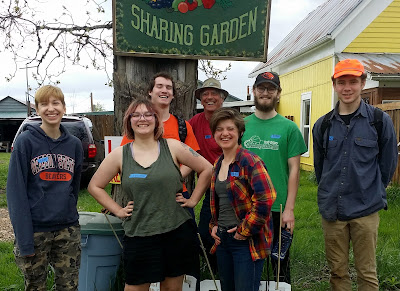
OSU Service Learning group, April 9th, 2022. The students always bring such positive energy into the gardens!

They help us with a variety of tasks...This year:
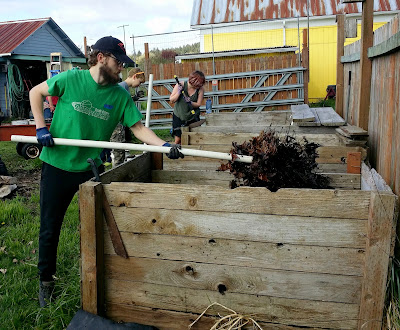
Students turning a compost pile...

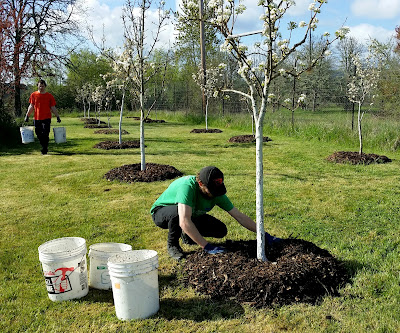
Spreading wood-chips at the base of our orchard trees.

The first group planted two rows of potatoes...
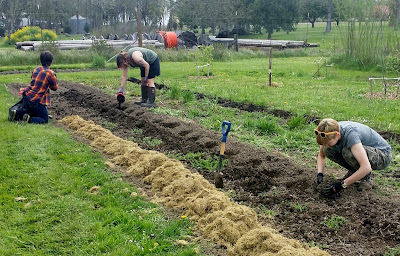
Potatoes "chitting" (collecting the sun's energy, for better sprouting - LINK for more info on planting potatoes).

They did a beautiful job of planting...Hopefully the April rains haven't drowned the plants.

Students re-potting sunflowers.

Sunflower plant Giveaway: Sunflower-pollen has the unique ability to protect certain types of bees from two types of parasites. They also provide food for many birds and the seeds can be harvested to eat or grown into sprouts. 

We've grown over 50 sunflower plants, both Autumn Beauties and Mammoth Russians to give away. The Autumn Beauties are from seed I (Llyn) harvested from a volunteer plant at our town's library a few years ago. So, as a way of giving back, and expanding our area's 'community' of sunflower plants:

We'll be giving away sunflowers through a collaboration with Monroe's Community Library. 

Mammoth Russians

Come to Storytime on Monday May 9th 10:30 am (380 N 5th St. Monroe, OR - 541-847-5174) for kid's stories about sunflowers, and the Give-away. 

Don't worry if you can't make it to Storytime, we're bringing plenty of plants and will leave them at the library till Thurs. May 12th so you'll have a few days to pick them up.

To learn Why growing Sunflowers is great for Bees...and how to grow and process sunflowers for birdseed and sprouts, CLICK HERE.  
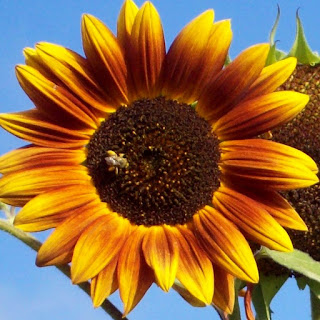
Autumn Beauty sunflowers

Our outdoor sunflower nursery: saw horses under the swing-set (till the kids come back this summer to reclaim it!)

Wood chips galore! A local tree-service company has chosen to make our parking lot their favorite place to dump wood-chips to share with the community. Bring buckets, totes or an empty pick-up truck bed! First come, first served. If you miss the current load, check back later as they'll be sure to drop off more.
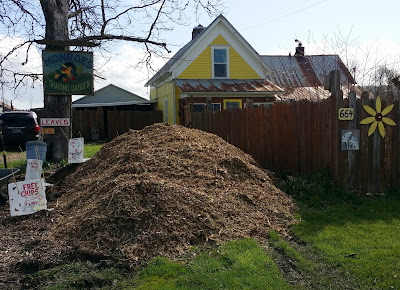
Come and get 'em!

And lastly, here are a few pictures showing the garden's seasonal progress...
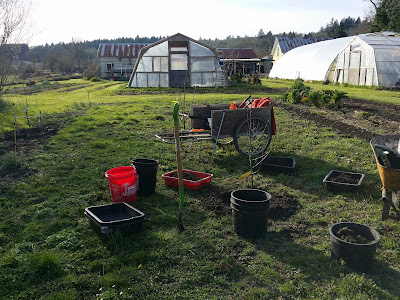
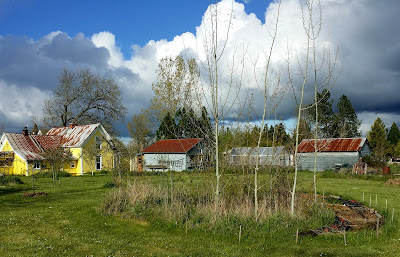
Planting fruit trees...

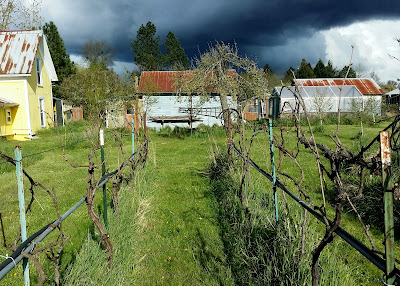
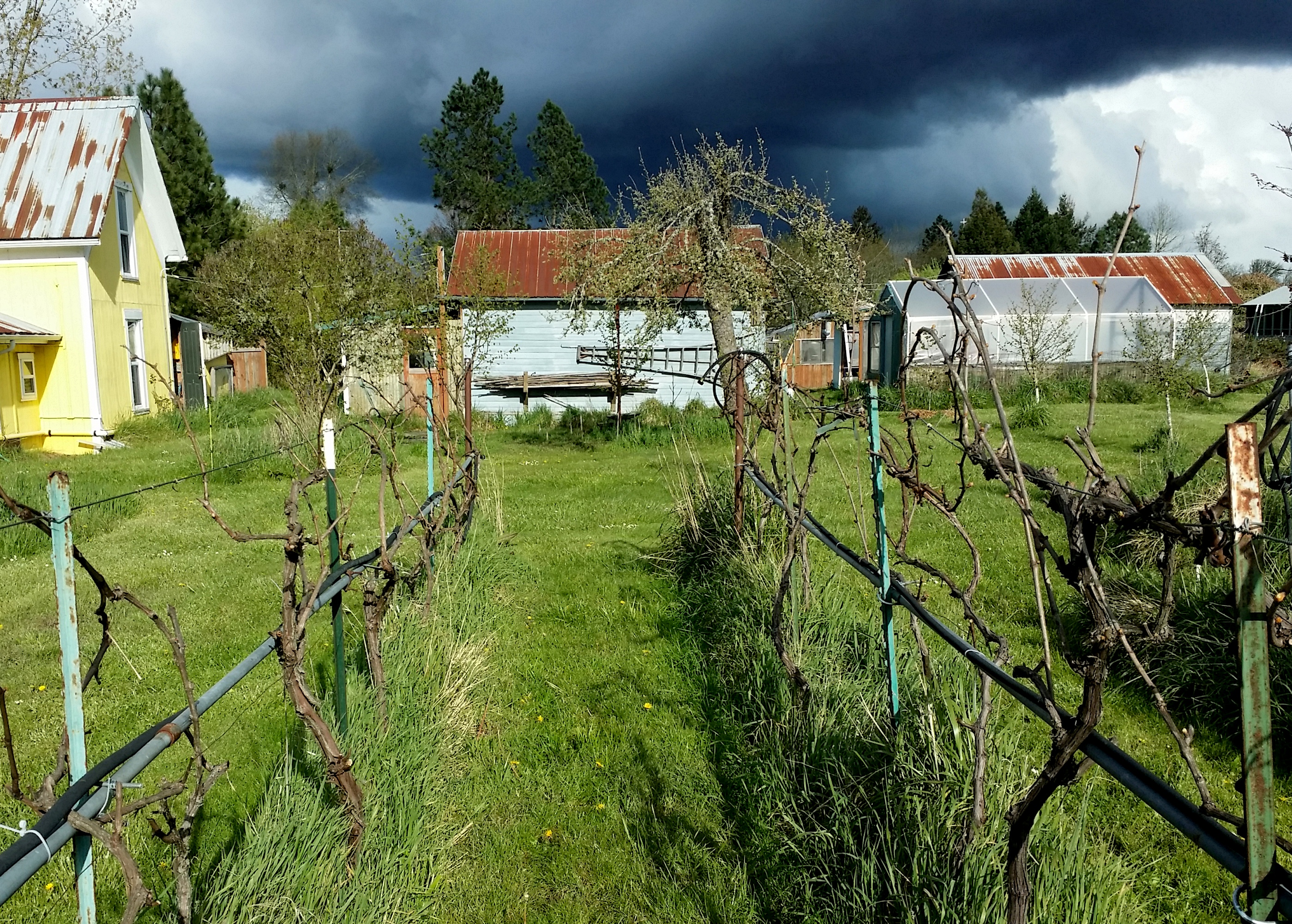
Pruned grape vines
A beautiful April sky at the Sharing Gardens.


Llyn's Mom sent us THIS LINK to an episode of Nature entitled "My Garden of a Thousand Bees". It is an absolute delight! A nature photographer during Lockdown films a full spring and summer season of native bees in his unruly backyard garden in London. The photography is amazing; the bees come to have individual personalities and the photographer is funny and humble as he explores this micro-world.

Friday, March 18, 2022

Garden Gallery - March 2022

Greetings garden-friends, spring has sprung in the southern Willamette Valley where we live. Daffodils and crocuses are in full bloom. Many of the seedlings Chris planted directly in our greenhouse beds are doing well and Llyn has started the heat-loving seedlings in pots in our other greenhouse. 

This post is comprised of a photo gallery of garden activities for February/March and relevant LINKS from previous posts we've written. Enjoy!

Bed-prep: We continue to prepare garden beds, both inside the greenhouses and out in the fields.

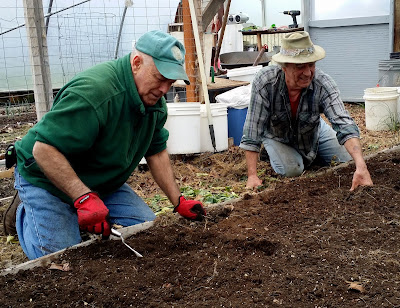
Donn and Chris fluff our raised beds after adding worm compost (made right in the paths of our greenhouses - LINK), coffee grounds and wood-ash - LINK. The soil in these beds is amazingly rich and has great tilth!
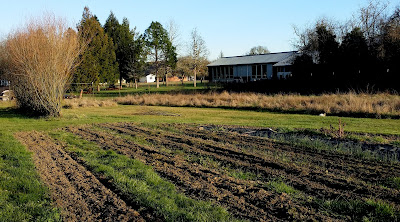
Here is one of our outside garden areas for heat-loving annual-plants (for example: squash, cabbage, broccoli, garlic, potatoes and more). We've been fortunate in that there have been long enough stretches between rain-storms for the soil to drain so we could roto-till these beds. This will make it easier to plant later in the spring and manage the weeds. That's a long row of basket-willow in the upper left corner of the picture.

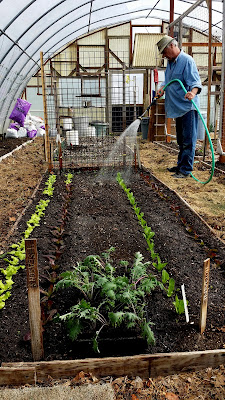
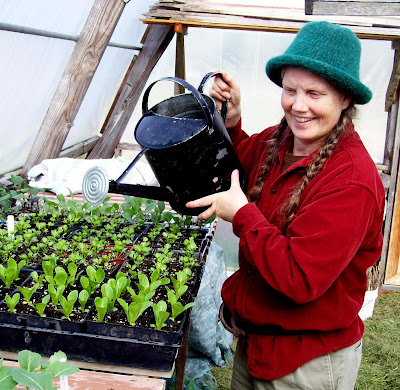
Starting seeds: February is time for starting seeds, directly in the ground in the raised beds in our greenhouses and in pots to be transplanted out later in the season. (Image right): Chris waters lettuce seedlings direct-seeded in the ground. Kale plants in foreground are volunteers that sprouted over winter. We have lots to share. Let us know if you want some.
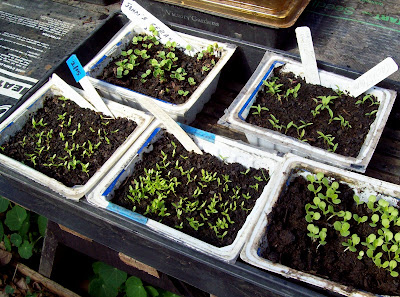
 

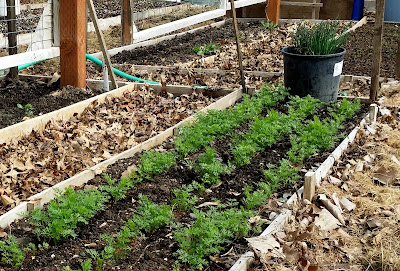
Carrot seedlings started in early February. Pot of chives at top, right of picture.

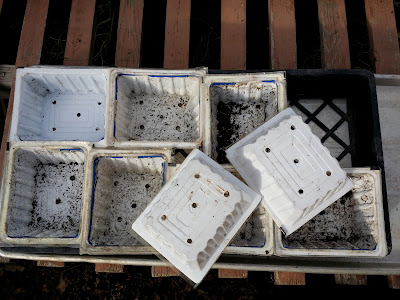
Some plants need to be started in pots on a heat-mat in order to germinate. We drill holes in the bottom of the plastic containers our tofu comes in and and start the seeds in them. Here's a LINK to a post about other ways to Repurpose Things for Re-use.

Later, once the seeds have germinated, we'll transplant them into larger containers so they have enough soil to develop strong root-systems.

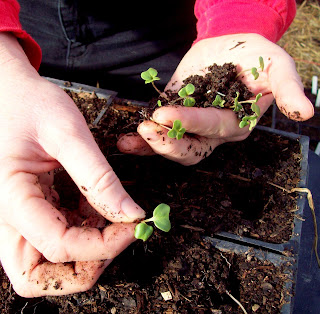
Transplanting seedlings takes patience but it's a lovely meditation too.

Sometimes we transplant into standard plastic pots...(here are lettuce seedlings in 6-packs)...

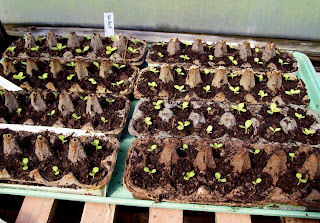
...but egg cartons make great containers for seedlings that don't have a big root system such a s lettuce. The seedlings' roots will grow right through the egg-cartons so all you have to do is tear off a section and plant it directly in the ground.

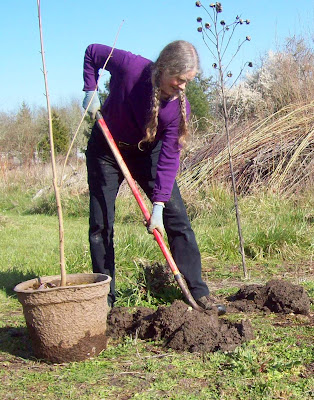
Planting perennials: If the ground isn't too wet or frozen, January through March are all good months to plant out perennial plants including trees, shrubs and flowers. In the winter, these plants are still be dormant in their pots (or bare-rooted if bought directly from a nursery). This year we have added three more apple trees, a quince and two varieties of plums to our orchards. We have an English walnut, several American chestnuts, a fig-tree and lots of yellow willow that we grew from seeds and cuttings that are ready to go in the ground. And, as for flowering perennials we're expanding our Showy milkweed and Echinacea plantings, also grown from seed.

Llyn, planting trees.

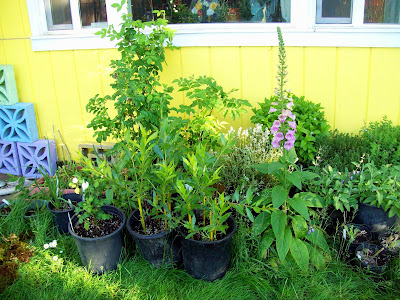
Our perennial plant nursery (summer). All these plants grown from seeds and cuttings benefit from a full year in pots to develop their root systems before being planted in the ground. Our nurseries receive plenty of indirect sunlight through the summer but don't like full sun as it can stress them in summer's heat.

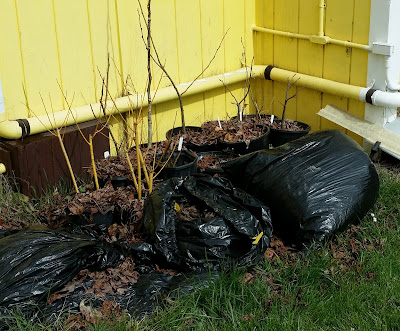
In the winter we move perennial-pots into a sunny place protected from the coldest north winds and surround the pots with bags of dry leaves for insulation.

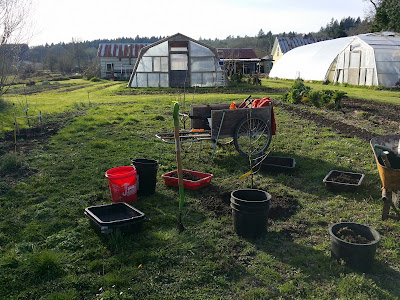
Our new orchard (foreground). We've had to convert some of our garden space into an orchard because we have an invasion of field bindweed/morning glory (Convolvulus arvensis LINK) which can choke many annual plants.

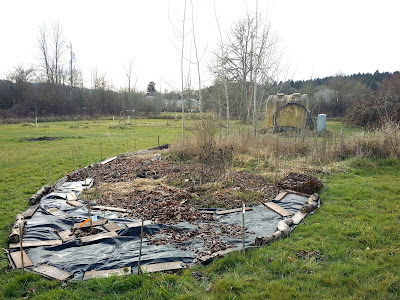
We are also creating areas dedicated primarily to wildlife habitat. The black plastic is lumber-wrap we collect for free from the garbage dumpsters at lumber-yards. It blocks sunlight to the plants below thus discouraging grasses and weeds from growing between the desirable perennial trees, shrubs and flowers and bulbs we've planted. It will be removed after one year and mulched heavily to slow down the inevitable re-invasion of grasses and weeds.

Pruning: Winter is pruning-time for our fruit and nut trees and grape vines.

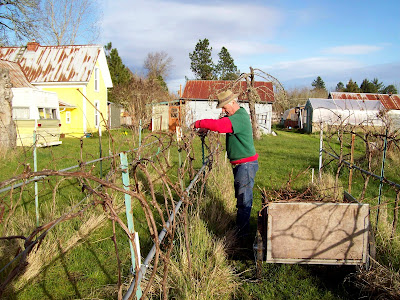
Chris, pruning grapes. For an excellent grape-pruning tutorial, see LINK below.

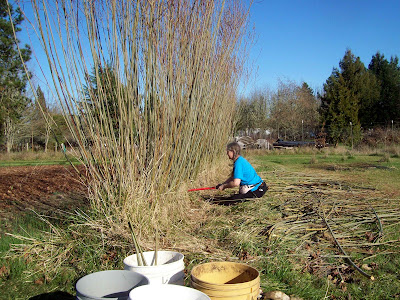
Llyn, pruning our 70' row of basket willow (Salix purpurea LINK). We harvest it every year to make living fences, to start more rows of willow along the edges of our land and occasionally to make baskets.

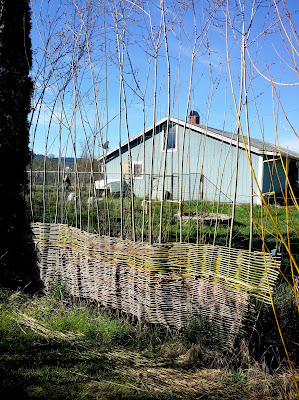
We're making a living fence (above) with basket willow to give us some privacy from our neighbor's yard. the uprights are actually rooted in the ground, planted approx. 8" apart and will live for many years. The horizontal "wattles" are cut fresh from our willow nursery (see above) and woven between the living uprights. They die and dry in place.
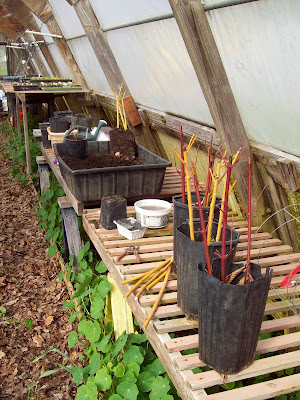
Time to plant cuttings and seedlings of perennials into pots to grow out their roots for next year's plantings. Pictured: yellow willow that grows wild along stream beds in western Oregon, and Red Osier Dogwood (Cornus sericea LINK)

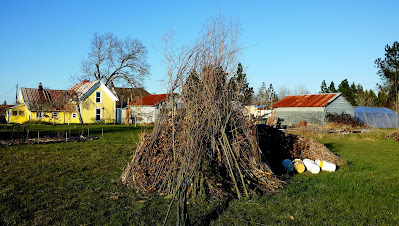
All the prunings are piled in a large brush-pile where they dry out through the summer while providing habitat for ground-nesting birds and bunnies. In the autumn, once it's legal to burn again, and animals are no longer nesting, we'll set the pile on fire.

Repairs and organizing:

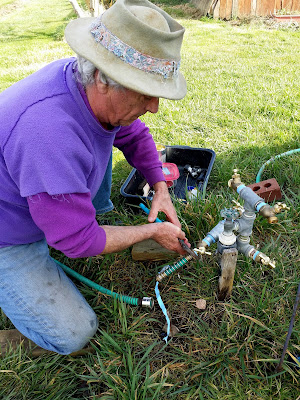
We finally got around to investing in, and installing brass hose-bibs for our garden faucets. These will last much longer than the plastic ones we had been using and prevent drips/leaks which waste water.

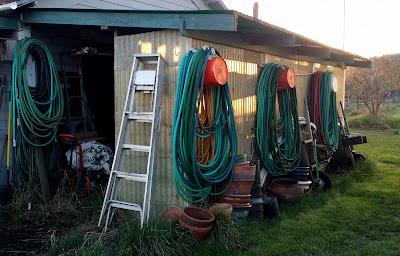
We use the winter to reorganize both inside and outside areas of the gardens. These hose-hangers are made from foot-long shelf brackets screwed into the upright 4"x4' posts with 5-gallon buckets hung on them. We can put a lot more hoses on them and the buckets keep the hoses rounded instead of kinking into tight bends.

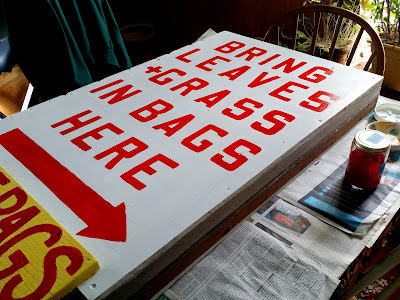
Time for repainting all our signs too...

LINKS for early spring: Here are links to posts we've previously written, relevant to this time of year.

Organic Solution to Slugs - Iron Phosphate - Having trouble with slugs eating your early spring plants? We've had great success with iron phosphate (commercially known as Sluggo).

Early spring is time for Mason bees to emerge from their tube-nests. Here's an article written by a local friend of ours who's had great success at encouraging these docile pollinators to thrive on her land.

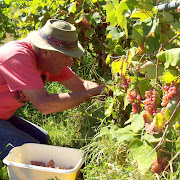
Here's the best video we've found on how to prune table grapes (and we've watched quite a few!).  Easy, straight-forward instructions which will allow you to confidently go out to your grape patch and tackle the tangle of vines that have grown since last year (or the last time you attempted to prune your grapes). 

On the lighter side... Here is a LINK to a video about Infectious Laughter on a Train


Saturday, March 5, 2022

Corvallis Garden Resource Guide: Goods, Services, and Learning for Food Growing

The print version of the garden guide is back! For more than 10 years, the Sustainability Coalition’s Food Action Team has produced a comprehensive, locally-focused Corvallis Garden Resource Guide: Goods, Services, and Learning for Food Growing. The 2022 guide can now be picked up at the Corvallis-Benton County Public Library, viewed as a PDF online, or printed in high resolution booklet format.


The guide includes resources for growing vegetables, fruit, herbs, mushrooms, poultry, and bees. It emphasizes organizations and businesses that are local, organic, unique, and perhaps not as well known as they should be. Intended for both new and experienced gardeners, the guide is divided into sections for easy reference.
  • If you’re new to gardening or want to learn new techniques in the off-season, you might want to start with Gathering Knowledge on page 3. “Getting Started” provides a starting point for folks about to turn their first beds. In addition to learning centers offering classes and workshops, the guide lists a selection of locally available gardening books with an emphasis on regional focus and local authors.
  • When it’s time to work the soil and plant the seeds, turn to Getting What You Need on page 7. The local farm and garden centers are one-stop shops, and multiple local and regional companies offer supplies, soil, amendments, seeds, and plants.
  • Gardening doesn’t need to be a solo activity or limited by a lack of space. Growing Together on page 15 includes listings for neighborhood gardening groups and community gardens.
  • When you’re swimming in rhubarb or tomatoes, turn to Harvesting the Bounty on page 17. The listed resources will help you preserve your surplus, donate to those in need, or make a little money at the farmers’ market.
  • Chickens and ducks don’t exactly grow from the soil, but they go hand-in-hand with backyard gardening. If you have a flock or are looking to buy chicks, turn to the Backyard Poultry section on page 19.
  • Beekeeping (page 21) continues to grow in popularity among gardeners wishing to harvest honey and ensure good pollination. For those willing to brave the stings, Corvallis has a local equipment supplier, a bee club, and plenty of learning opportunities.
No matter your level of experience or particular interest, there’s something in the guide for anyone who wants to grow their own food. Pick up your copy of the Garden Guide at the public library - or go straight to the online version at Garden Resource Guide | Corvallis Sustainability Coalition (sustainablecorvallis.org)Enjoy!

Monday, February 28, 2022

Mason Bees - The Friendly Pollinators

Mason Bees appear like a big house fly with a greenish black shine to them.
(Guest writer: Linda Zielinski) Did you know that Mason Bees (Osmia lignaria) are one of the most common hole-nesting bees? They are wonderful pollinators, especially for apples and pears. Researchers claim they can be up to 90% more efficient at pollinating than honeybees due to the fact that Mason Bees will forage in light rain and at cooler temperatures than honeybees and other pollinators. If you are worried or concerned about getting stung then this hard working little Mason Bee may be just what you and your flowers and vegetable gardens are looking for. Mason Bees are not aggressive since they are a solitary bee and are not defending a queen. They are considered quite docile. 
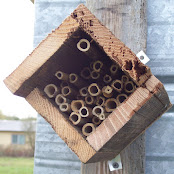
Linda's nesting boxes are hung under the eves, on the southeast side of a shed so they get sun and are protected from prevailing winds/rains. Insets show other styles of nesting boxes.
Nesting boxes for Mason Bees:  I have quite a few nesting boxes. My nesting boxes are hanging under the eaves of my pump house facing towards the southeast so they can be warmed by the early morning sun and protected from direct rain.  Mason bees are easy to care for. You can make new nesting boxes by using a drill press and a 5/16 bit and blocks of UNTREATED wood. You may also purchase nesting straws. I have found the straws at the WildBirdsUnlimited store in Corvallis. For right now I have placed 2 new nesting boxes and a package of straws for the ladies to use as new homes for their eggs. As these begin to fill up I will continue making new boxes. Last year the girls were so prolific that I had to make several new nest blocks 3 different times.
Chris hangs nesting boxes at the Monroe garden
Mason Bee life cycle: This year, my Mason Bees began emerging in early April. The males hatch out first once our temperatures get above 55 degrees for 3 days in a row. The females seem to understand that it is important to lay female eggs at the back of the holes and lay the male egg at the front of each hole. This assures the survival of this species as it only takes one male to mate with several female Mason Bees. Once the weather begins to warm and the males emerge they then wait around for several days for the females to chew through their cocoon and then chew through the mud wall that divides each egg cell until they reach the end of the nesting hole and crawl out to live their short productive life in our wonderful Willamette Valley. The males then fly around chasing the females in a mating dance.
 
Once the males have mated their job is complete and they die. The females immediately begin gathering pollen and laying eggs. They do not excavate holes but look around their environment for a 4-6 inch-long space that is approximately 5/16 of an inch in diameter. They are often seen crawling up under house shingles. No need to worry though. They do not damage your siding but are merely looking for a safe, dry place to lay their eggs. After she has gathered pollen she will return to the nesting tubes/boxes, fly into the holes and turn circles inside which helps the gathered pollen fall off her body as she wiggles her way to the end of the tube. 
Mason Bee larvae with pollen-ball for larval feeding. Image courtesy of Red58Bill.
There she will lay her tiny egg and put a pollen ball on top of that. She will leave about a 1 inch space and she then make a 1/4 inch mud plug to wall off that egg, hence the name "Mason" Bee. For the next 8-10 weeks these busy ladies continue gathering pollen and nectar. Sometime towards the end of June their life's work is over and they die. During the summer months the eggs develop into larvae. The larvae feeds on the pollen and nectar and develop into pupae. The Mason Bee pupae develop into bees protected inside a cocoon. They hibernate over the winter and emerge sometime towards the end of March or early April to start this marvelous life cycle over again. 
 
HappBee Gardening. Linda Zielinski
 
Linda Zielinski is an avid Mason Bee 'farmer' who lives in Philomath, Oregon. She generously provided the "Sharing Gardens" with a starter house of bees which we hope will multiply so we can spread them around the valley and help other gardeners get them established. Thank you, Linda, for writing this article about the bees for us to post on our site.

Note: This was originally published on this site, April 13, 2012. 

Wednesday, February 9, 2022

Onions and Lettuce and Peas, "Oh My!"

Reprinted from February 2021: It's early Spring in the Sharing Gardens. Oh sure, we could still get plenty more freezing nights and even some significant snowfall before Spring is fully here but the first crocuses and daffodils are budding, the days are noticeably longer and the air carries hints of the earth's slow warming.  Since we have several greenhouses, February is the time for starting the cool-loving crops like lettuce, cabbage, kale, broccoli, collards, celery, parsley, onions and peas. We have also seeded beets and carrots directly in the ground in greenhouse beds. Here are some previously written posts about how to start some of these crops in your own garden.
 
An early crop of red and green lettuce grown in our greenhouse.

Lettuce and other seedlings, Spring 2012
Our first CSA box-2018.
Please note that, while we do our best to update our posts to reflect our current methods, gardening is a dynamic art-form which we're always developing and these posts may not reflect our current practices. Happy gardening!

Valentines Day: Time for Pea Planting: Since our soil outside the greenhouses doesn't really warm up enough to germinate peas till later in the Spring, we've developed a method for starting the peas in pots, in the greenhouse which we then transplant outside once the soil warms up and the plants can outgrow slugs and snails. Valentine's Day: Time for Pea Planting LINK

John and Llyn transplanting peas grown in pots, in our greenhouse.
Lettuce: Growing from Seed: Lettuce is fairly easy to grow in our climate. You won't believe how sweet and delicious home-grown lettuce is compared to lettuce bought from the store! LINK

Lettuce: Saving Your Own Seed: If you leave a lettuce plant in the ground, very often it will "bolt" and go to seed (especially in the heat of summer). Lettuce-seed is easy to save and one plant can produce enough seed to grow lettuce for a whole neighborhood for years to come! That's "nature's economy" at its best! LINK

Delicious, home-grown lettuce.
Onions: Growing from Seed: Here's a method of growing onions from seed that will also produce copious amounts of onion-greens as well. LINK and LINK

Onions, grown from seed.
Carrots: growing from seed:  This post includes instructions for preparing the ground for carrots to grow and a short video-clip about planting carrots. LINK

Wish List: Spring is a time for cleaning out one's sheds and closets to make room for the new. Here's an updated wish-list of items that we can use in the Sharing Gardens or pass along to other gardeners in the area. Let us know if you can use anything and we'll see if we can help you out. Wish List

The Sharing Gardens is a registered non-profit and tax-exempt organization. We exist primarily through donations. If you have found benefit from our project or our site, please consider making a donation through PayPal. A receipt will automatically be provided for your records. (Click button below.)