A unique and viable approach to establishing local food self-reliance and building stronger communities.

Wednesday, January 1, 2025

Winter at the Sharing Gardens

Our newest greenhouse - the Sunship - Sept. 2016
Hi all - We are re-posting this winter garden update from January of 2017 since it gives a great summary of the kinds of tasks and projects that fill our time at this time of year. Enjoy!

Greetings everyone! Here we are heading into our ninth year with the Sharing Gardens, Can you believe it? From our humble beginnings at Alpine Park, with an 80'x80' garden-plot, an 8'x8' greenhouse, a handful of tools and willing spirits we've grown to the thriving, expanded project we are today.

In the beginning, we didn't even have pictures to use on our website so borrowed photos Chris had taken in previous gardens. LINK to first Post - A Seed is Planted Our readership has steadily grown over the years and is currently experiencing a surge in readership that peaked with over 17,000 site-visits in December 2016 alone! It has tapered off slightly since this peak but we are still averaging 300 visits per day. These visits come from all over the planet both for practical gardening knowledge and for inspiration about the power and joys of generosity.

Home-grown dinner!
This post features info about what happens at the Sharing Gardens during the winter months. Enjoy! From December through about mid-February, activity in the gardens is minimal. Here in the Willamette Valley of Oregon, our winters are typically cold and rainy (with occasional snow and freezing temperatures) and the shorter day-lengths mean that any plants that are still growing in our greenhouses (kale, fava-beans) just maintain their current size, without adding any growth until days get longer.

So, just what DO we do to prepare for the coming Spring?

Because we practice a style of gardening that requires deep mulch, even in our greenhouses, the winter is time for preparing beds. Preparing Garden Beds - One Low-Tech Way-LINK
 
Our largest greenhouse with tomato plants on left, peppers and fig-trees on right. October 2016.
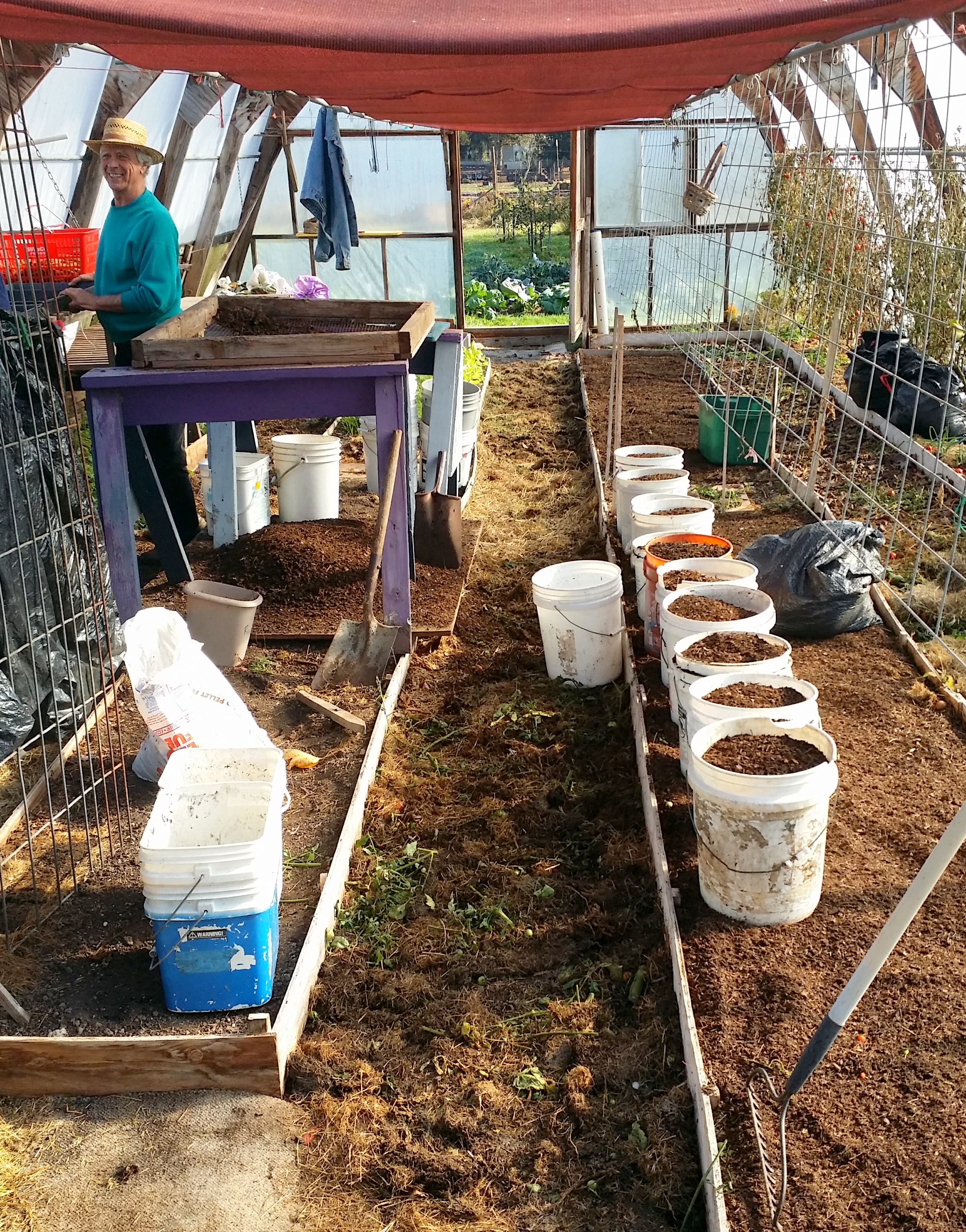
As the season comes to a close, and the last of the summer crops have been harvested, we rake away the left-over straw from the paths of the greenhouses. We remove cages from the tomato and pepper plants, cut them off at ground level and cut them stems up in 6" - 8" pieces and put these pieces in the paths underfoot. The stems are too course to decompose by planting time which is why we don't cut them in the garden beds. Cutting them speeds up decomposition and, by the time plant-roots are reaching out under the greenhouse paths, the stems will be almost entirely broken-down.

The next step is to cover the paths with the straw raked off prior to cutting up the plants. Clear any remaining straw, or plant matter off the greenhouse beds. The garden-beds - where we'll be planting in the spring - are generously sprinkled with coffee-grounds, and a dusting of wood-ashes.

Greenhouse beds covered in 1/2' coffee-grounds and a light dusting of wood-ashes.
We have been experimenting with creating greater soil-fertility using coffee grounds and wood-ashes. Coffee grounds are available for free from most coffee-shops; they're grateful to have someone come pick them up! And though they're not sustainable, they are a free resource at this time. For some reason, red-wiggler worms (also called manure worms) just love coffee! If you spread it liberally on your soil, they will migrate to find it. Their worm poo (castings) provides many nutrients that plants love and the tunnels they make help aerate the soil. Wood ashes should be used sparingly; they are very potent but provide a bounty of minerals to the soil.

Worms love coffee grounds!
Coffee grounds provide generous amounts of phosphorus, potassium, magnesium, and copper. They also release nitrogen into the soil as they degrade. When we have it, we spread it about 1/2" thick. We also layer it into our compost piles. Coffee grounds - Will They perk Up Plants - LINK

Wood Ashes provide all necessary nutrients except nitrogen and sulfur.  We use ashes from our wood-stove (that heats our house). We use only newspaper to start the fires and burn pure wood. We don't burn anything with paint; no ply-wood or other man-made products so the chemicals in them don't get into our food-chain. We sift the ashes to remove any big chunks, nails or screws. Be very careful not to use too much! We put just the lightest dusting in our beds. Do not use wood-ash to make a potting soil. It is caustic to worms and will alkalize your soil so use only a little and wait before planting seeds or seedlings. Do not use around acid-loving plants (like blueberries, or in potato-beds). Article from our local University Extension Service: Wood Ashes Can Benefit Lawn and Garden

Chris adds leaves to the greenhouse-beds - about 6" is ideal.
Next we add a thick layer of leaves, a layer of straw and, if we have it, green-grass clippings and more coffee grounds. Ideally we cover each garden bed with a layer of carpet, or cardboard - to keep in moisture and hasten decomposition, but sometimes we just leave the rows open to the air. All this organic matter is slowly eaten from below by worms and fungi and bacteria. In the spring, these beds will be ready to plant our new crops.

December 2016. Note trellises for winter-peas, a re-purposing project from an old chicken-coop (from left, to center). Light-green carpet covers row in lower-right corner.
Winter is also a time for pruning our fruit trees and blackberry bushes. Pruning helps fruit trees stay healthy and productive. Almost all our fruit trees were mangled by deer in their first year and a half so we still haven't had much fruit from them yet. Most of them have lots of fruit-spurs this winter so we're hoping that 2017 brings more fruit. In a few years' time, our 3-dozen apples, pears and plums should yield enough surplus that we can share the bounty with local food-charities.

 August 2016. Here is our first harvest from an Asian pear we planted in 2014. Not much, but they sure were delicious!
We've been enjoying herbal tea made from rosehips and fennel-seeds we grew and dried. Here are rosehips from rosa rugosa a hedge-rose that grows well in our climate that we started from seed three years ago.
October 2016. In mid-Autumn, we mulched most of our outdoor garden-beds with leaves and straw so they will be ready for planting in the spring. Chris looked under this straw just last week and found many worms! Even though the ground is saturated from winter-rains, the worms thrive at the surface where the straw meets the ground.
January/February is the time to plant biennial, root-crops for seed.
Carrots, beets and onions all produce seed in their second year so you must save them in your refrigerator or a root cellar and re-plant them to grow-out for seed. We plant them in gallon pots in January or February and than transplant them into the ground later in the spring. Seed-harvest occurs through much of the summer-months.

Tomatoes, peppers and squash make a bright compost pile!
We continue to build our compost piles. We don't have as much material to add to them at this time of year as the garden-debris has mostly been collected. The bins we are filling now won't be ready to use in the gardens till summer-time but you can never have too much!

We continue to process food for long-term storage. Llyn likes to make pumpkin-pie filling for freezing. In early January she noticed some of our Provence squash was showing signs of rotting so she had a marathon session and froze ingredients to make 22 pies. Yum! Making Pumpkin Pie from Scratch - Recipe - LINK

Baking Provence squash, a favorite for pie! Yes, it really is that orange, and so sweet!
Winter is also time for indoor-construction projects. Below, is a wood stove that Chris made from a kit that comes with legs, a collar and door for the stove. Holes must be cut out of the barrel using a metal-cutting saw. We purchased a used barrel from a food warehouse and Chris discovered that the barrel we bought for $4 had almost a gallon of honey still in the bottom which he drained and we enjoy on our toast!

 Here's a wood stove that Chris made from a kit.
Cleaning and lubricating hose-fittings, valves and timers so they'll be ready to use in the spring.

Each summer we dedicate a sizable amount of garden space to crops that store well: winter squash, potatoes, beets, carrots and storage onions to name a few. We want to be able to augment the Food Pantry's fresh produce offerings for as long as possible when their donations from other local sources begin to diminish. To be honest though, by the time all our share-givers receive their share of winter crops, the only thing we really have surplus for the Food Pantry is winter squash. Perhaps in future years we'll be able to increase our output, or other local gardens will join us in the project and dedicate a row of their space to storage crops to share.

Last week we delivered the last of our winter-squash and hot-peppers that we had saved to share with the Food Pantry. Because we plant our peppers and tomatoes in greenhouses, we can harvest them after everything outside is drooping and dying from heavy Autumn rains. We do have to harvest them before the first hard-freeze or they'll rot on the plant, even in the greenhouses. Our last harvest this year was December 6th!

The last of summer-harvest! Dec. 2016.
We are so grateful that the winter solstice has passed and that days are getting longer! In another six weeks (mid-February) it will be time to start seeds again for cool-weather crops (onions, cabbage, broccoli, lettuce, to name a few). Still plenty of time to finish our pruning, paint some more signs, clean and organize our garden-sheds and workshop and perform other maintenance tasks.

August 2016. Can't wait for next year's tomatoes!
The Sharing Gardens project is a unique model of community garden that is 100% non-commercial, uses local materials for soil-fertility, provides thousands of pounds of free produce to local food-charities and encourages gardening as a way to increase wildlife habitat. 

Monday, November 4, 2024

Free woodchips for our town!

We are so grateful to M.R. Tree for delivering wood-chips to the parking lot we share with Heritage Hall for the free use of anyone in the Monroe area. (The Sharing Gardens - 664 Orchard St.)

Here are a few guidelines to make this work for the whole community:

-Take from the front of the pile (closest to Orchard St.). Then, when the Tree-people drop off more, there's room at the front for them to drop their load.
- Share with your neighbors. If you take a large load, wait a few days before coming for another load so that people who have busy schedules have a chance to get some too. If the pile doesn't get any smaller after a week, feel free to come back for more.

Sticks: If there are un-chipped sticks in the pile and you don't wish to take them, please make a neat pile to one side or the other that will make it easy for us to dispose of them. 

Thank you for your cooperation. With your help we can make this program sustainable for the community to enjoy for a long time.

Though our initial purpose for forming the Sharing Gardens was to provide free fruits and vegetables to food charities, we've always wanted our project to be helpful and relevant to other folks in our community who don't shop at the Food Pantry. In the last few years, we found a way.

A free wood-chip pick-up and drop-off site!

We share a large parking lot with the S. Benton Food Pantry which provides easy access both for the chip-trucks and neighbors with trailers to turn around in.

The Sharing Gardens shares a large parking lot with the Community Center/Food Pantry next door.

This program has benefits for everyone involved:
it saves the tree companies the time to drive an extra 25 miles to the closest municipal-scale composting facility, and the money they charge for yard-waste deposits ($70/load!). And our neighbors have a reliable source of free wood-chips at an easily accessible site.

Tree companies are able to easily drop off a load of wood chips and our neighbors also can get close for loading.

Sandra and Jenny help Jim load wood chips onto his trailer.
We hope the program can continue indefinitely!

Thursday, October 31, 2024

Autumn Pleasures: Recipes and Tips for Stocking-Up

Recipes for: Pumpkin Pie, Crumb-free Cornbread, Amazing Quince and 'Nooks and Crannies' Hot Cereal

Autumn is a time for enjoying the bounty of the garden. Every bite of cucumber or tomato takes on special pleasure knowing the season is almost at an end. We enjoy preserving foods for later consumption; whether through canning, dehydration or freezing. It's also a time for seasonal favorites like pumpkin pie from scratch. Here is a collection of relevant posts to expand your autumn pleasure and help you squirrel away some of the season's bounty for leaner, winter times. Enjoy!


Stocking up:
Whether your motivation is to ride out a short-term power-outage, make less frequent trips to the grocery store, hedge your bets against the rising cost of food by taking advantage of sales or just to avert that sinking feeling when you go to your cupboards and there's nothing you really want to eat, this Tips for Maintaining a Well-Stocked Pantry offers many simple ideas and habits to keep your pantry 'topped off'. Note: the link will take you to All Things Sharing, our blog about positive things happening in the world.

Autumn at the Sharing Gardens; a time of beauty and bounty!

Amazing Quince! - Sugar-free Recipe (LINK): Many people are unfamiliar with quince though it's becoming more popular. Its tart apple flavor has undertones of pears and rose oil. It can be cooked into homemade applesauce, dehydrated for fruit leather or be baked as a stand-alone autumn treat. Be sure to read the full post and comments to read about other recipes and improvements we made on our methods of preparation. Nutritional benefits of quince. (image LT: www.modernfarmer.com)

Making Pumpkin Pie from Scratch - Recipe (LINK)

Pumpkin Pie recipe: Though it's a lot easier just to open a can of pumpkin puree to make your favorite pumpkin pie recipe, there's nothing that compares with the satisfaction of growing your own (or buying from a local farmer) and making enough puree as a base for pies all throughout the fall and winter. This post will help you avoid making common mistakes: Making Pumpkin Pie from Scratch - Recipe. (image RT: Llyn's niece, Jesse during her first autumn harvest, 4 months old).

Mix up a big batch of the dry ingredients for Crumb-Free, Whole-Grain Cornbread Recipe and you'll always have it on hand for a quick baked treat.

Cornbread recipe: We make large batches of the dry ingredients for this delicious Crumb-Free, Whole-Grain Cornbread Recipe. This makes it easy to just add the eggs, oil and other liquids, pop it in the oven and have a comfort-food snack or side dish for a larger meal, a quick dish to take to a last-minute pot-luck invitation or unexpected guests.

We grow two kinds of corn for our hot cereal. Hooker's Blue (left) and Golden Bantam (right). Though we've tried to keep the strains pure, corn is notorious for cross-pollinating, hence the variety in color. Grow your own Sorghum for grain and flour (LINK)

'Nooks and Crannies' hot breakfast cereal RECIPE (LINK): This recipe for hot cereal starts with the basics: mixed grains,nuts and dried fruit but it goes much further, offering suggestions for toppings that will make this a delicious power-house of nutrition that provides energy all morning long. Though we've been fortunate these past few years to grow enough of many of the ingredients ourselves, you'll find almost everything you need in a well-stocked bulk-foods section. Remember to buy organically grown ingredients: better for your health and better for the Earth. (RT: Tiffaney removing corn from the cobs using a homemade tool.)


And lastly, though not part of the main topics of this post, here is some really inspiring news about a river in England that was encouraged to return to its original meandering course. Not only did this encourage many kinds of wildlife to return but the new river's pathway and the subsequent wetlands this created served to mitigate flooding of the downstream towns and villages during record-breaking wet years of rainfall. (Note: the link will take you to All Things Sharing, our blog about positive things happening in the world.) LINK: What happens when you set a river free?

Double-rainbow seen to the north of our land.

Thursday, October 24, 2024

Tips for Maintaining a Well-Stocked Pantry

The autumn season always brings out the 'inner squirrel' in me! Time to clean out our pantries and use up or pass along to others anything getting close to its 'best by' date (or, if past that, compost or toss it out). Once clean and organized, I love restocking our pantries with the many foods we've harvested and preserved over the summer.

But even if you don't have a lot of food you've grown or preserved yourself, autumn is a great time to take refresh your pantry. Seasonally, it just 'feels right' and at least in the U.S. there are lots of holiday sales on food you can take advantage of.

Regardless of the season, whether you’re concerned about preparing for a natural disaster or economic hard times, or just tired of opening your cupboards and not having a variety of tasty, nutritious items to choose from, it’s always a good idea to get in the habit of stocking and maintaining one’s pantry. Here are some tips to help: Tips for Maintaining a Well-Stocked Pantry

Wednesday, October 23, 2024

How we grow...Veganic Community-based gardening

The Sharing Gardens is based on the concept of mutual generosity; building relationships through the sharing of time and resources. One of the ways we demonstrate this is through our process of building fertility in our soils.

Since 2020 we have grown all our food "veganically" and without the use of commercial fertilizers. This means we use no livestock manures (cow, chicken, sheep etc) and no animal by-products (blood or bone meal etc) or any products mined or shipped from distant lands (gypsum, bat guano etc.). Being vegetarian, and committed to deriving our food from local sources whenever possible, this way of growing food just makes sense to us!

Most of our garden's fertility comes from leaves...
Our system is simple: the majority of our soil's fertility comes from leaves and grass which we compost in large wooden bins or in the paths of our greenhouses. 

...and grass clippings.

The challenge is in gathering enough materials. Here's where the mutual generosity comes in! We provide a drop-off site for our neighbors and yard-maintenance companies to bring their leaves and grass. This means they don't have to pay to have these valuable materials hauled away in trash cans, or deposited at the closest municipal-scale composting site (25 miles away). We receive these materials in abundance and are able to extensively mulch and compost our garden beds, create our own potting mix and have enough compost to share with the volunteers in our gardens who have small gardens of their own.
Besides composting yard waste in large wooden bins, we spread it in layers in the paths of our greenhouses which turns to compost beneath our feet. Donn: spreading grass clippings in the SunShip greenhouse.

Compost is scooped up from the paths in the autumn, sifted and bagged for use throughout the coming season.
Craig, sifting compost.
When people drop off their yard waste in plastic lawn/leaf bags
, we hang them to dry on clotheslines in our greenhouses. Once dry, we roll them into bunches of 5-6 bags, twist-tie them together and put them in a covered barrel at the drop-off site for our neighbors to take for free and use for future loads. This helps reduce our community's use of plastic.

Llyn, folding leaf bags for re-use.

We place a sandwich-board sign out on the street, inviting neighbors to bring us their  leaves and grass. Touching up the paint is a winter task...

Barrel on the left holds free bags that have been dried and rolled in bundles for people to re-use. We ask people to leave the bags untied and to turn them upside-down to prevent rain from getting in.

To read a detailed post about our veganic soil-making methods, CLICK HERE.


A small percentage of our soil  fertility also comes from coffee grounds collected from coffee shops by friends of the Gardens and wood ash (left), a by-product of how we heat our home. Here is a LINK explaining the benefits of these free resources.

We're so very grateful to all our neighbors who have participated in this program this year.


Tuesday, October 22, 2024

Crumb-Free, Whole-Grain Cornbread Recipe

Yummm!
Here is a recipe I developed over the years for a delicious, whole-grain corn-bread mix. I make it in bulk, pre-mixing all the dry ingredients so, if we want a loaf for breakfast or guests, or potlucks, it's a simple matter of adding the wet ingredients and popping it in the oven.

For best results, use all 'organic' ingredients. Most corn grown in the United States that is not-organic, is GM (genetically modified) and both corn and wheat, even if not GM is often grown with heavy pesticide use. "Organically grown" means: good for your health; good for the health of the planet!
We grow our own blue-corn for meal.

Corn Bread Mix (makes enough for about 13 loaves).

In a large bowl, measure and mix thoroughly:

3 cups All Purpose Flour
2.5 cups Whole Wheat Pastry Flour
2 cups Corn Flour
3/4 cup Yellow Corn Meal
3/4 cup Blue Corn Meal

Mix all the flours and meals together thoroughly. I like to use my hands!

In a smaller bowl, measure and mix thoroughly:

2.5 cups Brown Sugar
3/4 cup Coconut Flour
1/2 cup Baking Powder
2.5 teaspoons Salt
1.5 cups Ground-Seed Mix (1/3 cup Poppy seeds, 1/3 cup Chia seeds, 2/3 cups (and a bit) of Flax seeds - See note below.)

Mix  the two bowls of dry ingredients together. Take extra-care to be very thorough in this mixing process, otherwise you may have some loaves that don't have enough baking powder to rise well, or a loaf might be too salty (or not salty enough). Store in an airtight container, in a cool place out of direct sunlight. Corn products are especially susceptible to rancidity.

Recipe uses a 7.5" x 4" mini-bread pan

Recipe for Individual Loaves: Preheat oven to 350 degrees. Oil 7.5 " x 4" mini-bread pan (see picture).

  • Measure wet ingredients, whip briskly - thoroughly mixing. For best results, bring wet ingredients to room temperature.
  • Add dried fruit/nuts, or savory ingredients (see notes below). Mix well.
  • Add bread-mix. Gently fold together so all flours are moistened. Don't over-mix because the baking powder works by creating air-bubbles. Mixing too briskly causes them all to pop, making a flat loaf.
  • Let batter stand in bread-pan for five minutes before putting into pre-heated oven so baking powder can begin to rise.
  • Bake for 30-35 min. (till top is brown and toothpick inserted comes out dry).
Wet ingredients:
2 eggs
1/3 cup not-milk (soy, almond, oat milk...)
1 tablespoon light oil - we use sunflower or safflower as they don't have strong flavors

Fruits/Nuts etc.
1/4 - 1/2 cup - This recipe is nice because it can be made sweet or savory depending on what meal it's accompanying. Be creative! (See variation-notes below).

Dry mix:
1 cup

Notes-Mix:

Blue Corn Meal: Blue corn meal is higher in protein than yellow corn meal (by as much as 30%). We like to grow and grind our own - LINK.
Coconut Flour: We recently discovered coconut flour and love using it for many purposes: we sprinkle about a tablespoon on our bowls of hot cereal, we use it in pie crusts and sometimes use it to thicken smoothies. Important: if you experiment with substituting it for regular flours, it is highly fibrous so use it in place of an other whole grain at a rate of 3/4:1 (if receipe calls for 1 cup WW flour, use 3/4 cup coconut flour instead).
Baking Powder: Baking powder, especially if exposed to air and moisture will lose its potency over time. So, don't buy more than you can use in 6-9 months and store it in an air-tight container.
Ground seeds: Using a 2-cup measuring cup, fill to 2/3 cup with chia and poppy and then top it off with flax-seeds up to 1.5 cups. Grind the mixture of seeds using an electric coffee-grinder that is dedicated to non-coffee grinding-- or cleaned very well.

Variations-Notes: 

Here are some of our favorite sweet combos:
  • Banana/dried date-pieces/walnuts 
  • Dried apricot pieces/date pieces/dried lemon peel (soak well in wet ingredients for 30 min.)
  • Raisins/sunflower seeds, 
OR savory options:
  • chopped red-peppers/green onions/small cubes of cheese. 
Pancakes - thin the batter with a splash of soy-milk, milk or water. Great with homemade apple butter, yogurt and honey or your own favorite topping!
Thin the batter for pancakes and add your favorite toppings.
The Sharing Gardens is a registered non-profit and tax-exempt organization. We exist entirely through donations. If you have found benefit from our project or our site, please consider making a small donation through PayPal. (Click button below.)