A unique and viable approach to establishing local food self-reliance and building stronger communities.

Monday, August 28, 2023

Wow, SO much Food!

It's time for another garden update at the Sharing Gardens. For gardeners who do a lot of food preservation, mid-to-late August, here in the Willamette Valley of Oregon, is like cresting to the top of a giant roller coaster hill; you can see everything that's coming but you haven't begun to slide, excited of course (but with a slight feeling of panic!) into the big downhill rush of harvesting and food preservation that's to come. (left: OSU students showing enthusiasm for gardening! Here's a fun, short video about the SG made by Trent Tony, far left: SG video - 2015).

We've got a great crew this summer; nine folks who come once or twice a week to assist with whatever needs doing. We look forward to these Monday and Friday sessions of learning, food production and community spirit. (LINK: Volunteering at the SG)

At this time of year, the first hour or so of garden-time with our sharegivers (volunteers) is spent in harvesting the ripe crops of the day. It's a joyous, bounteous time! Donn, Chris and Suzanne: picking tomatoes.


Llyn, harvesting Red Russian Winter kale. That whole row of plants extending behind her (12-13 plants) started out as volunteers in various places in our greenhouses in March and April. We carefully dug them up and transplanted them into this row and have been harvesting gobs of kale since late May!

We're getting better and better at succession cropping. We try to always have something ready to go into a space shortly after it's been emptied from a previous crop's harvest. Here, Donn and Chris are transplanting baby lettuces.

Stupice tomatoes (an Heirloom variety originally from Czechoslovakia) are a staple favorite in our gardens. They start producing early and continue producing late in the season and provide a small, but classically tart, flavorful fruit.

Darlene carrying a tote of weeds out of the greenhouse to be composted. (Note: hedge of Toscana kale to the left of Darlene). Suzanne, harvesting Stupice tomatoes on the right.

Late August...All those Toscana kale plants on the left in the picture above have been pulled out and processed. Chris and Joey then added compost and wood ashes and dug them in. We'll probably grow lettuce and spinach and cilantro in this bed.

This year, we're devoting more space than in previous years to root crops for winter storage: these include beets, carrots and potatoes.

We've had a fantastic harvest of carrots this year. Chris has been re-sowing them in succession so we've hardly had a break between harvests.
Lots of beautiful beets too!
Cindy, with an abundant onion harvest.

 Compost is another significant "product" of the Sharing Gardens:

In addition to the dozens and dozens of 5-gallon buckets we harvest from our greenhouse paths, starting in November when much of the greenhouse produce has completed its growth cycle... - LINK: How we grow...Veganic Community-based gardening

...we also have three large wooden compost bins right by our front gate. The biggest one (closest in the pic) is layered almost exclusively with weeds, leaves, grass clippings and other yard waste.  Sometime in the winter, this is pitch forked out into a huge steaming pile and tarped. This provides a coarse, rich compost for use in cucumber and squash mounds in the spring. The other two compost bins, in addition to the yard waste, have kitchen scraps layered in. These bins produce a finer, richer compost that we either sift, or distribute directly into whole beds and roto-till in to create fertility ahead of planting. 

Joey spreading the fine-grade compost from Bin #3 to improve this bed's fertility.

Joey and Chris putting buckets of compost where we planted our succession crop of cucumbers (heavy feeders). Maddie, in the background is mulching newly-planted cabbage plants with dry grass mowed from our extensive lawns. The mulch keeps the soil around the plants an even temperature and they don't need to be watered as often.
Jim, harvesting yellow Bantam sweet corn in late August (another heavy feeder!). Jim's about 6' tall, Note how tall the Kassaby sweet sorghum stalks are in the back! It looks like we'll have a great harvest of this delicious grain to grind and use in our hot cereal mix.

June and July are the months for garlic harvesting and curing:

Joey and Maddie, harvesting garlic. In 2022-23 we grew over 200 bulbs. Garlic gets planted in mid-late September, winters over and is harvested in June.

Garlic must be laid out to 'cure'. We put it in our greenhouse and lay a cotton sheet over the bulb-end (so they're not in direct sun) until the greens have all dried down.
 
Jim, cutting the greens off garlic, and trimming the roots so they're ready for storage.

Rook, prepping the Elephant garlic for storage. Elephant garlic, while not a true garlic, has a milder taste but because of the size of the cloves is much easier to cook with.

We're growing a much higher proportion of winter-storage crops this year. This includes beans and grains to dry for winter use. The beans we're growing are kidney and scarlet runner beans. The grains we're growing are: Kassaby sorghum (a long-season, sweet variety), Golden and Hopi Red Dye amaranth and two kinds of corn - Hooker's blue and sweet Bantam. All of these will be dried, ground and combined to make a delicious and nutritious hot cereal (which we also share with our sharegivers through the winter).

Over the past few years we've begun shifting our focus towards more storage crops. Here, Chris and Jim are threshing kidney beans. The bean pods were left on the plants till they began to dry (but you can't wait too long or the pods will shatter during harvest and all your beans will end up in the field). We cut the plants off at ground level (leaving the roots in the ground) and lay them on a tarp in the sun for several weeks while the beans continue to dry. Threshing is done by whacking the plants with a broom stick and tossing the plant material in the air so the beans are freed from their shells. Lastly, we wait for a windy day and pour the beans and chaff from one container into the other so the lighter chaff blows away.

Jim, with part of a previous year's harvest. We are now growing all the beans Chris and I need for the year (We're vegetarian, so that's a lot of beans!) and enough so that our sharegivers (volunteers) can each prepare several meals through the winter with their share of the harvest. It's a great feeling to know that, if we had to, we could expand our gardens to grow enough beans to feed quite a lot of people.
Scarlet runner beans. Aren't they beautiful?! (LINK: Grow Your Own Protein - Scarlet Runner Beans

Here, Joey is planting scarlet runner beans at the base of a tipi in early June of this year.
This tipi is showing the beans starting to grow up from the base, two weeks later.
Here are those same tipis, eight weeks from when we first put the seeds in the ground. Most plants are slow to get started but once they get a root system established, growth becomes exponential.

We grow a lot of our Scarlet Runner beans inside our largest greenhouse too, the Sunship:

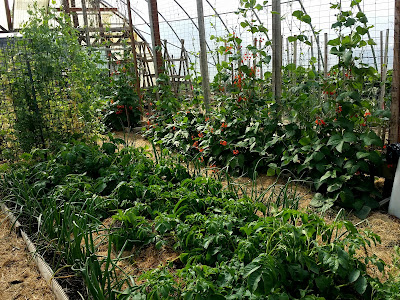
The scarlet runner beans reach ten or more feet in the air (as high as they can go on our trellis!) They provide rich pollen for bumblebees and hummingbirds, and a lot of food for us humans!

Growing Golden Amaranth: Our increase in winter storage crops this year also includes grains (amaranth, sorrghum and blue and yellow corn - all to be dried and ground for a delicious hot cereal mix we eat ourselves and share with our helpers too). Though we've grown Hopi Red Dye amaranth for several years (and now it volunteers all over the garden!) this is the first year we've tried Golden amaranth. Though the Red amaranth is edible, it's primarily grown as a fabric dye - as its name suggests. The Golden amaranth is specifically cultivated as a food crop. It's quite beautiful too, don't you think?


This picture shows the front area of the Sharing Gardens (the entrance gate is at the far back of the picture). Those rust-colored plants in the center are Golden amaranth. This is a new variety we're trying this year that's supposed to be very tasty. Once harvested, dried, winnowed and ground, it will be a great - high protein - addition to our morning cereal.

A closer view of the Golden amaranth. Each plant grew 6'-7' tall from a tiny seed, in just four months! We love it when the healthy food we grow is also beautiful to look at.

A close-up of Golden amaranth the seed heads.

We clip the seed heads once they're ripe (and before the goldfinches and chickadees find them!) and lay them out on tarps to dry in our greenhouse. The seeds are then dislodged by rubbing the seed heads between our hands. We then sift out the remaining chaff using a sieve (just a regular household metal strainer with appropriate-sized holes).

At a time when our focus on mass-production has been decreasing, our call to be educators and mentors has slowly been increasing. Our Sharing Gardens website recently passed the mark of  645,000 all-time visits and we currently are averaging about 100 visits a day from all over the world. The vast majority of visits are to the 200+ 'how-to' posts on our site. But quite a few people are also interested in the more philosophical posts about the value of sharing and generosity in healing the world's ills (just a reminder: we don't have membership fees for our sharegivers or charge money for any of the food we grow. - LINK: How it works) And, not to toot our own horn excessively but we get quite a lot of thanks from our sharegivers for the valuable lessons in gardening, and the feeling of sanctuary our project provides as well.

Chris and Llyn, enjoying a little 'down-time' in between the harvests.

And lastly, though as humans, we often place much higher value on what we can get out of nature, here at the Sharing Gardens it is profoundly important to us too to give back as well. Slowly, over the years, both the cultivated gardens and orchards, and the outer, wild edges of our 3 and 1/2 acres have become host and home to an ever-increasing refuge for wildlife. 

Birds, insects, reptiles and small mammals find a respite and sanctuary from the pressures of the consumer society and domestic pets pressing in all around us. Just the other day, one of our regular visitors, who likes to take long walks around our small town said, "There's no other place around here where I see so many butterflies and bees and varieties of birds; or snakes or frogs or bunnies." It gives us a really good feeling to be cultivating a haven for all these little ones. (LINK: Making Room for Animal Voices)

Tuesday, July 4, 2023

Season's Turning...High Summer, to Winter Crops

This is a quickie-post with a few seasonally relevant links particularly for people who have their own gardens (Starting Fall and Winter Crops, and Saving Tomato Seeds). But, even if you’re not a gardener I've included a link to a post about Interdependence Day. Enjoy!

Our biggest greenhouse, the Sunship (30'x50') on July 3, 2023

Read an inspiring essay about celebrating Inter-dependence day. What if we celebrated Interdependence Day instead?

The Sharing Gardens are growing exponentially these days. We dug our first potatoes last week (an experiment at growing them in the raised beds of our greenhouse, which seems to have worked beautifully!); our corn and sorghum plants are knee-high; the cucumber, winter squash and bean plants are all flowering and all our amaranth and ornamental flowers are in the ground and growing strong.

Golden Amaranth (foreground) is a grain crop which we'll harvest, dry, winnow and grind to add to our hot-cereal mix. Scarlet Runner beans are climbing the tipi, behind. The sunflower (top, right) volunteered from seeds dropped last year! (LINK: Why growing sunflowers is great for bees... July 2, 2023

We had a whole bunch of sprouting potatoes in late winter, and it was still too cold and wet to plant them outside so we experimented with growing potatoes in our greenhouses. (LINK: Sprouting potatoes? What to do. ) The potatoes are the plants in the middle of the frame, with purple blossoms. Started in early March - as I recall...they were probably about12-14 weeks old in this picture. May 29, 2023
 
This pic, taken in mid-June, shows how the potato plants have begun to flatten with their own weight. The potatoes were rapidly growing below. June 14, 2023.
 
This pic was taken one month after the first and shows the potato plants beginning to die back which means that the potatoes are almost ready for harvest. We ended up with about 30 pounds from this row. June 28, 2023

Maddie, digging potatoes, July 3.

Here's a 20 pound harvest from a different row in the same greenhouse. This experiment was definitely a success. Every year, last season's potatoes begin sprouting before outside conditions permit us to plant. At the same time, we have plenty of space in our greenhouses. I'm guessing we'll do this again. (pic: June 29, 2023)

Saving Tomato Seeds: We picked our first ripe tomatoes on June 30. The variety was Stupice (left), an heirloom/open-pollinated tomato, known for its early ripening, delicious flavor, and long season (they are also usually the last variety we’re still harvesting in the fall!). We’ve saved seed from the first fruits that ripened, to encourage this trait in our seed collection. To read about how you can save seeds from your tomato plants, CLICK HERE. (Note: you can only save seeds from heirloom, or open-pollinated varieties. Seeds saved from hybrid, or F1 types while not breed “true” and next year’s plants will/may revert back to the characteristics of one of the parent-plants they were bred from). 

Stupice tomatoes grow in such abundance that we pack them in egg cartons for safe transport home with our volunteers. Here, Llyn getting help from Adri and Jazmyn a few years ago.

Striped German tomato: To learn how to save seeds from tomatoes, CLICK HERE.

Starting Fall and Winter crops: Though it may seem counter-intuitive, now is the time to start your fall and winter crops from seed (late June/early July- Zone 7B, Pacific NW - USA). They need 8-10 weeks to gain some size before day-length begins to seriously shorten around the fall equinox (I know…it’s sad to think that we’re already headed back to winter’s short days after having passed the summer solstice!).  

Now is the time to start any brassicas (cabbage, kale, collards etc.) and other ‘greens’ such as chard. If you have room in your garden, there’s still time to plant a second crop of cucumbers or summer squash; these will carry you through till first-frost and you'll have plenty of these summer delights when your neighbor’s patches have ceased to produce. 

We’re starting a second batch of basil too as our first batch is already trying to go to seed. We’re taking a chance in starting more lettuce too. It may be too hot for it but we’ll plant it in places where it’s partially shaded and hope for the best. Also, because we’ve been harvesting lots of beets and carrots, we have lots more room (and time enough) to start succession crops of both these excellent winter-storage crops.

Time to start fall and wintering-over crops! Here are cabbage plants getting moved to larger pots. For a full post on planting fall and winter crops, CLICK HERE.

...and finally, a few strategies to help your cool-loving crops through the hottest part of summer:

See those new, little lettuce plants to the left of the tomatoes and behind the flowering nasturtiums in the front?...

...Those same lettuce plants are covered with a polyester 'row cover' in this picture. You can find these row-covers from nursery-stores (or, if you have a free-cycle program in your neighborhood, see if you can find some without having to buy it new!). It lets some light through but provides a micro-climate that's less harsh for tender seedlings, and you can even water through it. We'll remove it once the plants are more established. This picture also shows the red, shade-cloth (above) that we have in our Ark greenhouse to provide diffused light and a slightly cooler space. In the path to the left of the lettuce are heavily applied grass-clippings which keep moisture in, stabilize the ground temperature, are comfortable to crawl on and will turn into next year's compost and potting mix. (LINK: How we grow...Veganic Community-based gardening)


Here's another use for row-cover (opaque, polyester cloth): after potting up seedlings into seed-trays, we put them in the shade, with the cloth so they won't be too shocked while their roots get established. (Lettuce seedlings: right, milkweed plants: left).

If you're local and want to learn more about planting fall and over-wintering crops, here's a free workshop: 

SAT, JULY 29 (10 am – 1 pm) PUBLIC SEED LIBRARY POP-UP VEGETABLE GARDEN PLANT CLINIC: Bring your vegetable gardening questions and get advice from a Benton County Master Gardener! Now’s the time to plant cool season crops for fall and over wintering: Come learn how to extend your vegetable garden harvest through the winter, look for seeds of interest on the free seed rack, and find vegetable garden educational materials and links you can access anytime.
At Corvallis-Benton County Public Library, 645 NW Monroe St., in the historic Belluschi Wing (home of the Public Seed Library)
Contact: CorvallisPublicSeedLibrary@gmail.com
Sponsors: Corvallis Sustainability Coalition Food Action Team, OSU Extension Service/Benton County Master Gardeners, and Corvallis-Benton County Public Library

Inter-dependence...another name for sharing...

Tuesday, June 20, 2023

Growing Abundance! Sharing Gardens update - June 2023

Hello Folks - Well, we've got everything planted except some of the flowers. The veggies, grains and beans always take precedence since they'll be feeding us and the circles of people our garden supports but the flowers won't be far behind. Their beauty sustains our spirits (one cannot live by broccoli alone!) and we wouldn't want to neglect the wildlife that the flowers support either. Our spring-time harvests are coming on strong...lettuce, beets, carrots, green onions, celery, and more!
 
After a cool, wet La Nina winter and early spring, temperatures suddenly soared into the 90's F. Records were broken in many sites in the Pacific NW where we live. After that, our weather mellowed into one of the most beautiful springs I can remember. Temps in the mid-70's to low 80's and nights in the 40's and 50's. Very comfortable. The main challenge has been record-breaking grass-pollen counts and a dearth of rain. We are incredibly grateful for our deep, sweet well water so we can keep our crops watered.  
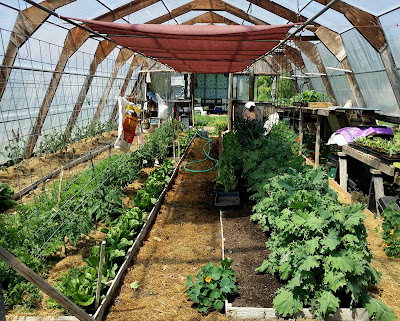
Our Ark greenhouse with tomatoes, carrots, lettuce and kale - May, 2023.

Sunship greenhouse - early June - onions, potatoes and scarlet runner beans. So much food!
This year we've scaled-back production of summertime's favorite vegetables
(tomatoes, peppers, cukes etc). Our intention with those is primarily to feed ourselves and the people who directly support the gardens. We'll still have surplus - which is being shared with local food-charities but not as much as in previous years. After 14 seasons, Chris and I need to reclaim a bit of the summer-season for recreation and other creative projects and not be so completely wedded to the Sharing Gardens. In our greenhouses, we're still growing 44 tomato plants and 22 pepper plants, and beets, carrots lettuce and other greens. We've experimented with growing potatoes inside too. I'm not listing everything we're growing but you get the idea. It's still a big garden, just not as big as previous years.
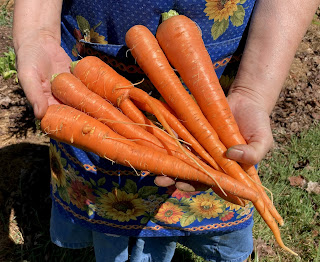
Tremendous Imperator carrots (from seed we saved ourselves)

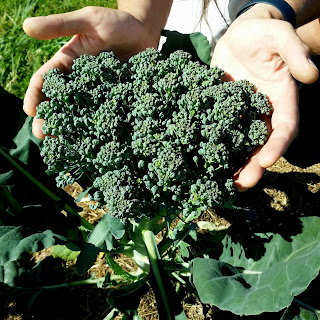
Waltham broccoli. After cutting the first, large, center head, the plant will continue to produce side-shoots for several months.

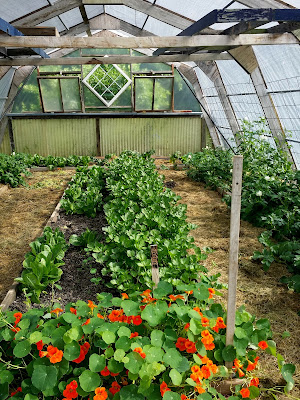
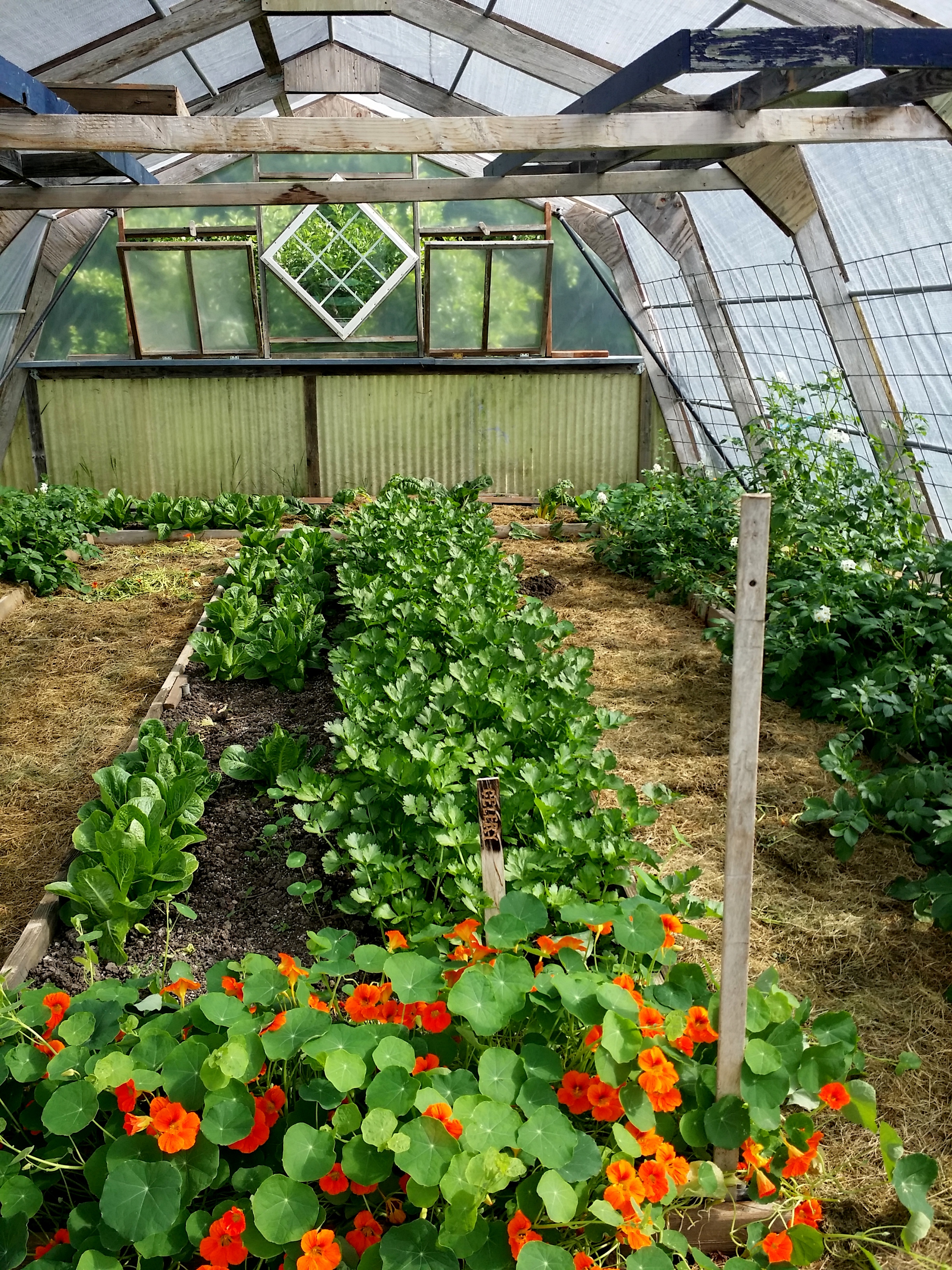
Our third, smallest greenhouse - with lettuce and celery in the center and potatoes down the sides. The flowers are nasturtiums - both the leaves and flowers are edible and the bees love them!

We have finally, successfully transitioned away from using any manures or animal by-products and commercial fertilizers! This year, we made all our own potting soil out of the compost generated in the paths of our greenhouses (made from leaves and grass), wood-ash, coffee grounds and perlite (our only purchased amendment. It comes from volcanoes and aids in water-retention and lightening up the soil).  Making Your Own "Veganic" Potting Soil in Your Greenhouse Paths - Using Worms

Our seedlings/starts were robust and healthy (grown almost entirely from seeds we saved ourselves). We grew enough to share extensively with our volunteers (and their families), Luckiamute Valley Charter School, Lilliputopia Farm and the Food Pantry that shares our parking lot. It's gratifying to see how many people are growing their own food in our area. We gave away over 450 'starts'!
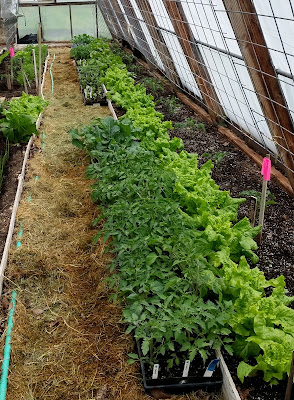
We grew 484 veggie and flower starts, shared in the community for free! Here are 72 tomato starts given to Luckiamute Valley Charter School (flanked by lettuce to the right).
In our outside beds, we're shifting to a greater focus on storage crops: beans, grains, potatoes, onions and winter squash. Typically, these take less effort to maintain between planting and final harvest and they'll continue to feed our little Sharing Gardens community through much of the winter.  Here is a post with LINKS to info on growing scarlet runner beans, building a tipi/trellis, growing blue corn and recipes for winter squash. Three Sisters - Winter Storage Crops and How to Grow Them
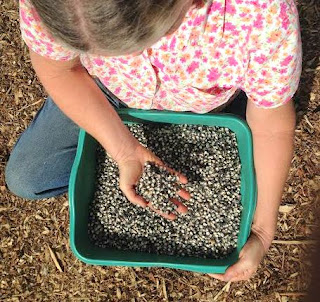
Llyn with some of the Hooker's blue corn we grew to dry, grind and use for hot cereal and baking
Here is a general post about the Sharing Garden's gradual shift from an emphasis on crops eaten fresh (cucumbers, tomatoes, lettuce etc) to storage crops including: dried corn, beans, sorghum and winter squash. "Squashes and grains and beans, oh my!"...a shifting focus on what foods we grow...
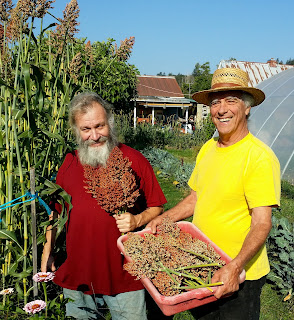
Rook and Chris, harvesting Ba Ye Ki sorghum which we dry and grind and share with our core group for use in cereal and baking.
So far it looks like we're going to have an excellent year for fruits: pears, apples, plums, grapes and quince. Our apple trees are so heavy with fruit, we actually had to thin it this month so the remaining fruits will grow to full-size and we don't break branches.
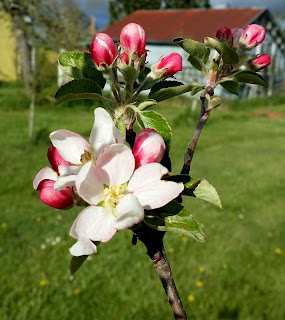
Apple blossom: we had fantastic pollination this year! We even had to thin some of the fruit.
Oregon State University reinstated the Service Learning Program (after their pandemic hiatus). This is an excellent program offered in a handful of classes where students earn college credit for volunteering in the community in projects relevant to their course-work. In our case we received six healthy, gung-ho young women who brought a spirit of cheerful, willing enthusiasm and curiosity. They managed to complete everything we'd staged for the day in less than the four hours allotted so we sent them home early.
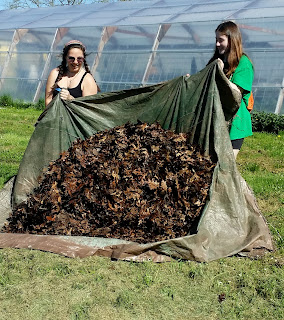
Students spreading leaves in our squash patch.

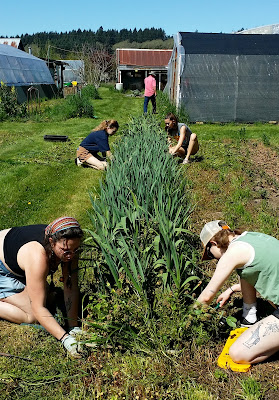
Students weeding the garlic that had over-wintered.
Lua Siegal, (the coordinator of the Luckiamute Valley Charter School we've been supporting this spring) brought us a full truck load of well-composted leaves on the day of the OSU Service Learning project and stuck around for much of the morning helping us unload it.  

OSU students unloading Lua's pick-up truck full of leaf-mold (composted leaves) which she purchased and donated.
Lua is an amazing person...so dedicated to giving the children in her care a positive introduction to gardening, connecting with nature and healthy eating. When we visited her at one of her two campuses to deliver 'starts' we'd grown, her director shared with us that many families decided to enroll their children at LVCS specifically because of the program Lua's created there. LINK - LVCS Facebook
Sign posted at the Luckiamute Valley Charter School. We appreciate them so musch for the values they are instilling in their children.

In late May we had a wonderful visit from Tree (and Angie, his wife, and Jocelyn, their friend). Tree is a soft-spoken man, just a few years older than Chris who paralleled Chris' time in the Bay Area in the late 60's/early 70's during the height of the idealism that characterized that time and place. Both men have continued to try to live by their ideals and leave the world a better place for them having been here. Tree is the founder, and steward of the Free Farm Stand in San Francisco (founded in 2008, the year before the Sharing Gardens was born).  
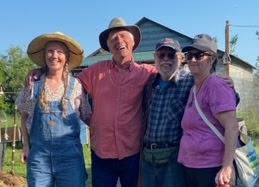
Llyn, Chris, Tree and Angie.
Their project is similar to ours...They:

"...grow as much food as we can in San Francisco and distribute it for free at our Free Farm Stand. We act as a gathering place in the Mission to encourage community growth and involvement. This effort revolves mostly around gathering surplus food from neighborhood gardens, various farmer’s markets, community gardens, public and private fruit trees,  and hosting a space where this bounty can be shared with all." they also:

  • Help empower people who have the space to grow their own food and become more self-reliant.
  • Promote good nutrition and health.

The Free Farm Stand is powered through volunteers every Sunday in a park in the Mission District. They redistribute thousands of pounds of produce per year.

We have been in online communication with Tree since 2009 and talked once on the phone but never met in person till now. In Tree we found a kindred spirit; someone with an equal passion for growing and distributing healthy food to those in need.

Here's what Tree had to say about us: "...visiting them in person was such a thrill. Llyn and Chris are the most beautiful and generous people and doing amazing gardening work (I would say more like farming work) on 3 acres of land...Their whole scene is so inspiring and we felt a heart connection; sharing a philosophy of how to grow food and how to share it once it is harvested."

To read Tree's full post and visit The Free Farm Stand website go to: Free Farm Stand, San Francisco, CA - Garden Glamour Queens
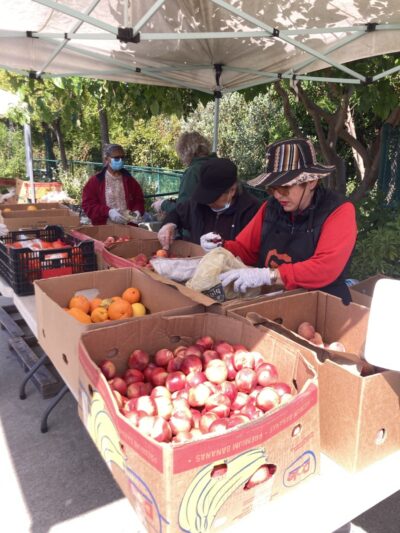
Free Farm Stand, in San Francisco, distributes free produce they've gleaned from gardeners, farmer's markets, public and private fruit trees and community gardens.

Our core group of share-givers (volunteers) has returned from their winter hiatus, and we have one new friend who's joined our circle. We could probably use one or two more people if you've been thinking about joining us. We have two sessions per week: Mondays and Fridays - 9:00 to noon. We need folks who are physically capable and who can make the commitment to come once a week for most of the season. For more information, follow this LINK and drop us an email

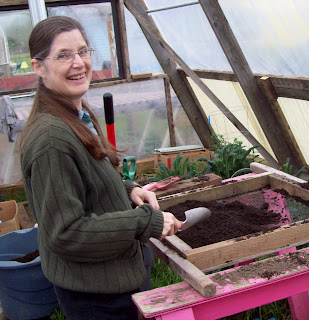
Cindy, sifting compost...

Jim, drying blue corn.
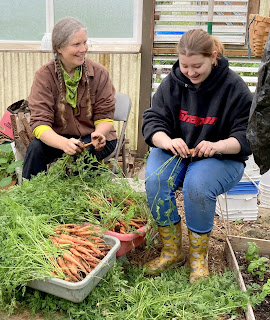
Llyn and Maddie, snapping greens off carrots.
Rook and Jim, harvesting sunflowers (for winter bird seed). 

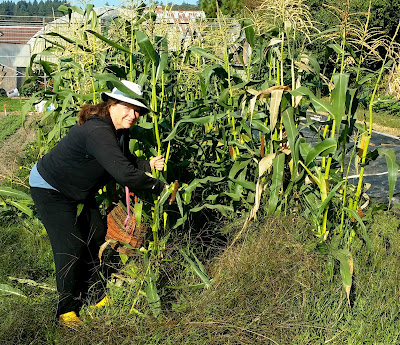
Sandra, harvesting corn for us to dry and grind and use for cereal and baking.
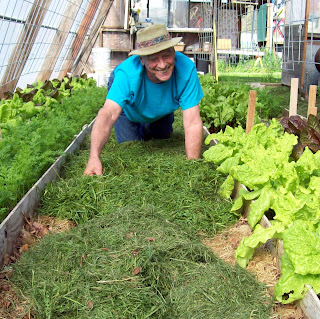
Chris, spreading grass mulch in greenhouse paths.
A special thank you to Donn Dussell, who came almost weekly, all through the winter

to join us for whatever needed doing in the gardens. I know that all three of us really looked forward to those Monday morning sessions as an inspiring way to begin the week.
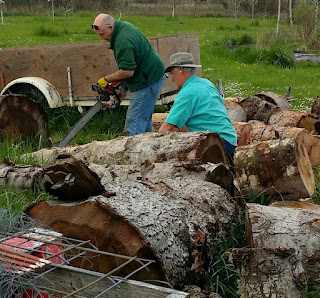
Donn and Chris processing firewood donated for us to share in the community.

I try to include at least one inspiration post about other projects happening around the planet that align with our Sharing Garden principles. We have two this month and a micro-dose of cuteness from the world of moths):
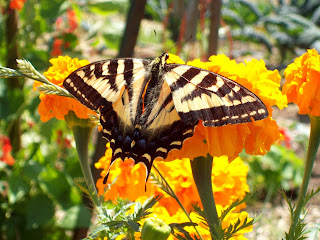
Swallowtail butterfly photographed in our garden.
This is an amazingly inspiring video which features a program in Oakland, California that provides hands-on job training for people coming out of prison to learn how to propagate and care for perennial plants (11 min.). Oakland Permaculture Heals The Hood!

...and, closer to home, a 'sharing'-type garden in Eugene, Oregon, which grows food for a local free-pantry and herbs for herbalists to use in their practices. Enjoy! Eugene neighborhood getting a community garden 

...and for those who need 36 seconds of moth cuteness...Click here.

Llyn, smelling the tansy we let flower in certain parts of our land. it smells like buttered honey and the bees and other pollinators love it. It's also the host plant to Cinnabar moths.