A unique and viable approach to establishing local food self-reliance and building stronger communities.

Thursday, February 16, 2017

Spring Planting Has Begun!

Chris gives a lesson in seed-planting - 2015.
Well, we've come through a wet, grey January with a couple of really cold spells but it seems that spring is finally on its way. We decided to take a break from bringing Oregon State Univ. students to the gardens for winter term. Chris and I are largely caught up on major building projects and tree-planting and we didn't feel we had enough projects that needed student help. Six students can get a lot done in four hours! But we've already got lists started for the spring and hope to host at least two OSU groups.
"Anyone who thinks gardening begins in the spring and ends in the fall is missing the best part of the whole year; for gardening begins in January with the dream." - Josephine Nuese

Adri fills pots with soil.
Being the gardeners that we are, we just couldn't wait to get some seeds started. This post is about  our continued experiments with creating fertile soil using locally-sourced materials and the seeds we've started (including some links to earlier posts on how to grow some of the plants listed below).

Soil-prep: (Growing food using "organic" methods is a very dynamic and ever-evolving process. What follows are the techniques we are currently using but we won't necessarily know if we are successful until crops come to harvest. Also, a method that works one year under certain climate conditions may not be successful in years to come).
Chris adds and mixes in compost.

Because we're slowly weaning ourselves from using the rototiller to loosen soil (outside) and creating permanent beds (in the greenhouses) much of winter "gardening" involves preparing beds for spring planting.

Greenhouse Prep: In the Fall we pulled old plant material from the beds and gave them a light sprinkling of wood-ashes and a thicker coating of coffee grounds. The ashes provide many needed minerals. The coffee-grounds also boost the nutrient-content of the soil but the main reason we like to use them is that they are a favorite food for worms. With this food source, they reproduce rapidly and add their worm-poo (castings) to the soil which is an almost perfectly balanced fertilizer! In the Fall we also covered the beds (and paths) with a thick mulch (leaves, straw and fresh grass-clippings).

Llyn adds more coffee grounds.
In late January we began to we pull all the mulch off the beds and add it to the paths. It will continue to compost through the spring and summer and, as plant-roots grow out into the paths, they will be nourished by this material.

Once the beds were cleared, we added more coffee and compost, and gently dug it in a few inches. We've been absolutely amazed with how much worm activity we're finding in our greenhouse beds!

It's good to have several weeks with the bare soil exposed as the sun's heat will warm it and activate many micro-organisms. The added coffee also encourages worm-reproduction which adds more nutrients and worm-tunnels to the soil. LINK: Preparing Garden Beds - One Low-tech Way

We put the first batches of seeds on electric heat-mats with plastic covers to keep in heat and moisture. This gives a head-start to seed germination. For later batches of seeds, when there is more sun to heat up the soil, we won't use the mats.

This is what the greenhouse will look like in a short time!
Here is a list of the seeds we've started in pots, in the greenhouses:

Peas back-lit by the sun.
We started peas at the New Year but it was too cloudy and cold for the seeds to germinate (many rotted in the pots) so we re-planted mid-January. The peas are mostly up about an inch now. When they're 4"-5" tall they'll be transplanted into greenhouse beds.


Cindy with carrots - 2016.


As an experiment, we've started a small patch of carrots and beets in a greenhouse (they prefer cooler soil to germinate). Ideally, they'll be done producing by mid to late-spring leaving room in the beds for summer-crops such as tomatoes and peppers that love the heat!

Burgundy Globe onions-an Heirloom variety from which you can save seed.
Onions: We like to start onions from seed as it is less expensive than buying "sets" and we have less incidents of onions "bolting" (going to seed) which means that we have a bigger harvest.  Here is a LINK to a post about growing onions from seed. Another LINK.

Lettuce! Can't you just taste that tender goodness?
Lettuce: Our goal this year, is to start small batches of lettuce every few weeks until it gets too hot to grow it (it prefers the cooler spring and fall weather). This way we can have enough for everyone who helps with the gardens and to share with the South Benton Food Pantry and Local Aid. LINK: Growing Lettuce from Seed.
 
Red Winter Kale - one of the most nutritious land-vegetables!
Kale: We have a few plants that wintered-over outside this year. We'll eat most of these spring "greens" (so sweet and tender after getting a "kiss" of frost). Kale-flowers, formed in their second year, also called raab, are also delicious and nutritious. We'll eat some of the flowers and let some of it go to seed so we have enough seed for next year.

Llyn with Broccoli-2009
Broccoli: We're experimenting with growing some of our broccoli crop in the greenhouse this year. It doesn't like a lot of heat but we hope to have it done and harvested by late-spring when the heat begins to build.


We use milk-cartons or large soy-milk containers as collars.
Celery: Celery takes a very long time to grow, especially at first. Once it establishes a long and extensive root system, the upper part grows more rapidly. Commercially-grown celery is one of the more highly-pesticided crops so it's good to grow your own or buy "organic".

The collars - pictured above - provide pest-protection, cause the celery to grow up-right and "blanch" the stalks so they are more tender.

These potatoes, with their short, stout sprouts, are ready for planting.
Potatoes: Each year we try new methods to grow potatoes. Potatoes have a natural dormancy period and will begin to sprout once this period is over. They need to be planted within a month or so of sprouting or they will begin to shrivel and won't be as viable. We have a lot of clay in our soil and it can stay cold and wet until late spring. Many times we have had our seed-potatoes rot in the ground before the last of the spring rains drain.  This year we are going to plant two rounds of potatoes; a first crop inside the greenhouse and a second one outdoors in late spring. This later batch will provide storage potatoes and perhaps even seed-potatoes for next spring. Here is a LINK to a post on preparing potatoes for planting.

Re-potting a tomato seedling.
Tomatoes: It's always a tricky dance to start seeds early enough to have the longest growing season but not so early that you have to keep transplanting the 'starts' into larger pots until it's time to put them in the ground - using your precious time and potting soil. For the second year in a row we will plant all 90 (or so) tomato plants inside greenhouses so we started our first batch of seedlings in early February. Later we'll start more tomato seeds that we can share with people in our community.
 
Saving Seeds: We save and re-plant over 85% of our own seeds. Developing this skill is fun and very rewarding. The seeds you save yourself will be adapted to your own micro-climate and soil conditions. One of the advantages of having a community-garden organized like the Sharing Gardens (with all of us growing food together; no separate plots rented by individuals and families) is that you can coordinate seed-saving and isolate varieties that might 'cross' and give you impure seed. LINK to saving your own seeds

Chervena Chuska peppers. If peppers are pulled up in the Fall before the first frost, and hung indoors, they will continue to ripen on the plant.
Peppers: Like the tomatoes, we finally have enough indoor greenhouse space (2500 square feet) to grow most of our peppers. This extends our season for growing by at least a month. These heat-loving plants require warm soil to germinate so, when starting the seeds (even in a greenhouse) we put them on an electric heat-mat. Our seeds typically break through the soil in 8-10 days.

Chris has been painting a new sign for the Food Pantry.
Winter's not over yet! Though the days are growing longer and signs of spring are all around, there's still plenty of time for creative projects, baking and other activities that must retreat to the background in the height of the garden-season.

...and Llyn's been having fun in the kitchen baking pies and bread and muffins!
The Sharing Gardens is located in the southern Willamette Valley of Oregon and is considered Zone 7b by the USDA. Click here to find your gardening zone. To find a planting guide for your area, do a search on-line. Most agricultural universities offer guides specific to their regions.


Friday, February 10, 2017

We Give Thanks

A "praying" mantis, giving thanks!
The Sharing Gardens is a hub of giving and receiving. People give what they can and receive what they need. We give thanks to those who continue to contribute to and support the program; we couldn't do it without you!

Last month we received three cash donations, totaling $145. Much of the project runs on donations of materials and labor but, as we all know, you can't fill your gas tank by trading a basket-full of tomatoes! Thanks to Rob and Elisa, Cecilia and Dave Gore and Cathy Rose.

Rob and Elisa are a married couple that have bought land near-by. This is their first experience at 'homesteading' and  they are enthusiastic about growing food, harboring wildlife and moving towards a more sustainable lifestyle. We always enjoy their participation in the gardens, especially knowing that much of the knowledge and experience they gain, they're able to go home and put into practice.

Chris and Rob planting Fava beans in the greenhouse. Since this pic was taken, we've had several days in a row that never got above freezing and the beans died. This is why Chris is always saying, "Plant for all contingencies"!
Elisa - harvesting raspberries.
That's Jen in the pink tie-dye shirt.

Cecilia and Dave Gore (not pictured), besides making a cash donation, have become seed-distributors for the Sharing Gardens. We gave them a huge batch of seeds to share, some we'd saved ourselves and some commercial varieties that had been donated to the project. They have been taking the seeds to many gatherings in Corvallis and doing their best to find good homes for them! Grow seeds!
Well-pipe makes good fence-posts.

Long-time friend and participant, Jen Revais (above), donated about 200-feet of well-pipe. This heavy-duty metal pipe has many uses for us including fence-posts and trellises.

Thanks go to Dorene Wolfe, whose daughter Dina is the pastor at the church that shares a parking lot and property-line with the Sharing Gardens. Dorene is a can-do lady and took the initiative to rake leaves all around the church grounds and cart them over to our pile. We don't have a picture of Dorene but here's the view we have of the church from our front yard (below).

Growing in partnership with our neighbor - the United Methodist Church. Love those leaves!
Our last round of thanks goes to all the wild-critters who have come to make the Sharing Gardens their home. You enhance our life with your funny antics and help keep things in balance  by playing your parts in the great web of life. These first few pics were all taken here at the Sharing Gardens.

Pregnant preying mantis. We see egg-cases frequently on wood-piles and fence posts.
Baby "Racer" snake. We saw one that was easily four-feet long near one of our greenhouses.
We grow some pretty big earthworms too!
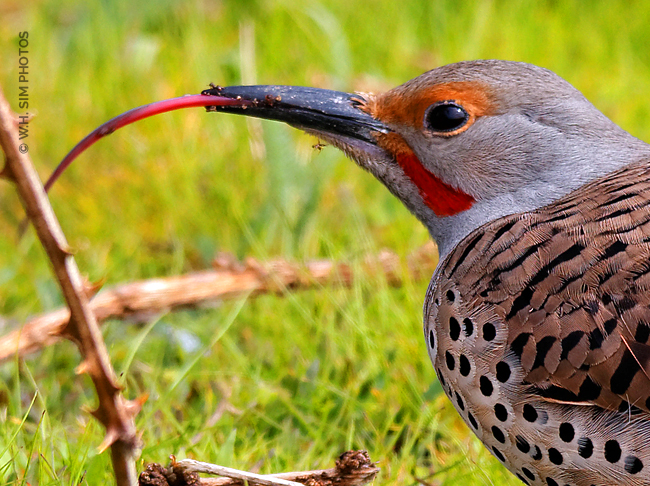
We don't have any good pictures of the birds and mammals that live in and around the Sharing Gardens; our camera just isn't good enough to zoom in on them at a distance. But here's a story about the flicker family who comes daily to our feeder. We've seen as many as five flickers at a time in the upper branches of our walnut tree and one or two come regularly to our feeder. They seem to enjoy the millet we provide (purchased in the bulk-foods section, it's much less expensive than buying it as "bird-seed mixed with other ingredients). I've watched them with binoculars and they feed by extending their sticky tongues, coating them with millet seeds and retracting their tongues full of the yummy nibbles.

Northern Flicker
Flicker with tongue extended; they're in the woodpecker family and love eating ants. Photo credit: W.H. Sim LINK
The flickers are the only birds at our feeder who aren't intimidated by the scrub jays. Though the juncos and sparrows are far smaller than the flickers, they all feed happily side-by-side.
Western Scrub Jay - though "bullies" at the feeder, they play an important role in planting nut trees. They probably plant the  majority of walnuts and hazelnuts around our land in the leaves and straw we use as mulch. If they're planted in good spots, we nurture them along for future nut crops. Photo credit
It is one of the most beautiful compensations of this life that no man can sincerely try to help another without helping himself. 
--Ralph Waldo Emerson


Thursday, January 19, 2017

Time for "Peas" on Earth!

Planting peas in a greenhouse for early-harvests.  At the Sharing Gardens we use two methods to increase our chances of an early, abundant edible-pod pea harvest. Both involve starting seeds indoors, in pots and later transplanting them.

Pea-seedlings - a promise of delicious, sweet nibbles to come!
If you have a greenhouse (or indoor seed-germination set-up), and live in a similar climate as the Sharing Gardens (we're in zone 8b, according to the USDA zone map) you can start your seeds in pots much earlier than you would be able to direct sow them outside. Depending on when you start the seeds, they can be transplanted into a greenhouse for earliest pea-production, or later, to beds outside.
 
For greenhouse plantings, we start our seeds as early as the first week of January. These are then transplanted to  greenhouse raised beds by mid-February. Seeds started in pots in mid-February can be transplanted to outside beds in March. 
 
By starting our first batch of seeds at the new year, we can be eating peas by late March and on into April - at which point the peas we plant outside the greenhouse will begin producing and carry us through May or June!

You'll need:
Fill pots to within a half-inch of the top. Water the soil to help it settle.

Poke two seeds, in opposite corners, about the depth of one knuckle (3/4" or so). That's two seeds per pot. This gives each plant enough soil to germinate and grow to several inches in height before you transplant. Cover the seeds with soil (about the depth of two seeds-deep) so they're not exposed to sun. Water them gently. Do not over-water. Seedlings can rot if soil is too damp.

Note: Since having written this article, we have now shifted to planting two seeds per pot but do not have photos to reflect this.
Keep the potted seeds protected from marauding slugs by putting them up on a table, or putting a milk-carton collar around them. (Link to post on Re-Purposing Things - including milk-cartons as collars). If you're planting in January, you'll need a greenhouse, or indoor germination set-up to protect them and keep soil in pots warm enough for germination. If you wait until mid-February, pots can be outside in a sunny place, protected from north winds.

When they are at least 6", and no longer than 12", you can put them in your garden, or greenhouse beds. Best to wait until their root-systems are quite dense in the pots -- almost "root-bound". They will be easier to transplant without damaging the plants. On the other-hand, if you wait until the stems are too long, you risk breaking stems during transplanting so it's a matter of finding the right balance.

Pea-seedlings in pots.
Transplanting: Plant each 4" pot (with its two seedlings) about 8"- 10" apart with bamboo stakes or other climbing trellis in between each clump of starts. Pea-plants are not typically transplanted but sowed directly in place. They are very susceptible to shock so be gentle with the roots and stems. Best to have your trellis in place before you transplant so you don't injure roots driving in the stakes.  
 
If slugs are a big issue in your area, planting them in the milk-carton collars can make a big difference. We also typically sprinkle about a teaspoon of iron-phosphate ("Sluggo") around each bunch of plants. This is an organically-approved way of dealing with slug/snail infestations in your garden. (LINK to article about iron phosphate).

The plants might go through a little stress from transplanting but once they acclimatize to their new environment they'll be well along the way to yielding a bounteous and long-term harvest!


John and Llyn transplanting pea-seedlings outside, in early to mid-spring. It's a good idea to have your trellis in place before you transplant peas (so you're less likely to damage roots).
Sara picking peas in the greenhouse in April. Note: peas need a trellis with stakes or caging that is less than 1/2" (1 cm) in diameter. they climb using tendrils (instead of wrapping around the trellis - like beans) and won't be able to grab and climb if your trellis/caging is too thick.
Pea-vines headed for the compost pile. Peas, being legumes are able to add nitrogen to your soil through a symbiotic relationship with organisms that grow on their roots. This will help improve your soil, particularly if you leave the roots in the ground when you cut down the "greens" to add to your compost pile.
Growing food together, grows community too!

Thursday, November 17, 2016

Growing Gratitude

Dear Friends and supporters of the Sharing Gardens - Well, it's been almost six months since we last posted!

We just finished our eighth season, have a core group of 6-10 sharegivers who help us in the garden, deepening relationships with our neighbors, and we're still sending close to 5,000 pounds of fresh, organic produce -- free of charge--to two local food pantries. That's in addition to the sizable harvests our sharegivers take home each week to feed their families and can/dehydrate for winter-use.

Our website continues to have anywhere from 3,000 to 9,000 visits per month from all over the world  from people interested in how our project works and how to grow food in the methods we use.

Oregon State University, with their commitment to 'service-learning' has sent us close to 75 students in 2016 for volunteer time in the gardens. Here's a delightful video made by Trent Toney, one of the OSU students, that gives you a glimpse into a typical service-learning day at the Gardens. Enjoy! LINK

This post highlights many of the people and organizations who help us be in service to the world. Enjoy!

Gradually, people in our small town are beginning to see the Sharing Gardens as a place to share their surplus - whether that be building materials, canning and garden-supplies, yard "waste" or fruits and veggies.

Mulches Gracias

Leaves, a renewable natural resource.
Because we practice an organic method of farming that uses large amounts of organic materials (leaves, grass, kitchen-scraps) it has been important to develop relationships with our "neighbors" to keep a strong supply coming. Our town does not provide a yard-waste pick up service so this valuable resource is often burned or left to rot in the corner of people's yards where it benefits no one. Currently we receive leaves and/or grass clippings from six families in our community. These are - Cathy and Roger Coy, Jo and David Crosby, George and Irene Daugherty, Jody Kahn, Victor Stone and Michelle and Al Copeland. Thanks so much! Keep 'em coming!

Grass, donated by neighbors, increases garden fertility.
Chris and David Crosby - unloading a composted horse manure delivery.

Michelle and her partner, Al convinced the people they do yard-work for, to buy this large wheelbarrow so they could bring us grass clippings once a week from a block away.
Much of the organic material we receive is placed directly on the soil as a top-dressing or mulch. This feeds the worms, bacteria and fungi below. With the surplus, we build compost piles. The finished compost is used for planting in the spring. (Deep Mulch Method: LINK)

Llyn layering grass and leaves in a compost-ring. Minimum 3-foot diameter.
Service-learning students help to turn our compost piles.

Finished compost can be added to potting soil, mixed into planting holes or used as mulch around plants.

It takes a village...

There are many ways people support the sharing gardens. Here are some of this year's donors:


Our neighbors Donna and John Dillard have been very generous this year donating apples and pears, metal roofing, welded-wire fencing and all the firewood we could handle off a huge oak tree cut down in their yard. That will keep us warm for several winters!
Eva (above), also brought many bushels of apples gleaned from her neighbor's tree.

John Kinsey (left) has a backyard worm farm. He feeds his worms food scraps and coffee grounds. The worm-poo (castings) provides excellent soil-fertility. John donates worm castings and surplus coffee-grounds he collects weekly from a local coffee-shop. (Pictured with garlic seeds).

Steve Rose (right) has made many generous donations over the years --tomato starts, hundreds of gallon pots, bamboo, and more. This year he's provided us with spores from the Wine Red Stropharia mushrooms with which we have successfully inoculated a wood-chip pile. Delicious! Here he is giving a lesson in grafting fruit-trees. Steve is a fountain of knowledge and a real local treasure.

Monroe's United Methodist church had a long stretch of fence-boards they wanted removed. Here's Chris (above) de-nailing them for re-use as bird-houses and fencing around the gardens.

This year we extended our wire fence to encompass almost the full three acres of the property. We ran into some problems in late winter because the ground was too wet to pour cement for wooden corner posts. The gardens were open to local deer and we suffered some significant damage to our fruit-tree saplings and new spring crops. Our dear friend Rob (left) came to the rescue. He put in several long sessions with Chris, pounding metal posts and hanging the fence once we got the corner posts in. It was a huge help!

Oregon State Univ. students continue to come each term and provide volunteer help in the gardens. They receive credit and hands-on experience and we receive a huge amount of help! We have hosted close to 75 students in 2016 for four-hours each. Wow, do they get a lot done! Our biggest challenge is to provide enough tasks to keep them busy. Their time with us always includes a popcorn break when we engage them in rich conversations about organic gardening and sustainability. These students were transplanting tomato seedlings.
A recent student group leader wrote:
 "Thank you so much for having us participate in the Sharing Gardens. Our group appreciated everything you and Chris taught us today! I want to thank you for everything you do in helping to make your community better each and every day. We had a blast today and we want to also thank you for welcoming us into your home and passing your knowledge to us!"
We provide free produce to two Food Pantries. One of them is just a wheelbarrow's ride away (South Benton Food Pantry) but Local Aid is almost 10-miles from us. We're grateful to Pete Alford for coming weekly to drive our donation to Local Aid. We don't have a picture of Pete but the smiling faces above are volunteers at Local Aid, receiving our donation.

Llyn's mom, Judy Peabody continues to make a large cash donation each year. Thanks, Mom! Sandy and Andy (not pictured) have also made annual donations for several years in a row.

Meet Janeece and her right-hand man Dave Cook. Janeece took over the management of the South Benton Food Pantry a few years ago and has done a fantastic job. She has changed it into a "shopping style" pantry so, instead of each family getting the same contents in their boxes, they may choose the foods that their families will use. Janeece has also become an avid label-reader and has begun providing whole-grain, less processed and organic foods when available. In the time she has been manager we notice a real increase in the customers' awareness around food choices and greater attraction for the fresh fruits and veggies being offered. Earlier this Fall, Janeece went before her Board and advocated for financial support for the Sharing Gardens. The $500 annual stipend was approved unanimously by the Board with a retroactive $500 for 2015. We are now automatically included in their budget each year. We are so grateful for the growing sense of partnership with the Cooks and South Benton Food Pantry.

Meet Jim and Cindy Kitchen. Jim's holding about half of last year's kidney-bean harvest while Cindy can be found in her usual weekly task of rinsing beets. These two have become like family to us. Cindy discovered us back in 2010 when we made a presentation about community gardens. She wanted to start one with her church and was comparing models. She decided the SG was the way to go and tried for a season to get one started, coming weekly to our gardens for tips and inspiration. Well, her church garden didn't work out but she and Jim and their granddaughter, Adri began to be some of our steadiest participants. Cindy is known for keeping her eye out for organic foods on sale that she knows we'll like and quietly slipping them into our fridge or pantry when we're not looking; or finding garden-supplies at yard sales and leaving them in our garden shed for later discovery. She and Jim also made a cash donation this year to offset the cost of supplies. The big surprise came back in the Spring when they noticed we'd asked for a refurbished computer on our wishlist to replace our ancient desk-top model. Jim did the research and found us a wonderful computer that's lightening fast and able to keep up with all its needed updates. You guys are great!

Lest we give the wrong impression that the Sharing Gardens is successfully supported by our community, financial donations in 2016 were $950. The balance of costs to run the garden come entirely out of our own funds. If you're inspired by what we do and wish to see it thrive and grow, please be generous. All donations are tax-deductible. (See our wish list for info on donations - Wish list LINK).

The Sharing Gardens would not be complete without its community of sharegivers. These people come week after week and help with whatever garden tasks are needed - from planting and mulching to weeding and harvesting. We thank you!

Kat, Chris, Jim, Cindy and Rook. Just look at all those tomatoes!

Jim, Llyn, Chris, Rob, Sabine and Doreen surrounding part of a week's harvest. (Elisa, not pictured).
Each year I'm filled with joy and wonder at the beauty of the garden-harvests. The plants seem to know they're being grown to be shared and give with all of Nature's generosity.

Delicious celery.

Sweet Meat squash. great for pies!

Striped German tomatoes (left) and Black Krims (rt.). We grew 87 plants this year - all Heirloom varieties so we can save our own seed.
A very good year for peppers!
Thank you for your support of the Sharing Gardens!